
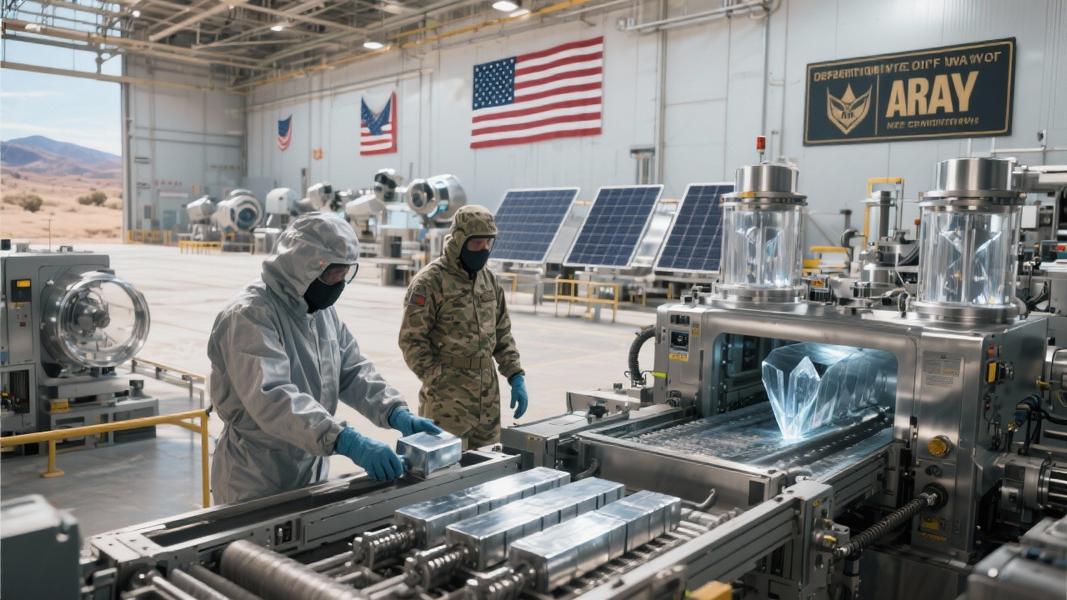
The Department of War is pouring millions into domestic germanium production, announcing an $18.1 million investment to expand refining capacity at 5N Plus Inc.’s Utah facility — a move officials say directly supports America’s military readiness in a world of increasing mineral competition.
The December 2025 funding, provided through Defense Production Act Title III, will boost 5N Plus’s zone refining capacity for germanium metal sevenfold to more than 20 metric tons annually at their St. George site. The expansion addresses what defense officials describe as a “capability bottleneck” affecting critical weapons platforms across all military branches.
Strategic Mineral Push
“Our warfighters depend on next generation optics for surveillance, reconnaissance, and targeting, and germanium is a key element in their manufacture,” said Assistant Secretary of War for Industrial Base Policy Mike Cadenazzi in a statement announcing the investment.
The relatively obscure metallic element has become increasingly central to defense applications, particularly in infrared optics and high-efficiency solar cells used in military equipment. Jeffrey Frankston, Acting Deputy Assistant Secretary of War for Industrial Base Resilience, emphasized that “optics are a pacing item for major weapons platforms across all the military Services.”
But this isn’t just about fancy lenses. The germanium push represents a broader strategic shift to reduce American dependence on adversarial nations for critical minerals. Fighter aircraft, munitions, surveillance systems, and satellite systems all rely on processed critical minerals like germanium, according to White House documents.
Big Moves Beyond 5N Plus
The investment in 5N Plus represents just one piece of a much larger strategy. In what may be the most ambitious component, Korea Zinc has secured a conditional commitment with both the Departments of War and Commerce for a $6.6 billion critical minerals smelter in Tennessee. The massive facility is expected to eventually produce 44 tons of germanium annually, though production won’t begin until after 2029.
“President Trump has directed his Administration to prioritize critical minerals as essential to America’s defense and economic security,” Deputy Secretary of War Steve Feinberg stated.
The scale is impressive. When operational, the Tennessee smelter will process 1.1 million tons of raw materials annually to produce 540,000 tons of finished products, creating an estimated 750 American jobs. Commerce Secretary Howard Lutnick called it a “transformational deal for America” in public remarks.
Meanwhile, Lattice Materials received an $18.5 million contract to increase production of optical-grade germanium and silicon crystals while establishing germanium metal production from recycled materials — marking the fourth U.S.-backed initiative focusing on gallium and germanium in just 18 months.
National Security Implications
Why this sudden focus on an element most Americans have never heard of?
The answer lies partly in the 2026 National Defense Authorization Act, which explicitly prohibits the acquisition of critical minerals — including germanium — from China and other adversarial nations. The legislation also enables Department of War investments in critical mineral refining projects, providing the legal framework for this spending spree.
These investments come amid growing concerns about mineral supply chains that have historically been dominated by geopolitical rivals. Department of War officials have repeatedly highlighted the importance of germanium for surveillance, reconnaissance, and targeting systems — all capabilities deemed essential for maintaining military superiority.
The push for domestic production isn’t just about having enough germanium — it’s about who controls the supply. With these investments, defense planners are betting that the relatively modest millions spent today will pay dividends in national security for decades to come.
