
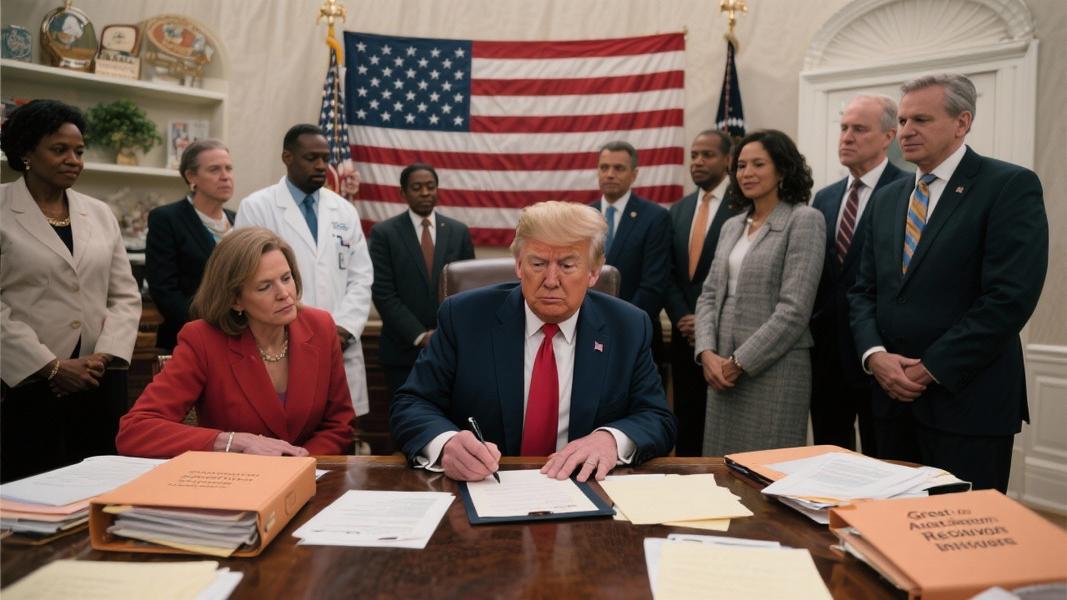
President Trump has launched a sweeping new initiative to tackle America’s addiction crisis, bringing together government agencies, healthcare providers, and private sector partners in what the White House calls a coordinated national response to a problem affecting millions of Americans.
The Great American Recovery Initiative, established through an Executive Order signed on January 29, 2026, aims to address the staggering reality that nearly 17% of Americans — some 48.4 million people — suffer from addiction, which the administration describes as “a chronic treatable disease.”
Why now? Despite the massive scale of the problem, awareness and treatment remain elusive for many. Among the 40.7 million adults with substance use disorder in 2024, an alarming 95.6% didn’t even perceive they needed treatment, according to White House statistics.
Leadership with Personal Connection
The initiative will be co-chaired by Health and Human Services Secretary Robert F. Kennedy Jr. and Kathryn Burgum, who brings her own personal experience to the role. Burgum has maintained sobriety for 22 years after struggling with alcoholism, providing what administration officials hope will be valuable insight into the recovery process.
“This isn’t just about policy — it’s about people,” said a White House spokesperson familiar with the initiative. The program’s scope is deliberately broad, directing federal agencies to recommend steps for coordinating response efforts, increasing public awareness, and integrating prevention, treatment and recovery services across multiple sectors.
The administration has emphasized that the initiative will work closely with states, tribal governments, and private sector partners, particularly in advising on grant allocations and developing regional approaches to addiction treatment.
Recovery Is Possible
There’s reason for optimism amid the troubling statistics. Data from the Substance Abuse and Mental Health Services Administration shows that in 2024, more than 74% of adults who recognized they had a problem with drugs or alcohol considered themselves either in recovery or fully recovered.
Still, the gap between those suffering and those receiving help remains substantial. Addiction specialists have long pointed to stigma as a primary barrier to treatment, along with insurance coverage limitations and insufficient treatment facilities in many regions.
The initiative’s success will likely hinge on its ability to bridge these gaps — not just in awareness, but in access to care for the millions of Americans whose lives have been upended by addiction.
As the program takes shape in the coming months, advocates for addiction treatment are cautiously optimistic that this whole-of-government approach might finally bring meaningful change to a crisis that has touched virtually every community in America.
