
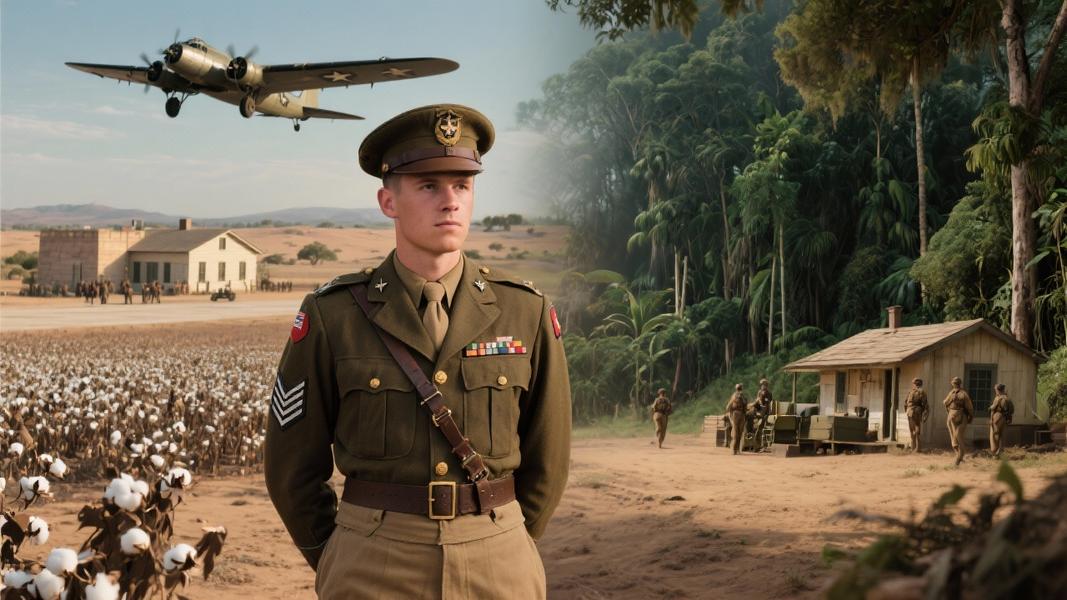
When Ben Fuelberg joined the Texas National Guard in 1934, he wasn’t dreaming of battlefield glory or military honors. His motivation was much simpler: survival during the Great Depression.
“The National Guard paid for meetings and we had four paid meetings a month, and a summer camp of 15 days,” Fuelberg recalled years later. “Of course the pay wasn’t very high, but a dollar was worth a lot more in 1934 than it is now.”
From Cotton Fields to Military Service
Born in December 1916 in Washington County, Texas, Fuelberg grew up working on a cotton farm before joining Troop E of the 124th Cavalry in Brenham. What began as a financial necessity would evolve into a remarkable military career spanning decades of American history.
Like many National Guardsmen of his era, Fuelberg’s part-time military commitment transformed dramatically when his unit was activated for full-time service on November 18, 1940. Initially told they’d serve just one year, Fuelberg and his fellow soldiers soon found themselves on a much longer journey.
“Of course we were called to active duty for one year, which the Congress had extended the call for six months and then Pearl Harbor happened,” he explained. “And of course it was obvious we wasn’t gonna get out of the service for some time.”
How quickly could the military transform civilians into officers during wartime? For Fuelberg, it took just three months. In 1942, he attended officer candidate school for 90 days before being commissioned as a second lieutenant.
The “90-Day Wonder”
The accelerated officer training program earned its graduates a nickname that reflected both respect and skepticism. “They called us 90-day wonders,” Fuelberg noted with characteristic understatement.
Following his commission, Lieutenant Fuelberg was assigned to the Second Cavalry Division at Fort Clark, Texas. There, he faced the additional challenge of leading Black troops during an era of military segregation, bringing with him training he had received at Fort Riley, Kansas.
The path from Depression-era farm boy to cavalry officer represents more than just one man’s journey. It mirrors the experience of an entire generation of Americans whose lives were fundamentally altered by global conflict and national crisis.
Fuelberg’s oral history, preserved by the Texas General Land Office, offers a window into how ordinary Americans responded to extraordinary circumstances — joining the military for practical reasons, then finding themselves swept into the defining global conflict of the 20th century.
