
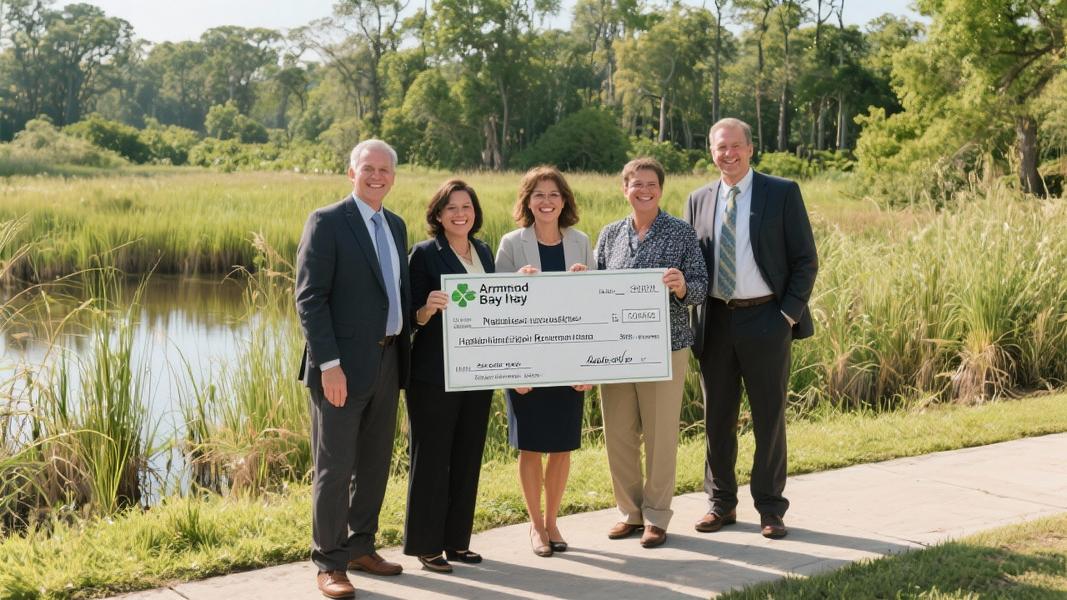
Nearly $770,000 in state funding will help restore 100 acres of endangered coastal habitat in one of Texas’s largest urban wilderness preserves, officials announced this week. The project aims to combat invasive species that have overrun a vital ecological sanctuary near Houston.
Texas Land Commissioner Dawn Buckingham awarded $767,396 to the Armand Bayou Nature Center (ABNC) for restoration efforts at the Taylor Bayou portion of the preserve, which protects critical wetland forest, coastal tallgrass prairie, and estuarine bayou ecosystems.
“Protecting the long-term ecological and economic health of the Texas coast is vital to our state,” said Commissioner Buckingham. “I am proud to present this funding to the ABNC who will work diligently to ensure that the wetland forest, coastal tall grass prairie, and the un-channelized estuarine Armand Bayou’s vulnerable ecosystems and the hundreds of species of wildlife that depend upon them survive and flourish.”
Prairie Power: Nature’s Flood Control
The 4,000-acre nonprofit preserve in Pasadena represents a rare pocket of undeveloped land in the Houston metropolitan area. What makes this ecosystem particularly valuable? Beyond its biodiversity, the prairie serves as natural infrastructure against increasingly common flooding events.
“Armand Bayou Nature Center is so grateful for this support from the GLO!” said Tim Pylate, Executive Director at ABNC. “The restoration of Texas coastal tall grass prairie not only preserves our state’s ecological heritage, it also contributes to our coastal resilience. A single acre of this prairie can absorb and hold a million gallons of flood water.”
The funding, provided through the Texas General Land Office’s Cycle 31 Coastal Management Program (CMP) and Gulf of Mexico Energy Security Act (GOMESA), will support a comprehensive restoration approach. Crews will remove invasive species including Vasey grass, tallow trees, persimmon, deep-rooted sedge, trifoliate orange trees, McCartney rose, Baccharis, and yaupon. After clearing these unwanted plants, the area will be mulched and replanted with native tall grasses grown in ABNC’s own nursery.
Massive Expansion of Urban Wilderness
This restoration project comes on the heels of significant expansion for the nature center. ABNC recently acquired 1,145 acres of remnant coastal prairie using $3 million in RESTORE Act funds via the Texas Commission on Environmental Quality, along with additional funding sources, as documented by restoration officials.
The acquisition represents part of a larger collaborative effort. ABNC partnered with Harris County Precinct 2 and ExxonMobil to purchase 1,147 acres of the former Clear Lake Oil Fields at the end of 2024 for a total of $11.7 million. This complex funding package drew from multiple sources including the Galveston Bay Estuary Program, GOMESA via Harris County, Flood Control bonds, RESTORE Act funds, and a donation from ExxonMobil, according to project details published by conservation groups.
The expansion brings ABNC’s total preserve to an impressive 3,947 acres, cementing its status as the largest urban wilderness in Texas. Approximately half the preserve consists of prairie, with the remainder comprised of riparian forest and bayou wetlands.
From Oil Field to Wildlife Sanctuary
The transformation of former industrial land into natural habitat represents a significant ecological win for the region. Beyond flood protection, these restored prairies serve as powerful carbon sinks in a state known for its energy production.
“You can almost offset your commute with an acre of prairie,” Pylate noted in discussing the climate benefits. Each acre of prairie sequesters approximately 1.3 tons of carbon annually.
The ecological stakes couldn’t be higher. The preserve provides critical habitat for species that have seen dramatic population declines, including bobwhite quail (down 80%), various songbirds (populations halved), and prairie chickens, which have plummeted from about one million to just 80 individuals in certain regions.
Other notable wildlife benefiting from the preservation efforts include bald eagles, alligators, and river otters—species that depend on the interconnected ecosystem of prairie, forest, and waterway.
For a region known for its oil and gas industry, the ABNC restoration represents a different kind of investment in the future—one measured not in barrels but in biodiversity, flood protection, and carbon sequestration. As climate challenges intensify along the Gulf Coast, these natural solutions may prove just as valuable as any engineered alternative.
