
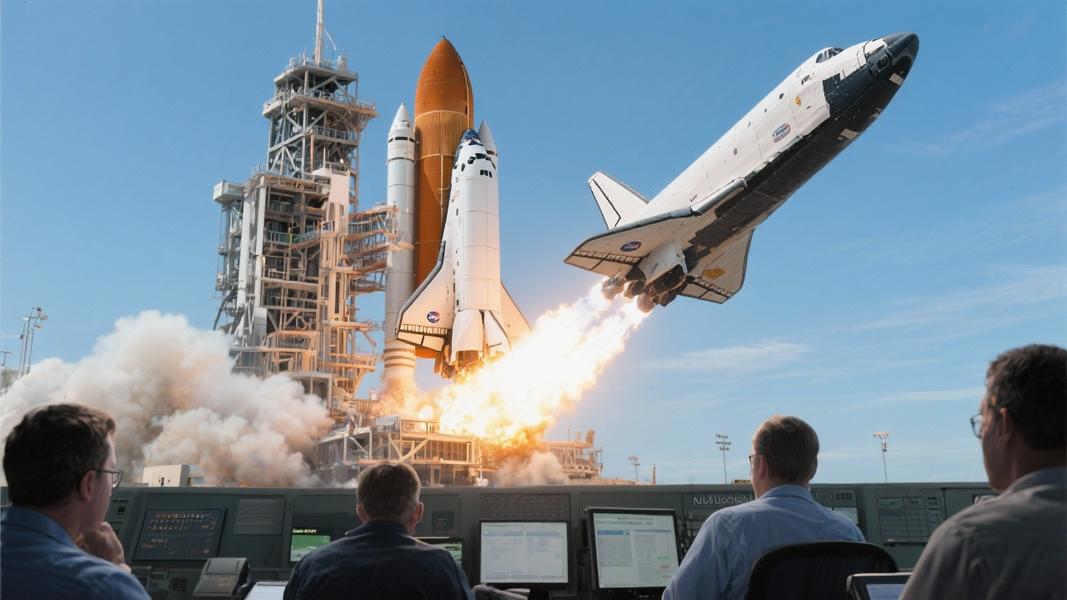
They were just 16 minutes from home when silence fell. The Space Shuttle Columbia, breaking apart in a clear Texas sky on February 1, 2003, claimed the lives of all seven crew members in what became one of NASA’s most devastating tragedies.
The disaster struck during reentry as Columbia approached Kennedy Space Center for landing, ending a 16-day scientific mission that had begun with high hopes on January 16. What most observers didn’t know then was that during launch, a piece of foam insulation had broken off the external fuel tank and struck the orbiter’s left wing, creating a critical breach that would later prove catastrophic.
The Fatal Flaw
That seemingly innocuous foam strike created a hole in Columbia’s thermal protection system. During reentry, superheated atmospheric gases penetrated the damaged area, causing the shuttle to break apart as it streaked across the sky at more than 12,000 miles per hour.
Commander Rick D. Husband’s final communication with Mission Control came as flight controllers were querying the crew about unusual sensor readings. “We’re checking that. We’ve got the flight controller power on. We’re working through the rest of it as well. Thanks,” Husband replied. His transmission was cut off mid-word: “And Houston, roger, buh—”
What went through the minds of the astronauts in those final moments? We’ll never fully know. But astronaut Laurel Clark had sent an email to her family just days before, reflecting on the view from orbit. She described herself as “doing science round the clock” and noted that she had come to “visit the beautiful Earth more than to visit space. It’s a wonderful planet,” she wrote in words that would carry an unintended poignancy.
A Nation Mourns
The nation learned of the tragedy that Saturday morning as debris scattered across Texas and Louisiana. By afternoon, President George W. Bush addressed a stunned country with the grim confirmation many feared: “The Columbia is lost; there are no survivors,” he stated solemnly.
Beyond the immediate shock of the disaster lay deeper questions about NASA’s safety culture. How could something as seemingly trivial as foam insulation bring down a spacecraft designed to withstand the extreme conditions of space travel?
The subsequent investigation revealed troubling organizational blind spots. Engineers had raised concerns about the foam strike during the mission, but management decisions limited the extent of in-orbit inspection efforts. The Columbia Accident Investigation Board would later conclude that NASA’s organizational culture had become as much a cause of the accident as the physical foam impact.
Columbia’s crew — Rick Husband, William McCool, Michael Anderson, Kalpana Chawla, David Brown, Laurel Clark, and Ilan Ramon (Israel’s first astronaut) — represented a cross-section of America’s scientific and military excellence. They had spent their mission conducting experiments across multiple scientific disciplines, unaware of the damage that would ultimately claim their lives.
Twenty years on, the Columbia disaster stands as a sobering reminder of spaceflight’s inherent risks and the terrible cost of institutional complacency. The foam strike that doomed Columbia wasn’t just a technical failure but a warning about the dangers of normalizing risk — a lesson written in the contrails of a spacecraft that came so close to home.
