
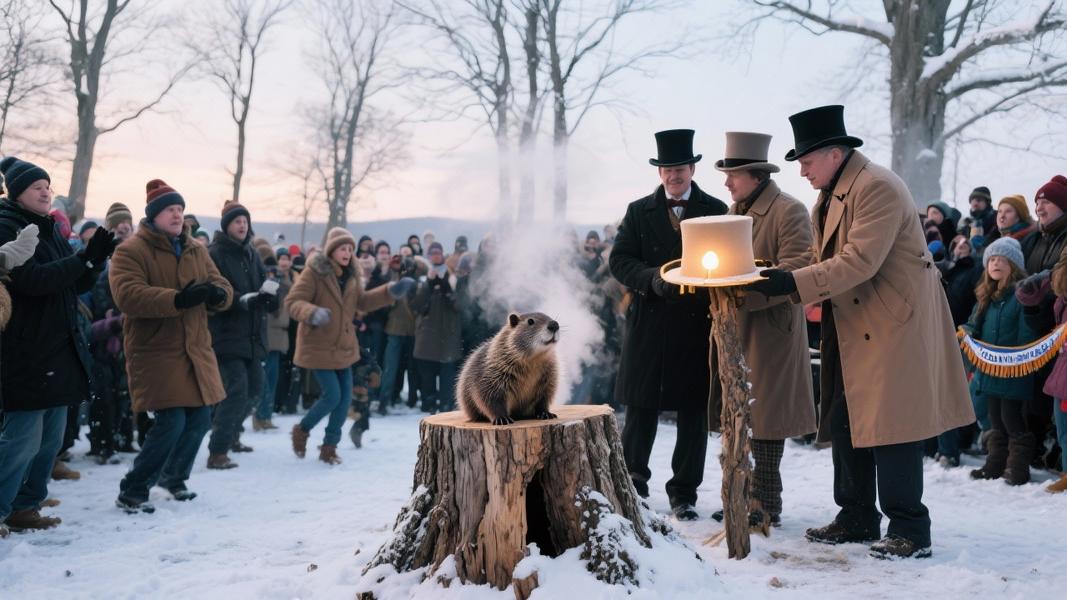
Punxsutawney Phil has spoken: Bundle up, America. The nation’s most famous groundhog emerged from his burrow early Friday morning, spotted his shadow, and retreated back underground — signaling six more weeks of winter ahead.
Braving bone-chilling temperatures hovering just above zero degrees, tens of thousands of spectators gathered at Gobbler’s Knob in Punxsutawney, Pennsylvania, for the 140th annual weather prediction ceremony. The crowd erupted in a mix of cheers and good-natured groans as Phil’s handlers from the “Inner Circle” interpreted his forecast for the assembled masses, according to tradition dating back to 1887.
A Chilly Reception
This year’s celebration came with an unusual twist. The severe cold prompted Phil’s handlers to skip the customary photo opportunities that typically follow the prediction. “Normally, guests can capture images with Phil on stage, but his handlers cited that the severe cold made it unsafe to hold him out too long,” the Economic Times reported.
According to Groundhog Day lore, “If the sun shines and Phil sees his shadow, he interprets that as ‘an omen of six more weeks of bad weather and returns to his hole,'” as the ceremony’s official interpretation states. Had Phil not seen his shadow, it would have signaled an early spring — a prediction the furry forecaster has made only 21 times since his first prediction nearly 140 years ago.
But how reliable is Phil’s meteorological prowess? Not very, as it turns out.
Fuzzy Math Behind Furry Forecasts
While members of Phil’s Inner Circle maintain his predictions are “100% accurate,” government data tells a different story. The National Centers for Environmental Information has concluded that when comparing Phil’s record with U.S. national temperatures over the past decade, the groundhog was right only about 40% of the time — worse odds than a coin flip.
“Thousands of people gathered for the 140th celebration of Groundhog Day on Gobbler’s Knob in Punxsutawney, Pennsylvania, to see the famous groundhog emerge from his tree stump,” Fox News noted in its coverage of the event.
Historical records show Phil’s predictions have skewed decidedly toward pessimism. The Farmers’ Almanac indicates that “since Punxsutawney Phil first began prognosticating the weather back in 1887, he has predicted an early end to winter 21 times” — compared to 109 predictions of extended winter conditions.
Science vs. Tradition
Meteorologists point out a simple calendrical reality that makes Phil’s predictions somewhat moot. “Spring doesn’t officially begin until we get to the vernal equinox, which comes around March 20 or 21,” a Pittsburgh meteorologist explained to Country Living. “We’re over the hump of what, at least climatologically, is the worst part of winter for most parts of the country—that’s a good portion of January into the beginning of February.”
In other words, six more weeks from February 2 lands almost exactly at the spring equinox — meaning Phil’s prediction of “six more weeks of winter” essentially just confirms the astronomical calendar.
Still, the tradition draws massive crowds year after year, with the tiny town of Punxsutawney (population approximately 6,000) swelling to many times its normal size for the annual celebration.
That the festival continues to thrive despite Phil’s questionable accuracy speaks to something deeper than meteorology — the human desire for ritual, community, and a bit of midwinter whimsy in the coldest stretch of the year. Whether you’re bundling up for six more weeks or hoping Phil’s shadow-spotting skills prove as unreliable as his track record suggests, the nation’s groundhog-in-chief has made his call for 2026.
