
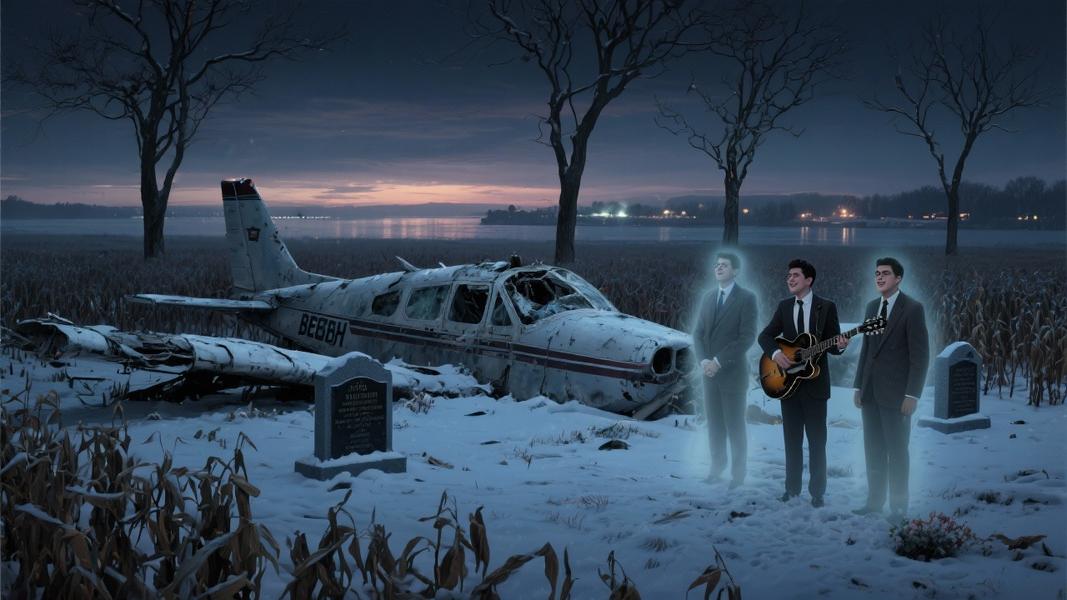
A simple coin toss on February 3, 1959, changed the course of music history — and the lives of several young musicians — in ways no one could have imagined. For $36, three rising rock and roll stars purchased seats on a flight that would become known as “The Day the Music Died.”
Fatal Flip of Fate
The weather was miserable that night in Clear Lake, Iowa. Buddy Holly, tired of freezing on a bus tour with malfunctioning heating, chartered a small plane to fly to the next stop in Moorhead, Minnesota. The aircraft had room for just three passengers plus the pilot.
Who would get those precious seats? That’s where chance intervened. Tommy Allsup, Holly’s guitarist, lost his seat to 17-year-old Ritchie Valens through a coin toss. “We flipped a coin a few times and the Big Bopper and I won. When I asked Buddy how much it was going to cost me to fly, he said $36,” Allsup later recalled.
Valens, whose real name was Richard Valenzuela, had never flown in a small aircraft before. Upon winning the toss, he reportedly remarked, “That’s the first time I’ve ever won anything in my life.” The irony of those words would echo through music history.
Premonitions and Joking Words
Strangely, Holly had previously expressed some anxiety about flying. During an interview on Alan Freed’s TV show, he had described a turbulent flight experience, imitating the “woop-woop” sound as the plane repeatedly dropped and climbed through rough air.
Bass player Waylon Jennings — who would later become a country music legend — had initially planned to take one of the seats but gave his up to J.P. Richardson (The Big Bopper), who was suffering from the flu. What happened next would haunt Jennings for the rest of his life.
When Holly discovered Jennings wouldn’t be flying, he jokingly said: “Well, I hope your damned bus freezes up.” Jennings shot back: “Well, I hope your ol’ plane crashes.” Those casual words, spoken in jest between friends, would become a terrible burden for the young musician to bear.
The Final Flight
Shortly after takeoff from Mason City Municipal Airport, the small Beechcraft Bonanza aircraft crashed into a cornfield. The impact killed all four occupants instantly: Buddy Holly, 22; Ritchie Valens, 17; J.P. “The Big Bopper” Richardson, 28; and pilot Roger Peterson, 21.
What caused the crash? Poor visibility, wintry conditions, and pilot error all likely contributed. Peterson, relatively inexperienced in instrument-only flying conditions, became disoriented in the darkness and snow.
The tragedy cut short three brilliant musical careers. Holly had already revolutionized rock and roll with hits like “Peggy Sue” and “That’ll Be the Day.” Valens had rocketed to fame with “La Bamba” and “Donna.” Richardson’s “Chantilly Lace” had made him a household name.
Legacy of a Coin Toss
For $36 — equivalent to about $360 today — these young men made a decision that would freeze them forever in time, preserving their youth and talent in musical amber. Their deaths inspired Don McLean’s iconic “American Pie” with its reference to “the day the music died.”
Tommy Allsup, who lived until 2017, often reflected on how that simple coin toss saved his life. He later opened a nightclub called “Heads Up,” commemorating the flip that changed everything.
Six decades later, the story continues to fascinate. Perhaps it’s the cruel randomness — how something as trivial as a coin toss determined who lived and who died. Or maybe it’s the eerie premonitions and joking words that preceded the tragedy. Whatever the reason, February 3, 1959, remains one of music’s most poignant what-ifs — a moment when rock and roll’s promising future suddenly became its mourned past.
