
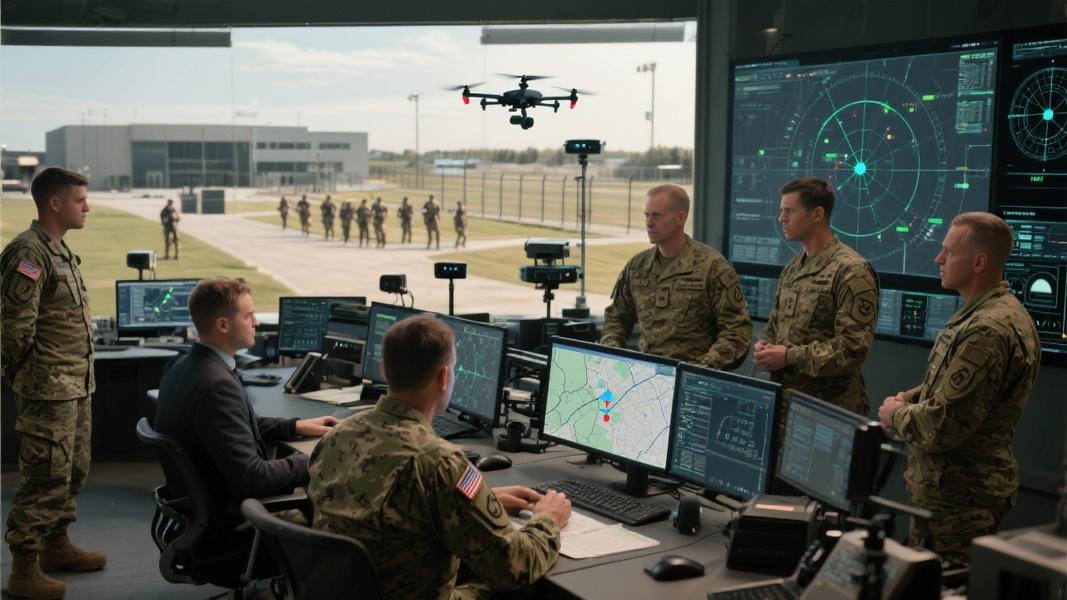
The Pentagon is dramatically overhauling its domestic drone defense strategy, giving military commanders unprecedented authority to counter unmanned aircraft that venture near U.S. installations — even before they cross the fence line.
In guidance released on January 26, 2026, the newly formed Joint Interagency Task Force 401 (JIATF-401) introduced sweeping policy changes streamlining how military installations can respond to drone threats, marking a significant shift in how the Department of Defense approaches homeland drone defense.
A New Era in Domestic Drone Defense
“Drones are a defining threat for our time. Technology is evolving fast and our policies and c-UAS strategy here at home must adapt to meet this reality,” said Brigadier General Matt Ross, Director of JIATF-401, in a statement accompanying the guidance, which was signed by Secretary of War on December 8, 2025.
The policy updates, which fall under 10 U.S. Code § 130i, include several key changes: expanded defensive perimeters that extend beyond traditional fence-lines, streamlined threat identification that treats unauthorized surveillance as an actionable threat, enhanced interagency cooperation with DHS and DOJ, and clearer delegation of authority to Service Secretaries for designating protected facilities.
“Countering drones does not start and stop at the fence line,” Ross emphasized. “With this new guidance installation commanders are empowered to address threats as they develop, and the guidance makes clear that unauthorized drone flights are a surveillance threat even before they breach an installation perimeter.”
What’s driving this urgent shift? The Pentagon’s own Inspector General found that confusing counter-drone policies have left U.S. bases vulnerable, with inconsistent guidance and slow procurement processes hampering effective defense amid increasingly sophisticated threats.
100 Days of Rapid Innovation
JIATF-401 has moved at breakneck speed since its formation. The task force recently celebrated its first 100 days of operations, during which it consolidated counter-small UAS policies, conducted site assessments under the Pentagon’s Replicator 2 initiative, and prepared to deliver $18 million in capabilities to the southern border by January 2026.
The organization has compressed timelines that traditionally take years into mere weeks. “In less than 60 days — a process that traditionally takes two or three years — JIATF-401 assessed and validated capability gaps on the southern border and translated them into the Joint Task Force-Southern Border requirements document,” said Maj. Anthony Padalino, a JIATF-401 response team member.
Among its first major acquisitions, the task force purchased two DroneHunter F700 systems from Fortem Technologies under the Replicator 2 program for approximately $3.5 million. These systems use AI and radar to autonomously capture Group 1 and Group 2 drones with tether nets and parachuted drogues.
“We have just one measure of effectiveness: to deliver state-of-the-art counter-UAS capabilities to our warfighters both at home and abroad,” Ross noted.
A Marketplace for Counter-Drone Tech
The task force is developing a Counter-UAS Marketplace expected to achieve initial operating capability by March 1. Rather than becoming another slow-moving acquisition office, JIATF-401 is focused on speed and real-world testing.
“We are not intending to be a program office; we’re buying the stuff that can be made available to the warfighter as rapidly as possible and then let the user experiment with it so that a service can decide if this is something that we want to now purchase at scale,” JIATF Spokesman Lt. Col. Adam Scher explained to Air & Space Force Magazine.
The DroneHunter systems will be tested at undisclosed installations in April, with user feedback directly informing the marketplace’s development. Meanwhile, the Army has issued a Request for Information for acoustic detection systems targeting Group 1 and Group 2 unmanned aircraft, informed by lessons from the Ukraine-Russia conflict.
Beyond the Battlefield
JIATF-401’s mission extends beyond military applications. The task force is also developing an interagency forum and supporting National Security Council airspace initiatives, recognizing that drone threats transcend traditional military boundaries.
“Countering drones is not just a battlefield problem — it’s a homeland defence imperative,” Ross said.
Secretary of Defense Pete Hegseth, who established JIATF-401 through a directive memo in August 2025, has made it clear that speed takes precedence over process in this rapidly evolving threat landscape. “My priorities for transformation and acquisition reform include improving [counter-small unmanned aircraft systems] mobility and affordability and integrating capabilities into warfighter formations,” Hegseth wrote in the founding memo.
As drone technology continues to advance and proliferate globally, the Pentagon’s shift toward more agile and preemptive counter-drone measures reflects a sobering reality that Secretary Hegseth acknowledged plainly: “There’s no doubt that the threats we face today from hostile drones grow by the day.”
