
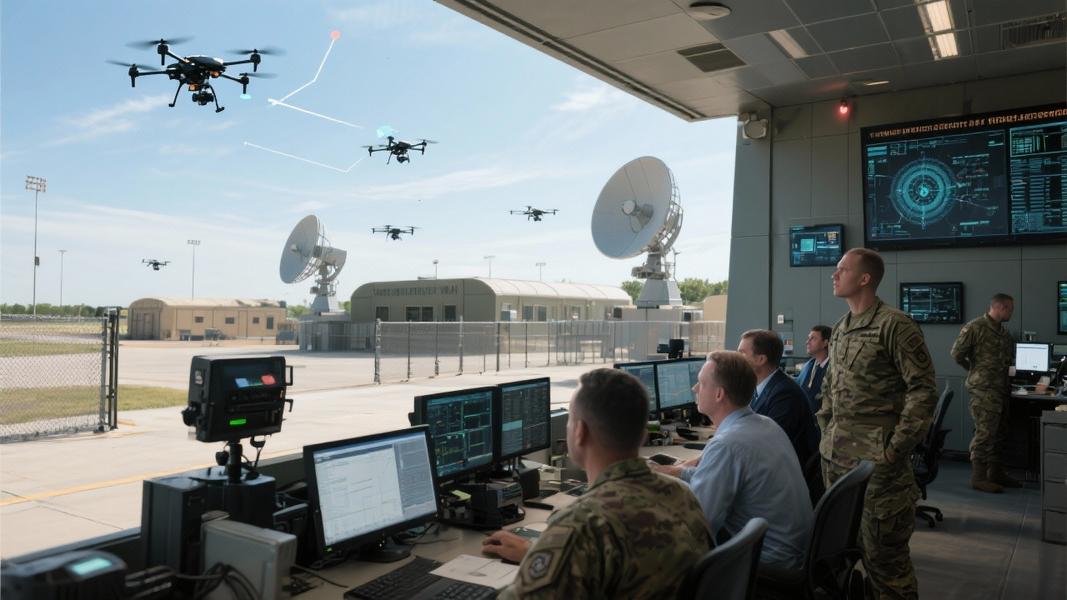
The Pentagon is dramatically expanding the military’s authority to counter drones beyond base perimeters, marking a significant shift in how America defends itself against what officials now describe as one of the most pressing homeland security threats.
JIATF-401, the Defense Department’s newly established counter-drone task force, announced updated guidance on January 26 that fundamentally changes how military installations can respond to unmanned aircraft systems (UAS) threats — including the critical ability to act before drones breach facility boundaries.
“Drones are a defining threat for our time. Technology is evolving fast and our policies and c-UAS strategy here at home must adapt to meet this reality,” said Brigadier General Matt Ross, Director of JIATF-401, in a statement accompanying the guidance released last week.
Fence Lines No Longer Define Defense
The guidance, signed by Secretary of War Pete Hegseth on December 8, 2025, removes previous restrictions that limited counter-drone operations to the immediate perimeter of military installations. Now, commanders can address threats as they develop — a critical change in an era where commercially available drones can easily conduct surveillance from standoff distances.
“Countering drones does not start and stop at the fence line,” Ross explained. “With this new guidance installation commanders are empowered to address threats as they develop, and the guidance makes clear that unauthorized drone flights are a surveillance threat even before they breach an installation perimeter.”
The policy shift comes after a damning Inspector General report highlighted confusing and inconsistent counter-drone policies that left U.S. military bases vulnerable to surveillance and attacks. Secretary Hegseth acknowledged the growing risk, stating “there’s no doubt that the threats we face today from hostile drones grow by the day.”
Rapid Response to Emerging Threats
JIATF-401, established by Hegseth in August 2025, has moved with unusual speed for a Pentagon initiative. The task force recently marked its first 100 days of operations with several notable achievements, including the rapid delivery of $18 million in counter-drone capabilities to the southern border.
How fast? “In less than 60 days — a process that traditionally takes two or three years — JIATF-401 assessed and validated capability gaps on the southern border and translated them into the Joint Task Force-Southern Border requirements document,” said Maj. Anthony Padalino, a JIATF-401 response team member.
The task force has also awarded contracts for innovative drone defense systems under the Pentagon’s “Replicator 2” initiative. Among them are two DroneHunter F700 systems from Fortem Technologies, which use AI, radar, and nets to physically capture small- and medium-sized enemy drones rather than destroying them with potentially dangerous kinetic methods in populated areas.
Whole-of-Government Approach
The new guidance also streamlines interagency cooperation between DoD, the Department of Homeland Security, and Department of Justice — a relationship formalized in the FY26 National Defense Authorization Act. This coordination is crucial as authorities for countering drones in U.S. airspace remain split between multiple federal agencies.
The Army is already moving to expand its counter-drone arsenal, issuing a Request for Information on January 14 for acoustic detection systems targeting smaller drones. These systems would help dismounted troops detect incoming threats without relying on heavy equipment or fixed installations.
“Everybody is going to have to be able to defend themselves against UAS. Everyone, every formation that we have,” a senior defense official explained in connection with the Army’s request.
Training the Force
Beyond policy and procurement, JIATF-401 is centralizing counter-drone training through the Joint C-sUAS University and creating what it calls a “marketplace” of vetted capabilities that military units can access.
The formal establishment memo for JIATF-401 included a 36-month sunset review provision, suggesting the Pentagon views this as an urgent but potentially temporary reorganization of its counter-drone efforts. The task force disestablished the previous Joint C-sUAS Office, consolidating all counter-drone initiatives under a single command structure.
“Countering drones is a team sport,” Ross said. “We have to work together, share information, and leverage each other’s strengths if we’re going to stay ahead of this threat.”
As drones become cheaper, more capable, and more widely available, the race between defensive measures and offensive capabilities continues to accelerate — with fence lines no longer defining the battlefield.
