
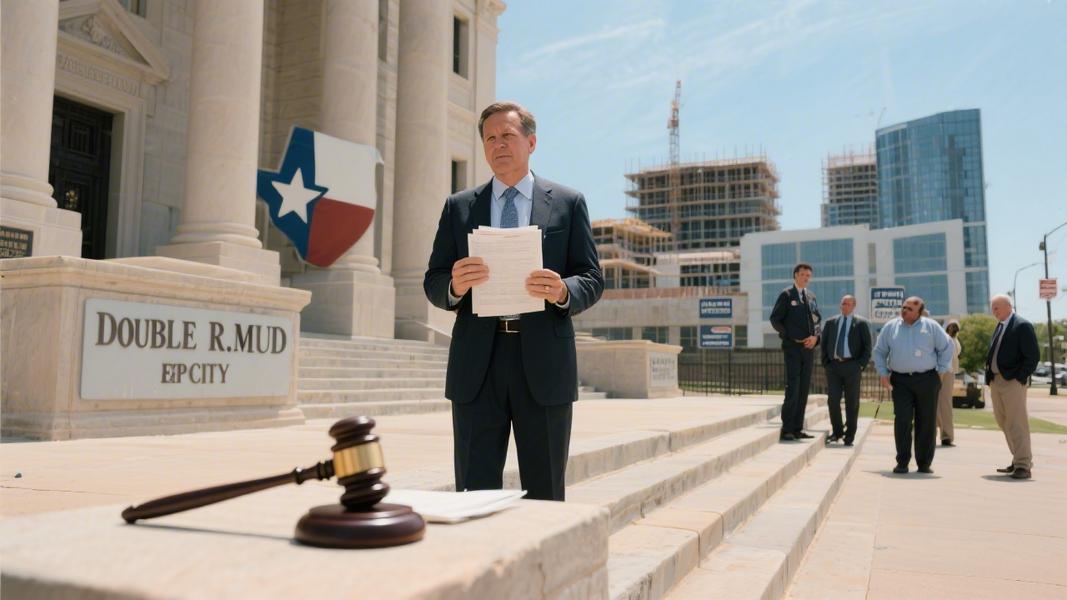
A Texas judge has put the brakes on a utility district accused of being hijacked to push through one of the state’s most controversial real estate projects — and Attorney General Ken Paxton isn’t hiding his satisfaction about it.
On March 19, a Collin County court issued a Temporary Restraining Order against Double R Municipal Utility District No. 2A, freezing the board’s ability to take virtually any meaningful action until a scheduled hearing on March 30. The move is the latest legal blow to efforts surrounding EPIC City — a large-scale Islamic community development that has drawn fierce scrutiny from state officials and local residents alike. The case cuts to a basic question: who actually has the legal authority to run a public utility district, and what happens when that authority is allegedly seized through improper means?
The Allegations at the Center of the Case
Paxton’s office contends that a group of individuals took unlawful control of Double R MUD back in September 2025, installing board members who didn’t meet basic eligibility requirements. Specifically, the TRO named purported directors Yaneli Molina, Hatim Mahmoud Yusuf, Nadeem Ashraf Khan, Asim Hussain Khan, and Faisal Abbas — none of whom, the lawsuit alleges, owned taxable property within the district prior to a September 12 annexation that conveniently changed the boundaries. Fox4 noted that detail in its coverage, and it’s a significant one. Under Texas law, owning taxable property in a MUD is generally a prerequisite for serving on its board.
That’s the crux of it. The allegation isn’t just that someone cut corners — it’s that the district was effectively captured to serve the interests of a private development project while dodging the state oversight processes that would normally apply. Paxton didn’t mince words. “My office has proven that these radicals were unlawfully appointed to the board of Double R MUD and that their actions to advance the EPIC City development were illegal and void,” he declared.
What the Court Order Actually Does
The restraining order blocked Double R MUD’s March 20 board meeting from proceeding in any substantive way. Under its terms, the board can’t direct district operations, appoint new directors, or act on agenda items — the only carve-out being matters directly related to the ongoing litigation itself. Audacy’s KRLD outlined those restrictions in detail.
It’s a remarkably broad freeze for what is, technically, a local utility district. But Paxton has framed the case as something far bigger than zoning or water rights. “This TRO is a win for the rule of law,” he said, arguing that allowing the board to meet would have “only furthered its illegal scheme to support EPIC City.” The Dallas Express reported those remarks in full.
A Development That’s Been Anything But Quiet
EPIC City — now rebranded as The Meadow, apparently in a nod to the power of optics — has been fighting headwinds on multiple fronts. Hunt County rejected the project’s plans outright, a development the Texas Scorecard covered as a significant setback. Meanwhile, a public hearing in Plano tied to the project was abruptly cancelled after a property owner pulled the plug on speakers — the kind of chaotic scene that rarely helps a development’s public image. The Dallas Express documented the fallout from that episode.
Still, supporters of the project have maintained that the opposition is rooted in religious and ethnic bias rather than legitimate legal concerns — pointing to the fact that much of the scrutiny has zeroed in on the Muslim identity of the development’s backers. That debate isn’t going away, and it’s likely to color how the March 30 injunction hearing is received, both inside the courtroom and out.
What Comes Next
A lot hinges on that hearing. The TRO is, by design, a temporary measure — it’s a legal pause button, not a final answer. Whether the court converts it into a longer-lasting temporary injunction will depend on whether Paxton’s office can sustain its argument that the board’s composition was fundamentally illegal from the start. If it does, every action taken by those purported directors — contracts signed, plans approved, votes cast — could be declared null and void.
For a development already struggling to find firm legal and political footing, that would be a serious blow. And for the residents and officials watching this unfold in Collin County and beyond, the case has become something of a stress test for how Texas handles the intersection of local governance, religious identity, and state authority.
The judge has already pressed pause. Now everyone’s waiting to see if the music ever plays again.
