
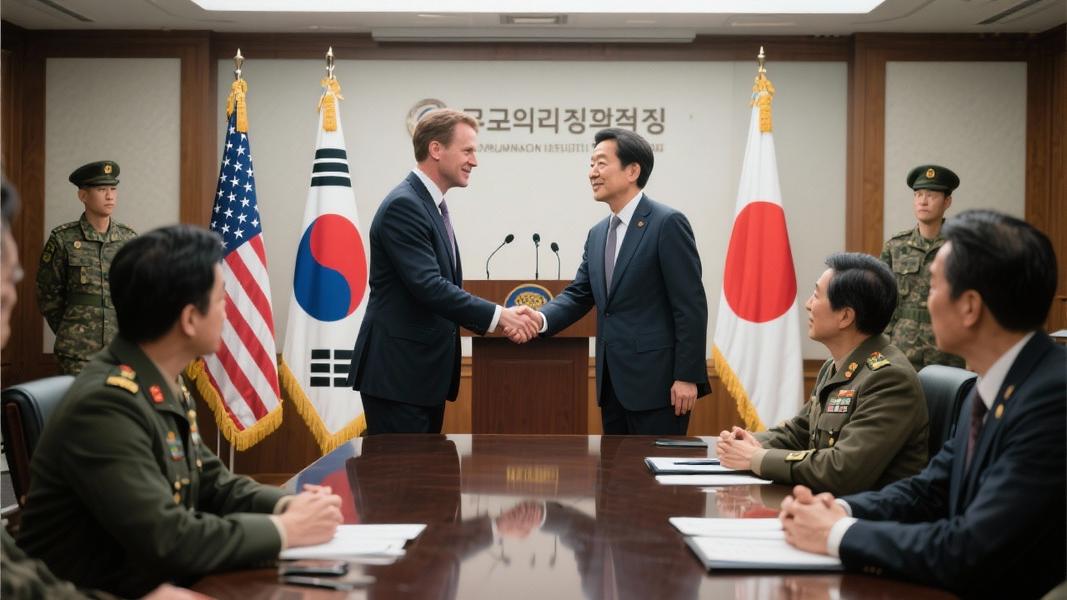
Elbridge Colby, the U.S. Under Secretary of Defense for Policy, wrapped up a whirlwind diplomatic tour through East Asia this week, pushing allies to dig deeper into their pockets for defense spending. His message to South Korea and Japan was unmistakable: the Trump administration’s “peace through strength” doctrine requires more financial skin in the game.
Raising the Stakes in Asia
Colby concluded his visits to South Korea and Japan on February 4, 2026, meeting with senior officials to advance the 2026 National Defense Strategy — a blueprint that calls for U.S. allies to increase defense spending to an ambitious 5% of GDP.
During his stop in Seoul, Colby met with an array of top officials including Minister of National Defense Ahn Gyu-back and National Security Advisor Wi Sung-Lac, where discussions centered on alliance priorities. The under secretary and Ahn discussed the transfer of wartime operational control and South Korea’s plans for nuclear-powered submarines — a significant capability upgrade that would reshape regional naval power dynamics.
“Colby reaffirmed Washington’s commitment to strengthening defense cooperation with South Korea, calling it a ‘model ally,'” according to defense officials familiar with the talks.
Why “model ally”? South Korea has already pledged to raise its defense spending to 3.5% of GDP — not quite the 5% target in the new strategy, but significantly higher than most U.S. allies.
Gen. Xavier Brunson, who also met with Colby during the visit, characterized their meeting positively, saying, “Great discussion on defense strategy and integrated deterrence as we continue to advance the [South Korea]–U.S. Alliance. Katchi Kapshida — We Go Together.”
Japan’s Evolving Role
In Japan, Colby’s schedule was equally packed. He met with Vice Minister of Foreign Affairs Funakoshi Takehiro, Vice Minister of Defense Yamato Taro, U.S. Ambassador George Glass, and Lt. Gen. Stephen Jost.
The Japanese leg of his tour highlighted the administration’s focus on bolstering collective capabilities in the face of regional challenges. Colby and Japanese Vice Foreign Minister Takehiro Funakoshi emphasized reinforcing alliance capabilities.
“They concurred on the critical role both countries play to reinforce the Japan-U.S. Alliance capabilities to deter and respond,” according to a joint statement issued after their meeting.
China Strategy Takes Shape
Speaking at South Korea’s prestigious Sejong Institute, Colby outlined the administration’s approach toward China with a message that balanced firmness with restraint. Washington under the Trump administration “does not seek to dominate China, nor do we seek to strangle or humiliate it,” he stated, signaling that containment isn’t the goal.
That said, his tour comes amid increasing tensions in the Taiwan Strait and South China Sea, where Chinese military activities have escalated in recent months.
The under secretary’s visit appears designed to reassure allies while simultaneously pressing them to shoulder more of their defense burden — a longstanding Trump administration priority now formalized in the latest defense strategy.
For regional observers, the question remains: will allies meet the ambitious 5% spending target, or will they push back against what some see as an unrealistic expectation during times of economic uncertainty?
As Colby returns to Washington, he leaves behind allies grappling with the implications of America’s evolving defense strategy — one that demands more resources from partners even as it promises continued U.S. commitment to regional security.
