
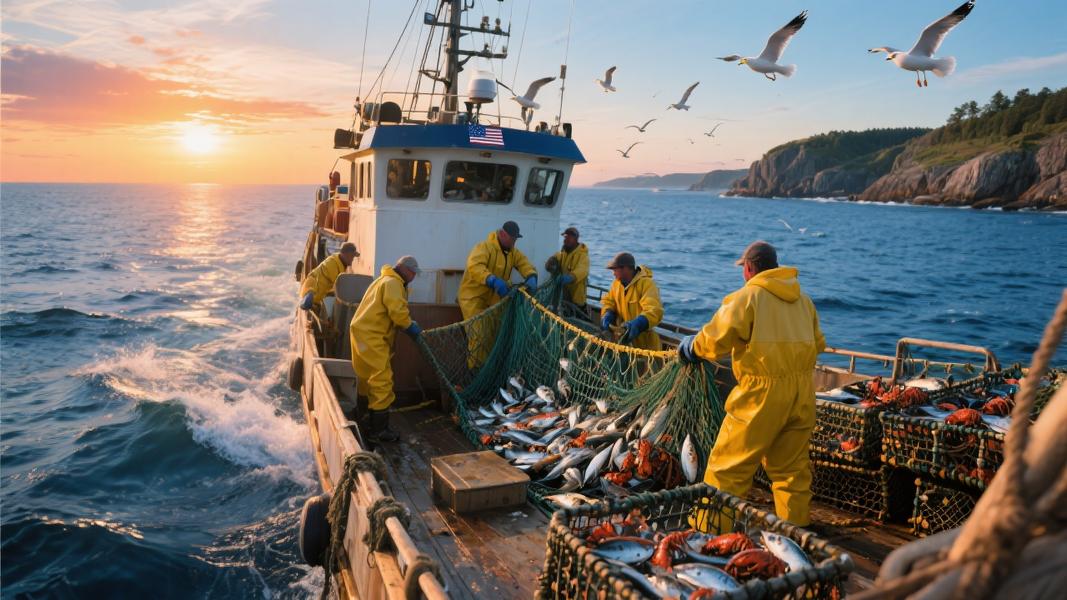
Former President Donald Trump has reversed a Biden administration policy that prohibited commercial fishing within the Northeast Canyons and Seamounts Marine National Monument, reopening the protected Atlantic Ocean area to fishing activities.
Protection Ping-Pong: A Monument’s Changing Status
The Northeast Canyons and Seamounts Marine National Monument has been caught in a presidential tug-of-war since its creation. First established by President Obama in 2016 as the Atlantic Ocean’s first marine national monument, the protected area spans approximately 4,913 square miles of fragile deep-sea ecosystems.
Trump’s latest action effectively reinstates his previous Proclamation 10049, which had allowed commercial fishing within the monument’s boundaries. “Commercial fishing activity has been unfairly restricted,” Trump said while signing the order. “We’re putting American fishermen first.”
The monument’s status has flip-flopped repeatedly in recent years. After Trump initially opened it to commercial fishing in 2020, President Biden reinstated the fishing prohibitions in October 2021 through Proclamation 10287 — the very proclamation Trump has now revoked.
What’s at Stake?
Why does this underwater area matter so much? The monument contains what scientists describe as “largely pristine” deep marine ecosystems with remarkable biodiversity. Environmental groups have championed its protection, noting that it serves as critical habitat for endangered whales, sea turtles, various shark species, and rare deep-sea corals.
“These underwater canyons and seamounts are ecological treasures,” said Marine Conservation Institute president Lance Morgan. “Opening them to commercial fishing threatens decades of conservation progress.”
The fishing industry, however, has celebrated Trump’s decision. “This restoration of access recognizes the sustainable practices of American fishermen,” said Bob Vanasse, executive director of Saving Seafood, an industry group representing commercial fishing interests.
A Complex History
Under Biden’s now-revoked restrictions, most commercial fishing was prohibited within the monument, though there were notable exceptions. American lobster and Atlantic deep-sea red crab fisheries using fixed gear had been permitted to continue operating until September 15, 2023 — a sunset provision that now becomes moot with Trump’s action.
The back-and-forth protection status highlights the broader tension between conservation goals and commercial interests. The monument was originally designated using presidential authority under the Antiquities Act of 1906, which allows presidents to protect lands and waters of significant scientific or historical interest.
That said, the use of the Antiquities Act for large marine monuments has been controversial. Fishing industry representatives have argued that fisheries management should remain under the Magnuson-Stevens Act, with decisions made by regional fishery management councils rather than by presidential proclamation.
What Happens Next?
Environmental groups have already signaled they’ll challenge Trump’s decision in court. Similar legal battles have played out over other national monuments where protections were modified by presidential action.
“The whiplash approach to ocean conservation undermines long-term planning and creates uncertainty for both conservation and industry,” said Sarah Chasis, senior director of the Natural Resources Defense Council’s oceans program.
For now, commercial fishing vessels can once again operate throughout the monument area, though they remain subject to standard fisheries regulations that apply to all federal waters.
As the legal challenges unfold, the monument’s underwater canyons and seamounts — home to thousand-year-old coral formations and countless marine species — remain in limbo, their future protection status as uncertain as the shifting political tides above.
