
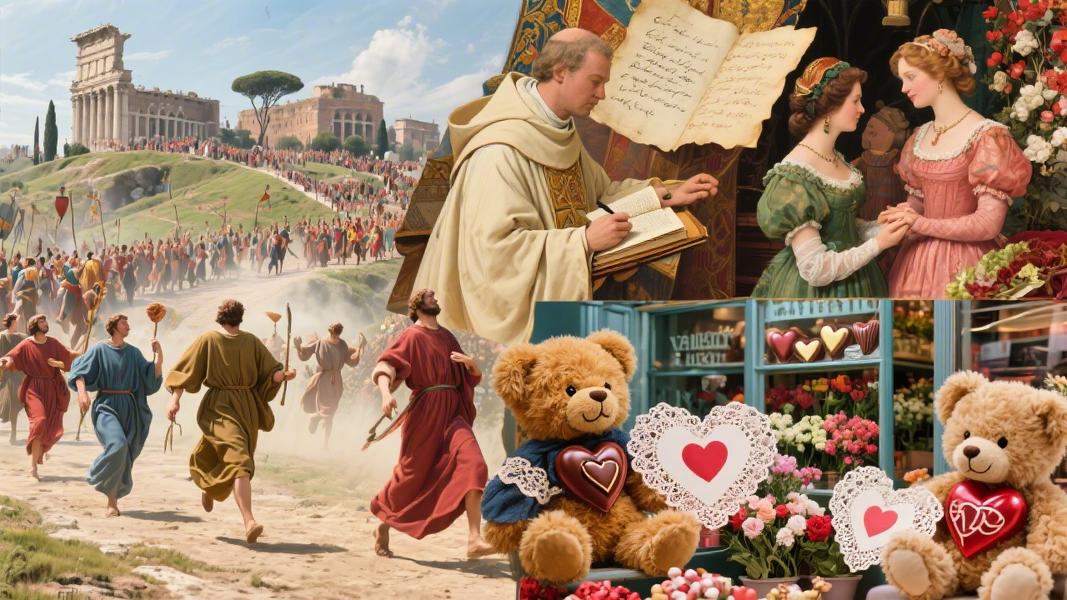
Naked men running through the streets swatting women with strips of animal fur. A martyred priest healing the blind. Birds mating in the middle of February. The origins of Valentine’s Day are far more convoluted — and perhaps more interesting — than the greeting card industry might have you believe.
The holiday celebrated with chocolate hearts and romantic dinners has murky beginnings that historians continue to debate. While many assume a direct connection between the ancient Roman fertility festival of Lupercalia and the feast of St. Valentine, the evidence linking them is surprisingly thin.
Lupercalia: Not Your Average Hallmark Holiday
Yale University historian Noel Lenski paints a vivid picture of Lupercalia that’s a far cry from today’s candlelit dinners. “Naked young men, drunk, would go running around Palatine Hill swatting virginal women with strips of dog fur and goat fur to make them fertile,” he explains. The raucous festival, celebrated around February 15, was believed to boost fertility and ward off evil spirits.
A common narrative suggests that Pope Gelasius I ended Lupercalia in the late 5th century and replaced it with St. Valentine’s Day. But that neat transition story doesn’t hold up to scrutiny.
Elizabeth White Nelson, history professor at the University of Nevada Las Vegas, dismisses this theory outright. “People who think that’s the story haven’t read the letter that he actually wrote about Lupercalia,” she notes. “Is he pissed off about Lupercalia? Yeah. But does it have anything to do with St. Valentine? It’s very, very hard to find any actual writing that says that.”
Who Was St. Valentine, Anyway?
The identity of St. Valentine himself remains equally elusive. According to historical records, he was a priest and martyr killed by decapitation under Emperor Claudius Caesar after performing healing miracles on the Via Flaminia in Rome. But that’s just one version of the story.
Multiple accounts describe Valentine healing a blind girl, being jailed for his Christian faith, and ultimately martyred for converting Romans to Christianity in the 3rd century. Some tales even suggest he performed secret marriages for soldiers forbidden to wed under the emperor’s decree.
Complicating matters further, Brenna Moore, professor of theology at Fordham University, has identified three distinct martyrs named Valentine associated with February 14. The similarities between these figures suggest they might actually be the same person, their stories fragmented and embellished over centuries.
Chaucer’s Romantic Reimagining
So how did we get from beheaded priests and naked fur-wielding runners to heart-shaped chocolates and roses? For that, we can largely thank Geoffrey Chaucer and his 14th-century poetry.
The English poet’s work “Parliament of Fowls” associated St. Valentine’s Day with romantic love, specifically linking it to birds choosing their mates in spring. But there was a problem with this February connection, as UCLA research professor Henry Kelly points out.
“It was the middle of winter, so there weren’t any birds around, there weren’t any flowers around, and so they started making up things about Valentine,” Kelly explains. Despite the seasonal inconsistency, Chaucer’s romantic reimagining stuck, gradually transforming into the holiday we recognize today.
Why did this particular narrative take hold? Perhaps because humans have always needed reasons to celebrate during the bleakest parts of winter — whether through raucous fertility festivals or gentler expressions of affection. The transformation from pagan revelry to Christian feast day to commercial holiday reflects our enduring desire to find warmth and connection in the coldest months.
So this Valentine’s Day, as you exchange cards and gifts, remember you’re participating in a tradition with roots both more complex and more peculiar than you might imagine — though thankfully with fewer naked men wielding strips of goat fur.
