
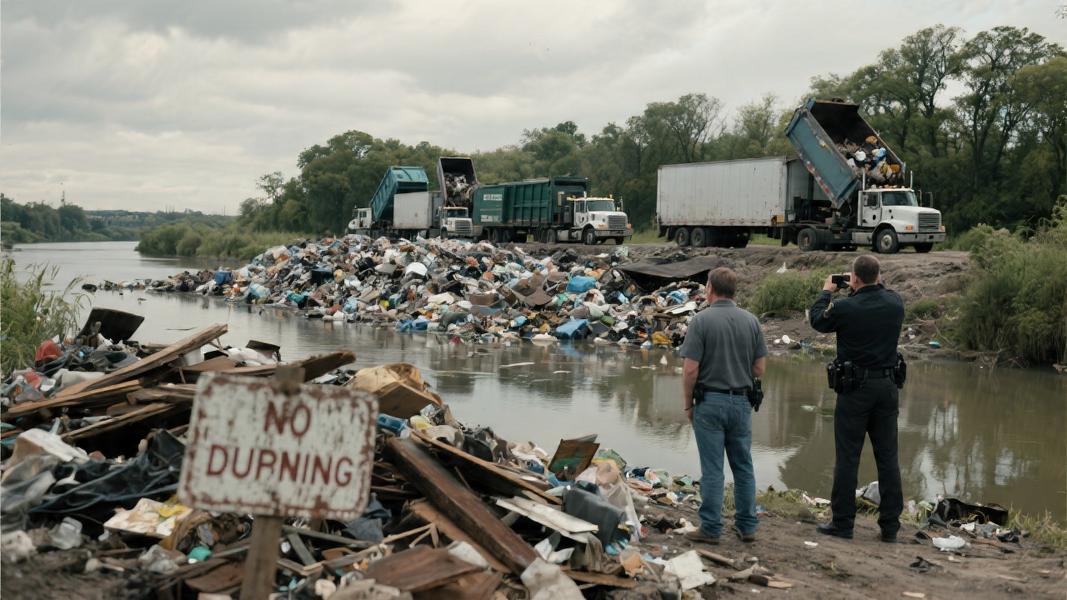
For more than two years, as many as 30 trucks a day rolled down a dirt road along the Trinity River in southeast Dallas — and nobody stopped them. Now, two men are under arrest, warrants are out for more, and the city is still trying to figure out how to clean up the mess they left behind.
Dallas police arrested Kyle Boyd, 59, on April 21, 2026, charging him with three counts of illegal dumping at a site stretching along the 1100 to 1500 blocks of Riverwood Road on the Trinity River bank. A second suspect, Joshua Fanslaw, was also taken into custody, facing one count of illegal dumping. Arrest warrants have been issued for multiple additional truck drivers believed to be involved in what investigators are calling a coordinated dumping scheme — not a few bad actors tossing trash on a back road, but an ongoing, industrial-scale operation that quietly fouled one of the city’s most significant waterways.
What’s Down There
How bad is it? The site is loaded with boards, metals, plastics, and a sprawling mix of construction debris and waste — much of it already spilling directly into the Trinity River. It’s the kind of environmental damage that doesn’t just go away with a weekend cleanup crew. State and federal partners are now involved, which tells you something about the scale of what’s sitting on those riverbanks.
Patrick Nolan, whose girlfriend owns property adjacent to the dump site, watched the whole thing unfold in real time. “I might see 30 trucks a day going down to what turned out to be an illegal dump site down there,” he said. He reported what he saw. The city, it turns out, already knew.
Years of Warnings, Stolen Cameras, and a Late Investigation
The City of Dallas has been aware of dumping activity at the Riverwood Road site for over two years. Surveillance cameras placed by the city marshal’s office were stolen or vandalized — a pattern that began as far back as 2020. Yet a formal investigation didn’t get underway until December 2025. That’s a long time for 30 trucks a day to keep moving.
Still, city officials say they’re now treating this seriously. In a statement, the city noted that it has “implemented a coordinated response with staff from Code Compliance, Dallas Water Utilities, Dallas Marshal’s Office, Dallas Fire-Rescue, and the City Attorney’s Office,” adding that staff is “working with state and federal partners to thoroughly investigate the affected properties.” Because the investigation is ongoing, the city said it couldn’t provide specifics on next steps. Translation: there’s no cleanup timeline yet.
That’s the catch. Two arrests have been made. Warrants are out. But the debris is still there, still touching the river, and the city is still — as of the latest reporting — developing a plan to clear it.
A Broader Pattern
Illegal dumping on or near waterways isn’t unique to Dallas. In Trinity County, California, a federal suspect was cited for illegal dumping discovered in August 2025 on national forest land, with cleanup only completed in January 2026 — a five-month turnaround that required federal resources. Separately, three men were arrested in Trinity County, Texas, for illegally dumping household items along East Texas roads. These cases don’t share suspects or geography, but they point to the same stubborn problem: illegal dumping is persistent, often brazen, and the enforcement and cleanup costs almost always fall on the public.
In Dallas, the legal process is now moving — but the river didn’t wait for it. The waste has been accumulating for years, and whatever damage it’s done to the Trinity’s water quality and ecosystem has already been done. Arrests are a beginning, not a resolution.
The trucks have stopped rolling down Riverwood Road. The hard part, it turns out, is everything that comes next.
