
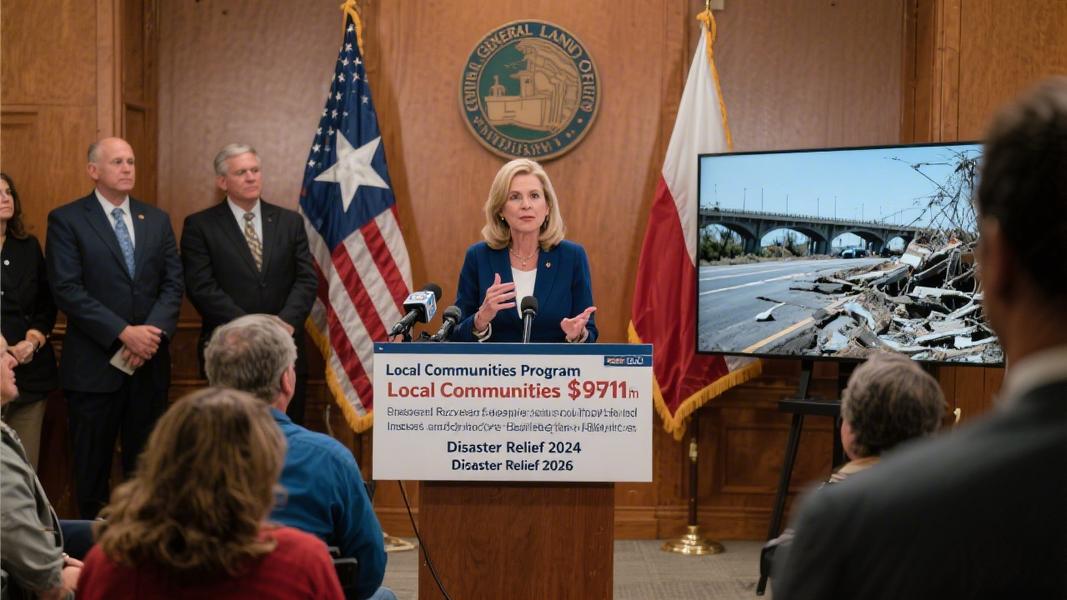
Texas is putting nearly $100 million on the table to help communities rebuild from Hurricane Beryl and other devastating storms that hammered the state in 2024.
The Texas General Land Office (GLO) announced it will allocate $97,033,950 for infrastructure projects through its Local Communities Program (LCP), with applications opening February 19, 2026. The initiative targets 92 counties designated by HUD as disaster-affected, with special priority given to the 27 counties classified as most impacted or distressed (MID) — which must receive at least 80% of the funding according to program guidelines.
Rebuilding Stronger After Beryl’s Destruction
“In 2024, Texas was impacted by Hurricane Beryl and other storms that devastates communities and damaged vital infrastructure,” said Commissioner Buckingham. “The GLO is proud of its role in helping Texans rebuild stronger and more resilient. The Local Communities Program will restore public infrastructure, strengthen local economies, and address long‑term recovery needs in eligible disaster‑impacted areas,” she stated in the announcement.
The infrastructure program is just one piece of a much larger recovery effort. It’s part of the State of Texas 2024 Disasters Action Plan, which oversees the distribution of $555,687,000 in Community Development Block Grant Disaster Recovery (CDBG-DR) funds allocated by the U.S. Department of Housing and Urban Development. These funds specifically target recovery from the Texas Severe Storms, Straight-line Winds, Tornadoes, and Flooding (DR-4781) and Hurricane Beryl (DR-4798) that devastated parts of the state.
Where’s all the money going? The action plan spreads funding across several critical programs, with the largest chunk — $244,100,000 — directed to the Homeowner Assistance Program. Additional allocations include $43,100,000 for Homeowner Reimbursement, $88,100,000 for Affordable Rental assistance, and the $97,033,950 for the Local Communities Program detailed in the funding breakdown.
Application Process and Eligibility
Local governments — cities and counties — along with Indian tribes in the affected areas can apply for funding, but they’ll need to act quickly. The application window opens February 19, 2026, and closes just over a month later on March 23, 2026, at 5:00 p.m. Central Time, giving eligible entities a relatively tight timeline to prepare their submissions.
To help potential applicants navigate the process, the GLO has scheduled a webinar on February 18, 2026, at 2:00 p.m. Central Time — just one day before the application portal opens.
This isn’t the GLO’s first rodeo when it comes to disaster recovery. The agency currently administers more than $14.3 billion in disaster recovery and mitigation funding across eight different disasters that have struck Texas. Applicants should note that the Texas Integrated Grant Reporting (TIGR) portal will be offline for upgrades from January 31 to February 8, 2026, after which it will be accessible at a new link: https://tigr.recovery.texas.gov/, as indicated on the GLO’s disaster recovery homepage.
The CDBG-DR funds are specifically designed to address unmet recovery needs for housing and infrastructure restoration in the hardest-hit communities. These federal dollars typically flow after other funding sources — including FEMA assistance, insurance payouts, and Small Business Administration loans — have been exhausted.
Following Federal Guidelines
Behind the scenes, developing these recovery plans is a complex process. The GLO must create detailed CDBG-DR Action Plans that adhere to strict HUD guidelines. These plans must comprehensively document disaster impacts, assess unmet needs, outline eligible activities, identify potential applicants, and establish a clear method for distributing funds — all while ensuring compliance with federal regulations.
For communities still reeling from 2024’s storms, particularly those devastated by Hurricane Beryl, this funding represents not just infrastructure repair but a chance to rebuild with greater resilience against future disasters. The question remains whether $97 million will be enough to address the extensive damage across dozens of counties — especially with 80% earmarked for just the 27 most severely impacted areas.
As Texas continues its long recovery from multiple weather disasters in 2024, these infrastructure funds mark an important step forward — but for many communities, they’re just one piece of a much larger rebuilding puzzle that will take years to complete.
