
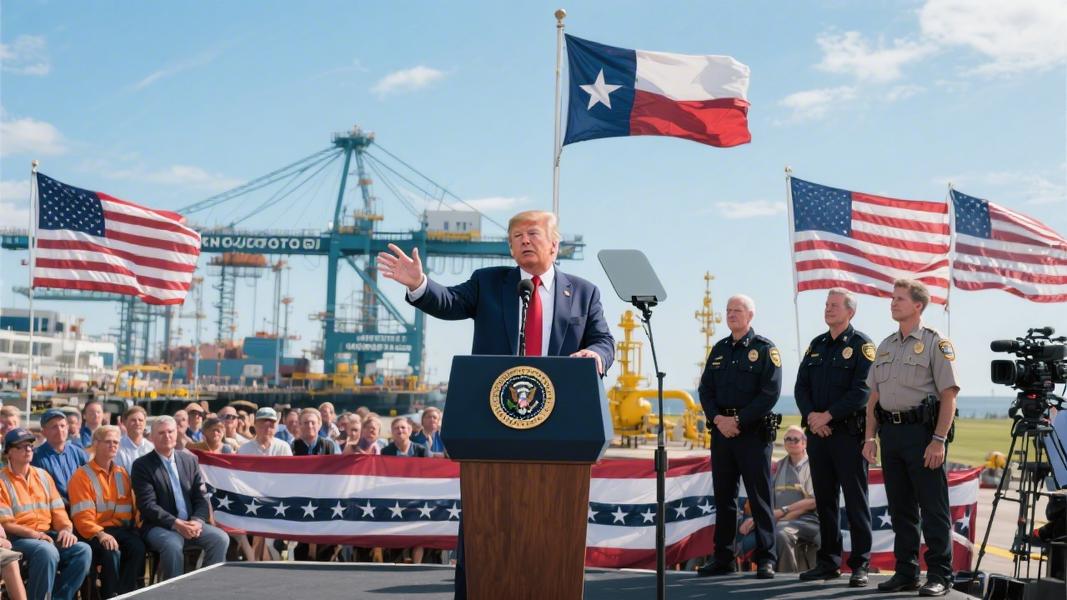
President Donald Trump took his energy pitch on the road this week, landing in Corpus Christi, Texas, with a message as blunt as a Gulf Coast headwind: America is open for business, and this port is proof of it.
The visit, which followed Trump’s State of the Union address, brought the president to the Port of Corpus Christi — the nation’s busiest hub for liquefied natural gas and petroleum exports — where he delivered remarks on his administration’s sweeping energy agenda and the economic case he’s building around it. It wasn’t his first time in the Coastal Bend, and the symbolism of returning here was hardly accidental.
A Stage Built From Steel and Crude
There’s a reason Trump keeps coming back to Corpus Christi. The port isn’t just a backdrop — it’s a billion-dollar argument. As the country’s premier export gateway for LNG and petroleum, it represents exactly the kind of industrial infrastructure the administration wants to hold up as a model for American energy dominance. Trump spoke to the crowd after receiving an energy briefing from port officials, framing the region’s output as central to both national security and economic revival.
The president’s remarks touched on expanding domestic production, slashing regulatory barriers, and positioning the United States as the world’s leading energy exporter. It’s a familiar refrain from the Trump playbook — but delivered here, surrounded by tankers and terminals, it carries a certain industrial weight that a White House podium simply can’t replicate.
Texas Families and the Tax Angle
What about the dollars hitting closer to home? The White House isn’t just talking pipelines. According to figures published by the administration, the average Texas family is saving $4,009 this year on taxes under the Working Families Tax Cuts Act — a figure the administration has been eager to attach to Trump’s broader economic narrative heading into 2026.
That’s a number worth pausing on. Whether voters feel that relief in their daily lives is a different question — one that economists and political analysts will be wrestling with for months. Still, the administration is leaning hard into the combination of energy jobs and tax savings as a one-two punch for working-class Texans who helped deliver the state in 2024.
More Than a Photo Op
To be fair, this wasn’t purely theatrical. Trump’s team has framed the Corpus Christi stop as part of a sustained effort to highlight the Coastal Bend’s outsized role in the national energy picture. The port’s LNG export capacity has grown dramatically in recent years, and the administration has been credited — at least in part — with accelerating the permitting and infrastructure decisions that made that growth possible.
But it’s not that simple. Critics argue that much of the export infrastructure now coming online was planned and approved during prior administrations, and that the real beneficiaries are multinational energy companies rather than the Texas families the White House invokes. Those debates tend to get lost in the noise of a presidential visit, somewhere between the handshakes and the hard hats.
The Bigger Picture
Zoom out, and the trip fits a pattern. Trump has been methodically visiting energy-producing regions since returning to office, using each stop to reinforce a governing identity built around fossil fuel expansion, deregulation, and economic nationalism. Corpus Christi — with its refineries, export terminals, and blue-collar workforce — is practically central casting for that story.
The president addressed supporters and industry leaders with the kind of unscripted energy his base expects, and separately delivered more formal remarks on the administration’s long-term energy agenda — covering everything from export targets to grid reliability to what officials are calling a generational opportunity in American LNG.
Whether the policy substance matches the showmanship remains, as ever, the central question of the Trump era. But in Corpus Christi this week, with the Gulf breeze carrying the faint smell of petroleum and the crowd cheering along the waterfront, the president seemed entirely at home — and entirely convinced the rest of the country will be, too.
