
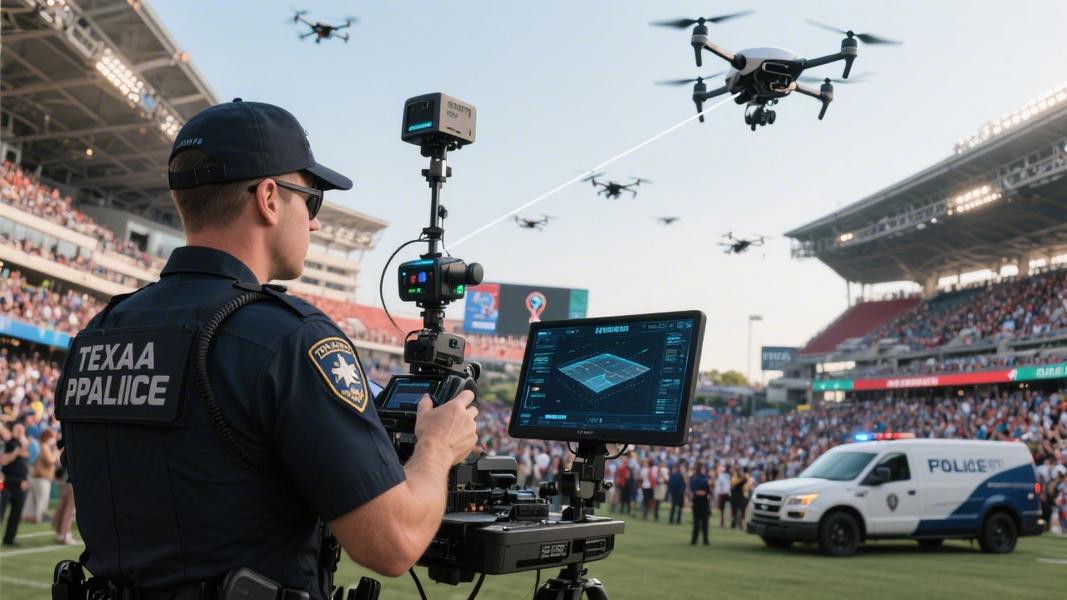
The skies above the 2026 FIFA World Cup are shaping up to be just as contested as the pitch below — and federal agencies are spending hundreds of millions of dollars to make sure they stay under control.
With matches scheduled across 11 U.S. host cities, law enforcement and homeland security officials are racing to deploy a layered network of drone detection, tracking, and interdiction systems before the tournament kicks off. The threat isn’t hypothetical. Small unmanned aircraft have already disrupted major events worldwide, and American officials aren’t waiting to find out what happens when one buzzes a stadium packed with 80,000 fans.
Texas Takes the Lead
In Texas, where multiple World Cup matches will be played, the Department of Public Safety has been particularly aggressive. The agency secured a $3.2 million FEMA grant to upgrade its drone detection and mitigation capabilities — including the authority to actually take rogue aircraft down. “It’s all about airspace safety, to be honest, to ensure that we don’t end up with an incident with all the aviation assets operating,” said Captain Aaron Fritch, who oversees drone operations for Texas DPS. When you consider the helicopters, fixed-wing aircraft, and law enforcement drones that will all be sharing the same airspace on match days, Fritch’s concern starts to feel less like caution and more like understatement.
Texas DPS also pioneered what officials describe as a first-in-the-nation drone detection system mounted on a helicopter — capable of geolocating both a drone and its operator in real time. For now, that system is limited to detection only, without interdiction capability. But the FEMA grant changes the equation considerably, giving the agency tools to move from watching to acting.
Net Guns and Radar: The Federal Playbook
At the federal level, the Department of Homeland Security isn’t leaving much to chance either. DHS placed a multimillion-dollar order with Utah-based Fortem Technologies for a suite of counter-drone hardware that reads like something out of a sci-fi thriller: DroneHunter interceptors, TrueView R30 radar systems, and SkyDome command-and-control software. The package is being deployed across all 11 host city venues.
Fortem’s DroneHunter is, in essence, a hexcopter that hunts other drones — using a net-based capture system to physically remove hostile aircraft from the sky without resorting to jamming or projectiles that could create their own hazards in a crowded stadium environment. It’s been described as the only kinetic counter-drone solution selected for U.S. World Cup venues. Jon Gruen, CEO of Fortem, didn’t hide his enthusiasm. “It’s an honor for Fortem to once again protect the FIFA World Cup, this time on our home turf,” he said. “The threat posed by small drones is one of the most consequential shifts in security of our lifetime. But it’s a threat we know how to stop — and we’ve already proven it on one of the world’s biggest stages.”
A Quarter-Billion Dollars and Counting
The money flowing into this effort is staggering. A $500 million federal counter-UAS grant program has earmarked roughly half its total funding specifically for World Cup host cities and states, covering everything from drone detection tools and scanning equipment to mapping software and interception systems, according to federal briefings. Separately, more than $250 million in counter-UAS grants has already been allocated to 11 states and the National Capital Region specifically for airspace security preparations tied to the tournament.
That’s a lot of money. But it’s not just about hardware.
The Gap Nobody’s Talking About
Here’s the problem no amount of radar can fully solve: the agencies protecting these venues still can’t talk to each other — not in any systematic, data-sharing way. A drone flagged outside a stadium in Houston has no guaranteed path into a shared intelligence picture visible to security teams in Los Angeles or New York. “If we see a drone at a game in Houston, we can then look up to see if that same drone has been detected at any of the other event sites — and that does not exist,” one official warned, pointing to the absence of a national database for sharing counter-UAS detection data across World Cup venues.
That’s the catch. Agencies are deploying some of the most sophisticated airspace security technology ever assembled for a sporting event, yet the connective tissue — the ability to recognize a pattern across cities, to flag a repeat offender before they reach a second stadium — simply doesn’t exist yet. Whether it gets built before the opening whistle is one of the quieter, more consequential questions hanging over the entire security operation.
The nets are ready. The radar is humming. Now someone just needs to build the database that ties it all together — because the drones won’t wait for the paperwork.
