
President Trump has ordered U.S. forces to shoot and kill any Iranian vessels caught deploying mines in the Strait of Hormuz — a dramatic escalation that underscores just how close the two countries are edging toward open conflict.
The directive came as a broader diplomatic breakdown hardened into something more dangerous. Negotiations between Washington and Tehran that were supposed to take place this week never materialized, and both sides are now dug in on preconditions that make any near-term talks look increasingly unlikely. The standoff has drawn in more American firepower than the region has seen in decades — and it’s costing Iran dearly by the hour.
A Diplomatic Deadlock With No Easy Exit
The core problem is almost comically circular. Iran insists it refuses to negotiate until the U.S. lifts its blockade on Iranian ports and ships. The White House, for its part, says it won’t come to the table until Tehran reopens the Strait of Hormuz to international traffic. Neither side is blinking. Neither side appears ready to.
That’s the catch. Both conditions are essentially asking the other to surrender leverage before talks even begin — which, in diplomatic terms, is usually a way of saying you’re not really interested in talking at all. At least not yet.
Still, the pressure is real. Iran’s economy is hemorrhaging roughly $500 million per day as a result of the U.S. blockade — a figure that, if sustained, would represent catastrophic long-term damage to an economy already battered by years of sanctions. How long Tehran can absorb that kind of hit before its calculus shifts remains one of the central questions hanging over the crisis.
Three Carriers, 15,000 Troops, 200 Aircraft
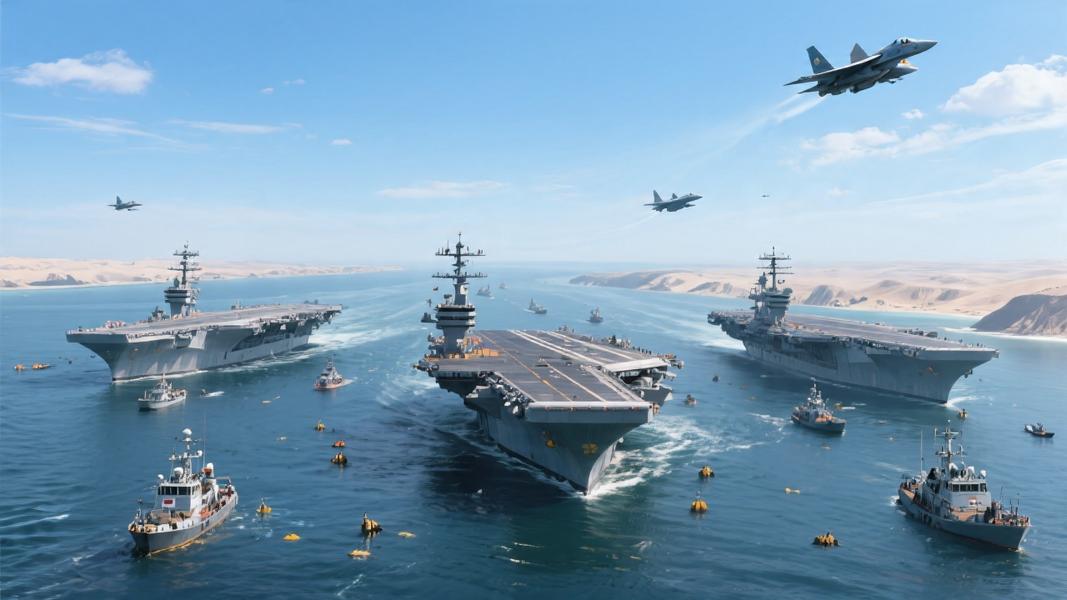
For the first time in decades, the United States has three aircraft carriers operating simultaneously in the Middle East. The USS Abraham Lincoln, the USS Gerald R. Ford, and the USS George H.W. Bush are now all in the region, collectively carrying more than 200 aircraft and some 15,000 sailors and marines — a show of force that’s hard to misread.
On the ground — or rather, at sea — the U.S. Navy currently doesn’t have any ships positioned inside the strait itself. Instead, it has stationed seven vessels on either side of it, essentially bracketing the chokepoint without sailing directly through it. It’s a posture that gives Washington flexibility without triggering an immediate confrontation in one of the world’s most strategically sensitive waterways.
Meanwhile, American forces have been actively enforcing the blockade far beyond the strait. For at least the second time this week, U.S. troops boarded and seized a vessel in the Indian Ocean that the Pentagon accused of conducting business with Iran. The message is deliberate: the enforcement net is wide, and it’s tightening.
A Separate Front: Israel and Lebanon
Not everything this week was brinkmanship. On a somewhat quieter note, President Trump announced Thursday that Israel and Lebanon have agreed to extend their ceasefire deal by three weeks, following talks at the White House. It’s a fragile arrangement, but it’s holding — for now — and it offered at least a brief counterpoint to the drumbeat of escalation dominating the broader regional picture.
Whether that same diplomatic patience can eventually be applied to the U.S.-Iran standoff is another matter entirely. Right now, with carriers in the water, mines in the strait, and both sides issuing ultimatums, the gap between a tense standoff and something far worse looks uncomfortably narrow.
