
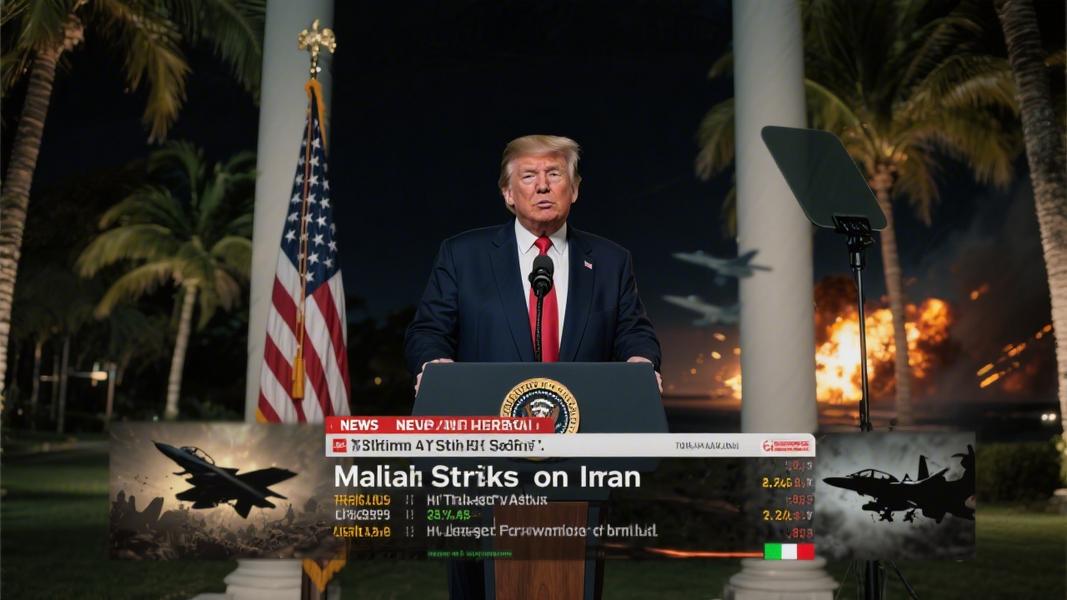
The United States and Israel launched major combat operations against Iran on Saturday, striking what American officials described as nuclear facilities, missile infrastructure, naval assets, and terrorist proxy networks — a military escalation that sent shockwaves through the region and reignited fierce debate in Washington over the limits of presidential war powers.
President Donald Trump confirmed the strikes in a public address on February 28, 2026, declaring, “A short time ago, the United States military began major combat operations in Iran.” The announcement, while anticipated in some intelligence circles, marked a dramatic new chapter in decades of hostility between Washington and Tehran — and it arrived without a formal congressional authorization for the use of military force.
A Sweeping Military Campaign
Trump framed the operation in expansive terms, describing it as an effort to neutralize one of the world’s most destabilizing regimes. The administration, he stated, was “undertaking a massive and ongoing operation to prevent this very wicked, radical dictatorship from threatening America and our core national security interests.” That’s a broad mandate — and the scope of the strikes appeared to match it.
Targets included Iran’s missile program, its naval forces, and what U.S. officials characterized as terrorist proxy infrastructure. The administration’s stated goal: stop Iran from ever acquiring a nuclear weapon. Whether airstrikes alone can achieve that is a question military analysts have debated for years. Still, the operation was clearly designed to send a message that went well beyond any prior surgical strike.
Israeli Prime Minister Benjamin Netanyahu threw his full support behind the campaign, framing it as something larger than a military mission. “Our joint operation will create the conditions for the brave Iranian people to take their fate into their own hands,” he said. It’s the kind of language that sounds like liberation and reads, to critics, like justification.
Trump’s Direct Message to Iran’s Military
In a striking move, Trump addressed Iranian armed forces directly — offering them a stark binary. They could, he warned, “lay down your weapons and have complete immunity, or, in the alternative, face certain death.” It was blunt even by Trump’s standards. In a phone interview during the strikes, he softened the rhetoric slightly, insisting that the endgame was humanitarian in spirit: “All I want is freedom for the people… I want a safe nation, and that’s what we’re going to have,” he added.
He also called on ordinary Iranian civilians to seize the moment and take control of their own government. Whether that’s a realistic expectation — or a rhetorical flourish dressed up as strategy — remains deeply unclear.
Tehran Fires Back
Iran didn’t wait long. Within hours of the initial strikes, Tehran launched a retaliatory barrage of missiles and drones aimed at Israel and U.S. military installations in the region, according to reports from the ground. The counterattack was swift and, by most accounts, significant in scale.
Iran’s foreign ministry had already set the tone before the missiles flew. In a statement that pointedly referenced ongoing diplomatic efforts, officials declared: “The time has come to defend the homeland and confront the enemy’s military assault. Just as we were prepared for negotiations, we are more ready than ever to defend the essence of Iran.” The line about negotiations wasn’t incidental — Tehran was making the case, loudly, that it had been willing to talk and that Washington chose war instead.
That’s a contested claim. But it’s one that will reverberate in international forums for months, if not years.
Congress Erupts Over War Powers
Back in Washington, the reaction on Capitol Hill was split along predictably partisan lines — though some of the sharpest criticism cut straight to constitutional bedrock. Representative Jimmy Gomez of California didn’t mince words. “The president’s own statement acknowledges this is war, yet he never came to the Congress to ask for authorization to start it,” he charged.
It’s a serious accusation, and it won’t be the last time it’s raised. The War Powers Resolution has been tested, stretched, and quietly ignored by administrations of both parties for decades. But launching what the president himself called “major combat operations” against a sovereign nation — without so much as a congressional briefing in advance, let alone a vote — is a threshold that even some hawkish lawmakers may struggle to wave away.
That said, Congress has rarely moved quickly to constrain a president already mid-strike. The institutional inertia is real. So is the political calculus.
What Comes Next
Nobody knows. That’s the honest answer. The region is already volatile — Iran’s proxy networks stretch from Lebanon to Yemen to Iraq — and the retaliatory strikes on U.S. bases raise the immediate question of American casualties. If there are significant losses, the domestic political landscape shifts overnight.
For now, the world is watching a conflict that has been simmering for more than four decades finally boil over into open warfare. The administration is betting that overwhelming force can reshape the Middle East’s most entrenched power dynamic. Tehran is betting it can absorb the blows and fight back hard enough to make the cost prohibitive.
History suggests that both sides rarely win that wager the way they expect to.
