
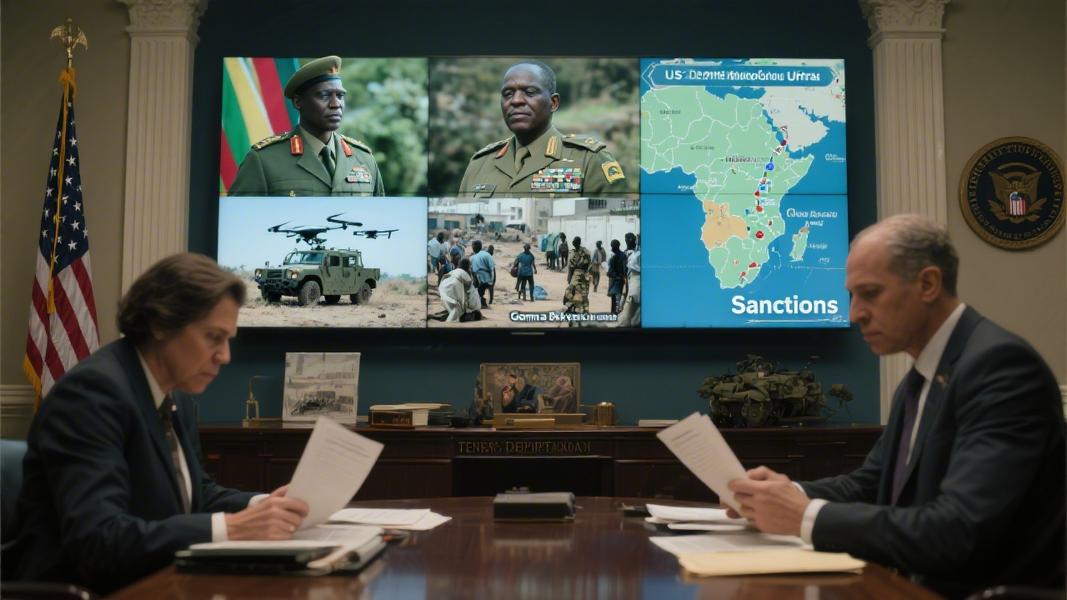
The United States government has drawn a hard line on the crisis in eastern Congo, slapping sweeping sanctions on Rwanda’s military and a roster of senior officials it says are fueling one of Africa’s most brutal and long-running conflicts.
The U.S. Department of the Treasury’s Office of Foreign Assets Control (OFAC) announced a series of targeted actions against the Rwanda Defence Force (RDF) and key individuals linked to the M23 armed group, which has terrorized eastern Democratic Republic of Congo for years. The measures freeze assets, block financial transactions, and send a pointed diplomatic message: Washington is watching, and it’s not bluffing.
A Military and Its Enablers in the Crosshairs
The first round of designations hit the RDF itself along with four senior officials — Vincent Nyakarundi, Ruki Karusisi, Mubarakh Muganga, and Stanislas Gashugi — all accused of providing material support to M23. Treasury Secretary Scott Bessent didn’t mince words. “President Trump is the Peace President, and Treasury will use all tools at its disposal to ensure that the parties to the Washington Accords uphold their obligations,” he declared, demanding “the immediate withdrawal of Rwanda Defence Force troops, weapons, and equipment.”
That’s a significant demand — one that implies Rwandan boots are, in Washington’s view, already on Congolese soil in an unauthorized capacity. Rwanda has long denied direct involvement with M23, a position that grows harder to maintain with each successive U.S. designation.
Ministers, Middlemen, and Shell Companies
Then came the second wave. James Kabarebe, Rwanda’s Minister of State for Regional Integration, found himself on the sanctions list — a remarkable step given his cabinet-level status. So did Lawrence Kanyuka Kingston, described as a senior M23 member, along with two companies he operates in the United Kingdom and France. The reach of those designations — stretching from Kigali to London to Paris — suggests a financial network far more sophisticated than a simple rebel operation in the jungle.
Acting Under Secretary Bradley T. Smith put it plainly: “Today’s action underscores our intent to hold accountable key officials and leaders like Kabarebe and Kanyuka, who are enabling the RDF and M23’s destabilizing activities in the eastern DRC,” he stated. “The United States remains committed to ensuring a peaceful resolution to this conflict.” Diplomatic, yes. But the subtext is unmistakable.
Blood, Minerals, and a Supply Chain That Runs to China
How bad is it on the ground? Bad enough that Treasury went after the money itself. A third round of designations targeted entities tied to illegal conflict minerals trading — including the armed group PARECO-FF — operating out of areas like Rubaya, a region rich in coltan and other critical minerals. Those minerals, according to Treasury, are being smuggled through Rwanda and ultimately finding their way to China, funding the very violence that keeps eastern DRC ungovernable.
Under Secretary John K. Hurley framed it in terms of American strategic interest as much as humanitarian concern. “The conflict minerals trade is exacting a deadly toll on Congolese civilians, fueling corruption, and preventing law-abiding businesses from investing in the DRC,” he noted. “The Treasury Department will not hesitate to take action against groups that deny the United States and our allies access to the critical minerals vital for our national defense.”
That framing matters. It’s not just about Congo’s suffering — it’s about supply chains, defense manufacturing, and the global competition for resources that underpin everything from electric vehicles to guided munitions. Washington, in other words, has skin in this game beyond the moral argument.
Pressure, Accords, and What Comes Next
Still, sanctions are a tool, not a solution. The references to the Washington Accords by Bessent signal that there’s a diplomatic framework in play — one the U.S. clearly feels is being violated. Whether these designations produce actual behavioral change in Kigali remains an open question. Rwanda is a small country with an outsized reputation for governance and economic reform; its government tends to push back hard on international criticism.
But it’s not that simple anymore. With a cabinet minister sanctioned, two European-registered companies frozen, and the military itself on the list, the cost of continued involvement in eastern Congo just got considerably steeper — not just politically, but financially.
The civilians of eastern DRC have heard promises before. What they haven’t seen, in decades of conflict, is accountability that actually sticks. Whether Treasury’s paper sanctions translate into real pressure — or real peace — is the question that will outlast any press release.
