
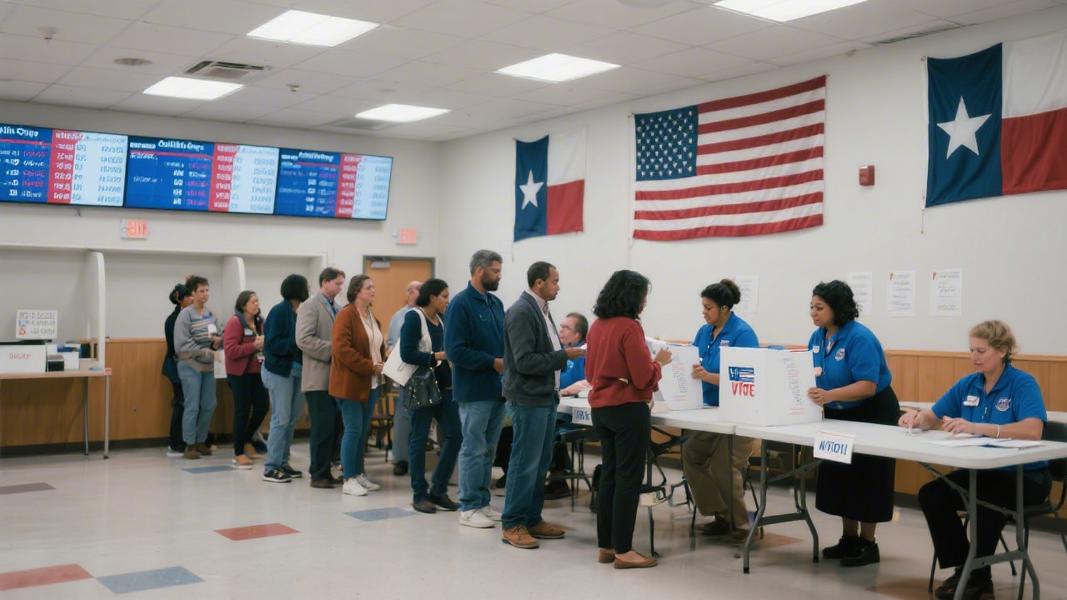
Hundreds of Dallas County voters showed up to cast their ballots Tuesday — and were turned away. What followed was a scramble that stretched Election Day well past its scheduled end.
Dallas County Judge Clay Jenkins extended polling hours for Democratic primary voters to 9 p.m. Tuesday evening, after widespread confusion left voters locked out of the process through no fault of their own. The extension came in response to a court request from local Democrats, who argued that a new precinct-assignment system — one that required voters to appear at a specific location tied to their home address — had caught too many people off guard.
A New System, A Familiar Mess
It’s a problem that sounds almost too avoidable in hindsight. In previous election cycles, Dallas County operated as a voting center county, meaning residents could walk into any polling location and cast a ballot. That flexibility is gone this cycle. Non-joint primaries now require voters to show up at their precinct-specific polling site — and plenty of people simply didn’t know that.
The result? Long drives to the wrong location, confused poll workers, and voters who ran out of time before they could find the right place. Democrats reported similar chaos unfolding in Williamson County as well.
“This effort to suppress the vote, to confuse and inconvenience voters is having its intended effect as people are being turned away from the polls,” one statement noted, adding that officials were “monitoring the situation and working with our local county party to explore all solutions, including an extension of election day voting hours.”
What the Extension Actually Means
Here’s the catch. Voters who cast ballots between 7 p.m. and 9 p.m. under the extended window won’t have their votes counted the same way as everyone else — at least not immediately. Jenkins confirmed those ballots would be logged as provisional ballots, meaning they’ll face additional scrutiny before being officially tallied.
Still, for voters who’d already been turned away once, the extension offered a second shot. Jenkins also clarified that the hours were not extended for Republicans — because, as he put it, they didn’t request it.
That asymmetry is worth noting. The extension wasn’t a blanket policy applied equally across both parties. It was a targeted legal remedy, granted specifically because Democratic voters and party officials went to court and asked for it. Republicans, apparently, either didn’t face the same scale of disruption — or chose not to pursue the same avenue.
Confusion by Design, or Just Poor Communication?
How much of this was intentional? That’s a harder question. Democrats used pointed language, framing the confusion as an “effort to suppress the vote.” Critics of that framing would argue that rule changes in election administration don’t automatically constitute suppression — sometimes they’re just poorly communicated transitions that catch voters flat-footed.
But whatever the intent, the outcome was the same: real people, trying to vote in a legitimate election, were turned away from polling sites that weren’t technically “wrong” — they were just wrong for them, under rules many didn’t know had changed.
Election officials in counties across Texas have long wrestled with how to balance administrative efficiency against the practical reality of voter education. Switching from an open voting center model to a precinct-specific system is a significant operational shift. Whether enough was done to communicate that shift — clearly, widely, and in time — is a question Tuesday’s chaos has made suddenly very urgent.
Provisional ballots, after all, aren’t a solution. They’re a safety net. And safety nets only matter if voters actually make it back to the polls in time to use them.
