
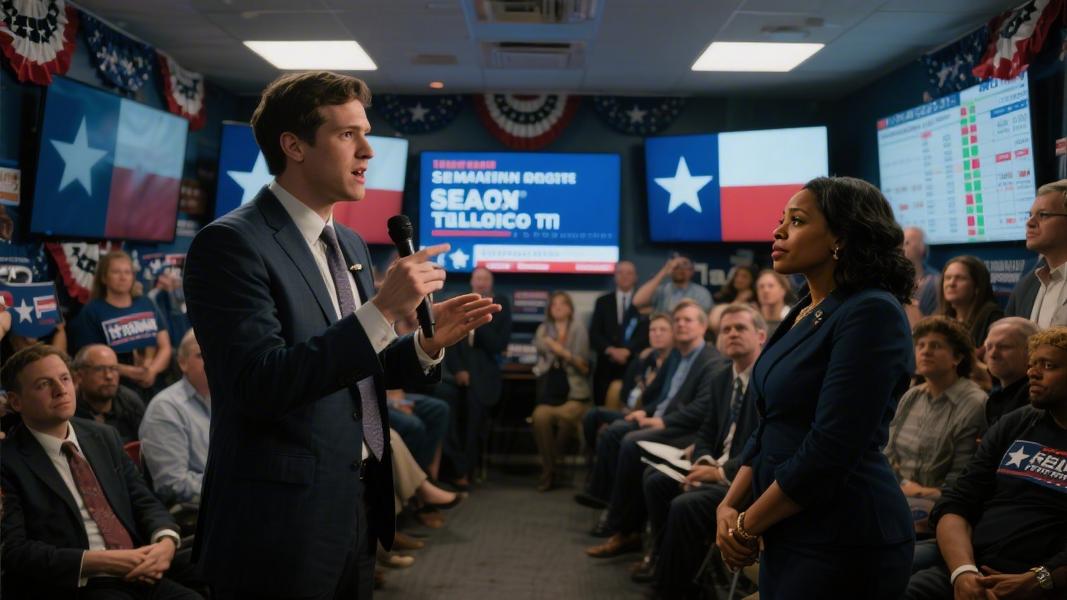
Texas Democrats came into primary night with energy, momentum, and a historic turnout story to tell. They left without a nominee.
In one of the most closely watched Democratic Senate primaries in years, neither Rep. Jasmine Crockett nor Rep. James Talarico cleared the 50 percent threshold required to claim the party’s nomination outright, all but guaranteeing a May runoff that will decide who faces Republicans in the November 3, 2026 general election. The race — expensive, racially charged, and increasingly bitter — is far from over.
A Night of Shifting Numbers
It started close. When the first 15 percent of votes were tallied, Crockett actually held a narrow edge — 50 percent to Talarico’s 48. Then the math moved. By the time 30 percent of precincts had reported, Talarico had opened up a six-point lead, buoyed by strong suburban numbers that offset Crockett’s solid showing in Harris County. By the end of the night, Talarico sat at 53 percent, Crockett at 46 percent — close enough that neither camp was ready to concede the broader fight.
Crockett, for her part, wasn’t exactly conceding anything. “I can tell you now that people have been disenfranchised,” she said. “The reason that we knew that there were problems is because we were receiving the phone calls and the emails.” It’s the kind of statement that signals a campaign prepared to dig in — not fold.
The Money Gap Was Real
That’s the catch. Talarico didn’t just outperform Crockett on election night. He outspent her by a staggering margin. Federal Election Commission data shows Talarico raised $20.7 million to Crockett’s $8.6 million — a more than two-to-one cash advantage that gave him the infrastructure to run a sprawling, statewide operation. In Texas, where media markets are vast and expensive, that kind of financial firepower matters enormously.
Still, money doesn’t always win. And Crockett’s coalition — particularly her overwhelming support among Black Democratic primary voters — gave her a durable base that kept her competitive well into the night.
The Coalitions Tell the Story
What’s really happening here is a Democratic Party in the middle of a demographic negotiation. Pre-election polling from Emerson College Polling and Nexstar Media showed Talarico leading 47 to 38 overall — but the internals were stark. 80 percent of Black Democratic primary voters backed Crockett. Talarico, meanwhile, commanded 59 percent of Hispanic voters and 57 percent of white voters. “Talarico has built momentum among Hispanic and white voters, while a majority of Black Democratic primary voters support Crockett,” said Spencer Kimball, executive director of Emerson College Polling.
A separate poll from the UH Hobby School had the race essentially deadlocked heading into primary day — 39 percent for Talarico, 39 percent for Crockett — with similar coalition splits. Crockett led Black voters 71 to 13. Talarico led white voters 53 to 34. The numbers were consistent. The divide was real.
Historic Turnout — With a Twist
Here’s what nobody expected: Democrats may have actually turned out in higher numbers than Republicans. Preliminary figures suggest historic Democratic primary participation — potentially enough to exceed Republican turnout, which would be, by any measure, genuinely unprecedented for Texas. Whether that enthusiasm translates to general election performance is a separate question entirely. But it’s a number that will get attention in both parties.
What Comes Next
Texas law is straightforward on this: if no candidate wins a majority in the primary, the top two finishers head to a runoff. That’s exactly where this race is headed. Talarico and Crockett will face each other again — this time with everything stripped down to the bare essentials: turnout, ground game, and which coalition can show up twice.
Talarico did ultimately defeat Crockett in the primary. But the road there was anything but clean. A race that exposed real fault lines within the Texas Democratic Party — along racial, generational, and ideological lines — doesn’t simply close with a final vote count.
The runoff will answer which vision of the Texas Democratic Party gets to carry the banner into November. That question, it turns out, is a lot bigger than any one candidate.
