
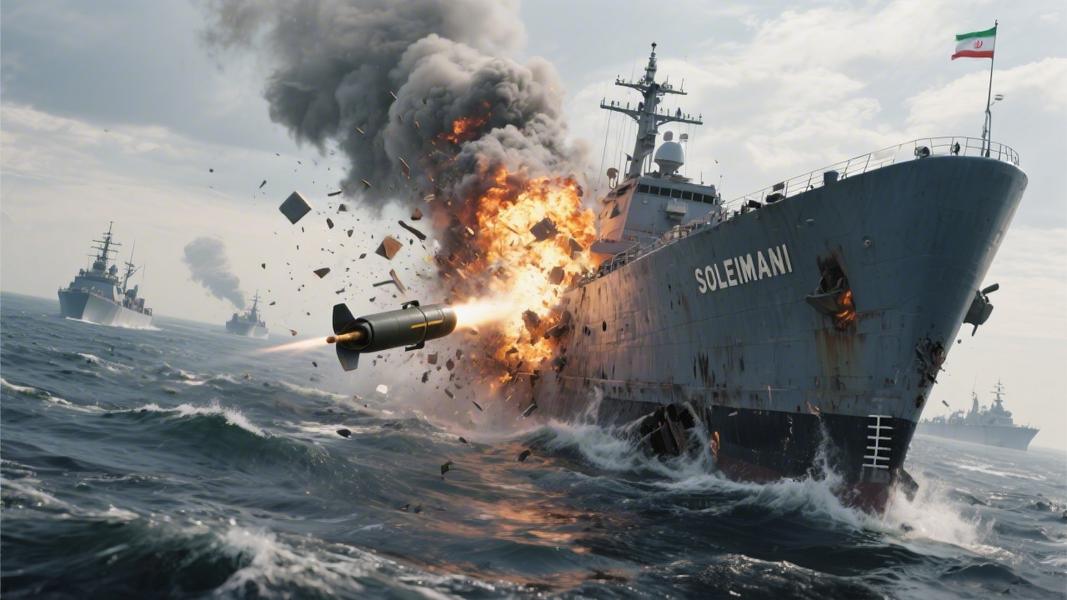
For the first time since the final years of World War II, a United States Navy submarine has sunk an enemy warship with a torpedo — and the Pentagon isn’t being quiet about it.
The IRIS Dena, an Iranian frigate carrying 180 people, was sent to the bottom of the Indian Ocean by a single Mk-48 torpedo fired from a U.S. fast attack submarine. The strike, confirmed Wednesday during a Pentagon press briefing, is the latest and most dramatic episode in what the Defense Department is calling Operation Epic Fury — a sweeping campaign targeting Iran’s naval and military infrastructure that has, by the Pentagon’s own account, effectively erased the Islamic Republic’s naval power as a fighting force.
A Historic Kill Shot
Defense Secretary Pete Hegseth didn’t mince words. “Yesterday, in the Indian Ocean,” he said, “an American submarine sunk an Iranian warship that thought it was safe in international waters. Instead, it was sunk by a torpedo. Quiet death. The first sinking of an enemy ship by a torpedo since World War II.” The briefing also featured Gen. Dan Caine, who put the milestone in starker historical terms, confirming that it marked the first time since 1945 a U.S. Navy fast attack submarine had achieved a torpedo kill on an enemy combatant ship — and that it achieved “immediate effect.”
Video footage of a U.S. attack boat striking the Iranian frigate off the coast of Sri Lanka has since surfaced, offering a rare visual record of the engagement. Sri Lankan naval personnel recovered 32 survivors from the wreckage, along with bodies. The fate of the remaining crew members has not been confirmed.
“Their Navy Is No More”
How bad is it for Iran? By Hegseth’s account, catastrophic. “The Iranian Navy rests at the bottom of the Persian Gulf,” he said at the briefing. “Combat ineffective, decimated, destroyed, defeated. Pick your adjective.” He added a line that drew immediate attention: “Last night we sunk their prize ship, the Soleimani. Looks like POTUS got him twice.” The remark was a pointed reference to the 2020 killing of Iranian General Qasem Soleimani — and a signal that the Trump administration views this campaign as something of a sequel. The full briefing, including Hegseth’s and Caine’s remarks, was broadcast live and has since drawn millions of views.
The scope of the destruction is staggering, at least on paper. U.S. forces have now struck more than 2,000 targets and destroyed over 20 Iranian naval vessels as part of Operation Epic Fury. Among them: a Jamaran-class corvette that was hit and is currently sinking at the Chah Bahar pier in southeast Iran, according to reports out of the region. A separate Jamaran-class vessel, displacing roughly 1,500 tons and armed with missiles and torpedoes, was also sunk at Konarak Naval Base — along with the destruction of Iran’s Shahid Bagheri drone carrier.
Flames Across the Fleet
It’s not just ships. Iran’s key naval base on the Strait of Hormuz was set ablaze in strikes that have rattled one of the world’s most strategically sensitive waterways, as documented by defense analysts tracking the campaign. Satellite imagery also captured Iran’s largest naval vessel — the IRINS Makran, a converted former tanker — engulfed in smoke and fire at a military port. The images are striking. The ship, once a symbol of Iran’s ambitions to project naval power far beyond its home waters, appears to be finished.
Still, the Pentagon has indicated this isn’t over. Strikes under Operation Epic Fury are expected to continue for another 24 to 48 hours, with Iranian infrastructure and remaining naval capabilities still in the crosshairs, according to reporting on the operation’s timeline. Earlier in the week, Trump himself announced that nine Iranian naval ships had already been destroyed and sunk — a figure that has since been eclipsed by a wide margin.
The Weight of History
That’s the thing about this moment that keeps cutting through the fog of operational briefings and satellite imagery: the sheer historical weight of it. A torpedo kill. The last one came more than 80 years ago, in a war that reshaped the entire modern world. Whatever one makes of the politics driving this campaign, the military milestone is undeniable — and the implications for how adversaries calculate their own naval exposure to American submarines just got significantly more serious.
As Hegseth put it, with the kind of bluntness that tends to echo: “It is no more.” Whether that verdict holds — and what comes next — is a question the region, and the world, is now watching very closely.
