
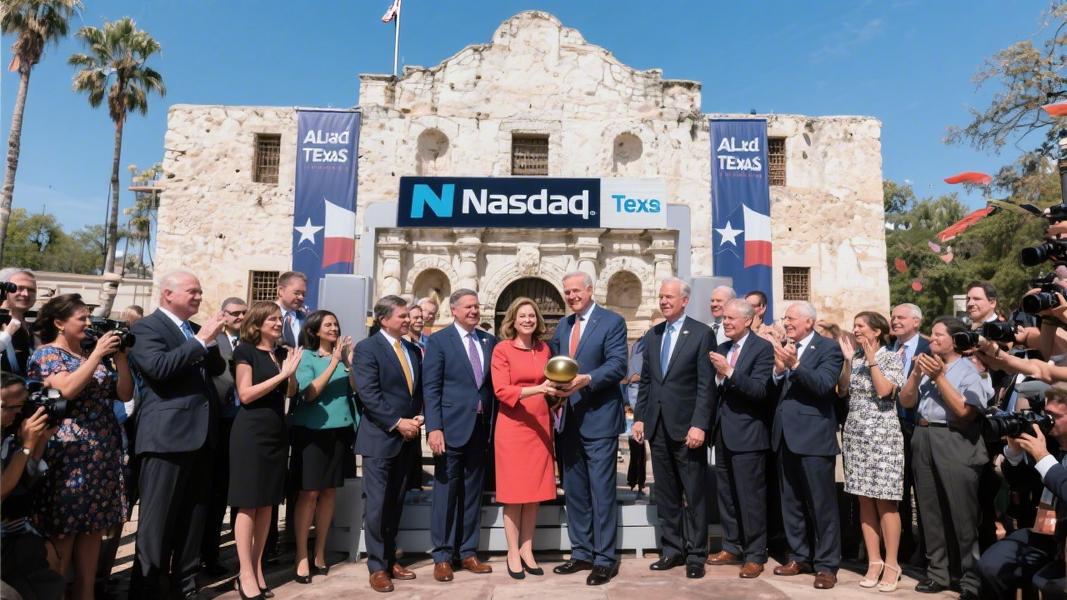
Wall Street came to the Alamo — and this time, nobody lost. On March 5, 2026, Nasdaq rang its closing bell not from its Manhattan headquarters, but from the hallowed grounds of one of America’s most iconic landmarks in San Antonio, Texas, marking the official debut of Nasdaq Texas.
The launch isn’t just symbolic pageantry. It represents a concrete structural shift in how American capital markets are organized. Nasdaq Texas is a fully SEC-approved dual-listing venue, legally domiciled in Texas, giving companies a new avenue to leverage the state’s business-friendly regulatory climate while still accessing the full suite of Nasdaq’s global exchange infrastructure. The date was no accident either — March 5 marked the 190th anniversary of the Battle of the Alamo, a detail that organizers clearly relished, as reported.
A Bell, a Battlefield, and Bipartisan Fanfare
The ceremony unfolded between 2:45 and 3:00 p.m. CST at 300 Alamo Plaza — a historic first for Nasdaq, which has never before rung its closing bell at the site. The guest list read like a Texas power roll call: Governor Greg Abbott, Lieutenant Governor Dan Patrick, and San Antonio Mayor Gina Ortiz Jones all attended, lending the event a rare strain of bipartisan political muscle, as the Alamo Trust noted.
Mayor Ortiz Jones didn’t hold back on the rhetoric. “Texas has long represented what it means to be bold. To take risks. To build. To lead,” she said. “That spirit mirrors Nasdaq’s own story. We were founded to challenge convention, to modernize markets and expand access to capital for innovators who shape the future.” It’s the kind of line that sounds like it was written for a bronze plaque — but given the setting, it’s hard to argue with the stagecraft.
Who’s In? The Inaugural Dual Listings
Six companies made up the inaugural cohort of dual listings, and the list spans industries in a way that feels deliberately curated to tell a story about Texas’ economic breadth. They include Nasdaq, Inc. (NDAQ) itself — which dual-listed alongside the new exchange it created — as well as APA Corporation (APA), Construction Partners Inc. (ROAD), J.B. Hunt Transportation Services (JBHT), Huntington Bancshares (HBAN), and ProFrac Services (ACDC), according to an official announcement.
APA Corporation’s CEO, John J. Christmann IV, struck a tone that was equal parts corporate and genuine. “APA Corporation is proud to be part of the inaugural group of companies dual listing on Nasdaq Texas,” he said. “This milestone reflects our deep roots in Texas and our continued commitment to disciplined capital allocation and long-term value creation for our shareholders.” The energy sector, construction, trucking, banking — it’s a cross-section that suggests Nasdaq Texas isn’t just chasing tech darlings. It’s going broad.
What Nasdaq Texas Actually Is
So what does “dual listing” actually mean here? Think of it less as a competing exchange and more as a legal and symbolic anchor. Companies listed on Nasdaq Texas maintain their existing Nasdaq listings while simultaneously being legally registered under a Texas-based entity. It’s a structure designed to appeal to firms that want the credibility of Texas incorporation — low taxes, looser regulatory friction, a governor who’ll show up to your ribbon-cutting — without abandoning the liquidity and visibility of a major national exchange, as explained by financial analysts covering the launch.
That said, it’s not without its skeptics. Critics have questioned whether the structure offers substantive advantages or whether it’s largely a political and branding exercise dressed up in regulatory clothing. Time — and the number of companies that eventually sign on — will be the real judge.
A “Permanent, Foundational Commitment”
For Nasdaq’s leadership, the language is unambiguous. Rachel Racz, senior vice president and head of listings for Texas, Central and Southern U.S., and Latin America, framed the launch in terms that signal this isn’t a one-off. “The full launch of Nasdaq Texas represents a permanent, foundational commitment to the companies that want to build the future of the U.S. economy from this state,” she said, as covered by local outlets in San Antonio.
The closing bell ceremony itself ran from 3:45 to 4:15 p.m. ET — a window that, logistically, required some coordination between Central and Eastern time zones. A video of the ceremony captured the moment in full, with the old stone walls of the Alamo as a backdrop that no Manhattan trading floor could ever replicate. Whether you find that stirring or slightly over-the-top probably depends on how you feel about Texas in general.
The full event details and official Nasdaq statement are also available directly from the exchange’s own newsroom, and the bell-ringing event page offers additional logistical context for those tracking the exchange’s formal rollout timeline.
The Bigger Picture
It’s tempting to read Nasdaq Texas purely as a product of the current political moment — a nod to corporate migration trends, to the exodus of firms from California and New York, to the broader cultural war over where American business belongs. And there’s truth in that read. But the SEC approval and the genuine structural architecture of the dual-listing venue suggest something more durable than a press release.
The Alamo, after all, is a monument to people who bet everything on a place they believed in. Whether Nasdaq Texas becomes a landmark of its own — or just a very expensive photo op — remains to be written. But the bell has rung, and it echoed off 190-year-old walls.
