
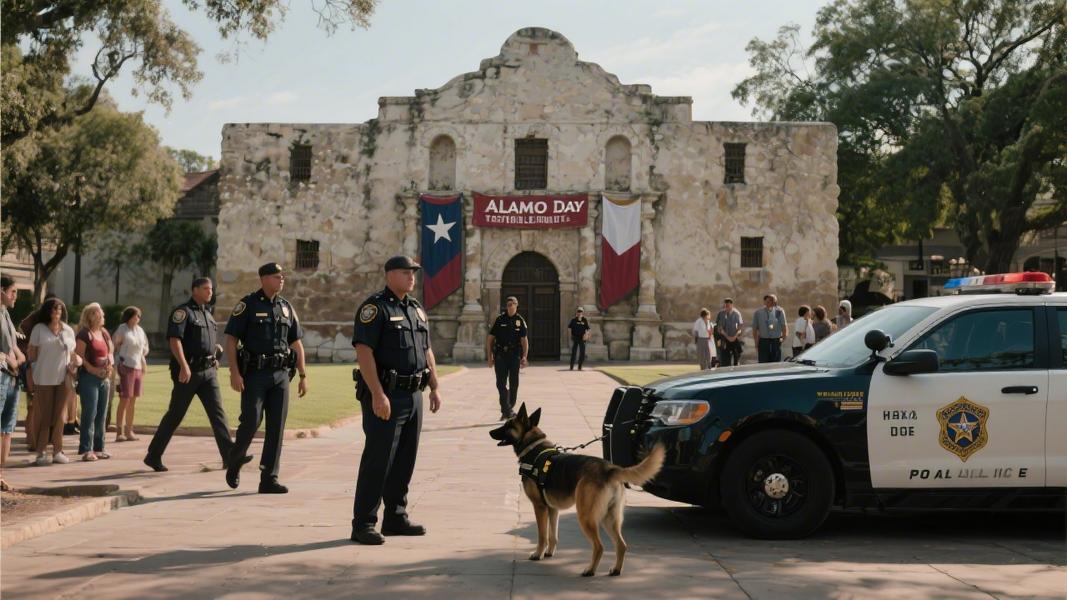
The Alamo has a new set of guards — and this time, they carry badges from the state of Texas itself.
In a significant shift for one of the country’s most visited historic landmarks, the Texas Department of Public Safety has officially taken over security operations at the Alamo complex in San Antonio, replacing the private Alamo Rangers who had protected the site for nearly five decades. The transition, completed in December 2025, marks a sweeping change in how the state intends to safeguard what many Texans regard as their most sacred ground.
From Rangers to Troopers
The handoff didn’t happen overnight. DPS troopers began conducting patrols as early as September 2025, easing into a role that became fully operational in December under the authority of Senate Bill 1, signed by Governor Greg Abbott. The legislation also shifted oversight of the site away from the General Land Office and placed it under a newly created Alamo Commission — a structural change that set the stage for the security overhaul.
The Alamo Trust formally transferred operations on a Wednesday in December, citing Senate Bill 3059 as the legal mandate. The bill draws a direct comparison to how the state secures its own Capitol complex — a telling benchmark for how seriously Austin is treating this assignment. “Security operations include providing the necessary security officers, troopers, and supervisory and indirect support staff,” the Alamo Trust stated, “to ensure the safety and protection of both visitors and the historical integrity of the site.”
That’s not a small operation. Hundreds of thousands of tourists pass through the Alamo grounds each year. Managing that kind of foot traffic — while preserving a 300-year-old mission — is a genuinely complex task, and one that private rangers, whatever their dedication, were never fully resourced to handle at a state level.
A Personal Mission for DPS Leadership
For DPS Colonel Freeman F. Martin, the transition carries a certain weight. A former Region Chief for DPS’ Central Texas Region, Martin didn’t mince words about what the assignment means to him. “As the former Region Chief for DPS’ Central Texas Region, I know just how important the Alamo is to the people of San Antonio and all Texans,” he said. “It is a tremendous honor to oversee the department’s transition in taking over security operations for the Alamo, helping to preserve one of the greatest symbols in Texas history.”
Still, sentiment only goes so far. The broader context here is a state that’s increasingly treating its landmark sites — and its borders, and its infrastructure — as security assets in a much larger strategic picture.
Part of a Bigger Play
The Alamo transition doesn’t exist in a vacuum. It coincides with the release of the Texas Homeland Security Strategic Plan 2026–2030, a sweeping blueprint that Governor Abbott and DPS unveiled alongside the security changes. Abbott framed the stakes plainly: “Protecting Texas from a broad range of threats and vulnerabilities is a critical mission that continues to evolve,” he noted.
The plan is ambitious by any measure — six goals, 31 objectives, and 158 priority actions organized across mission areas that include Prevent, Protect, Mitigate, Respond, and Recover. Goal one targets terrorist attacks and hostile foreign nation activity. Goal two focuses on reducing vulnerabilities. Goal three addresses mitigating the impact of attacks and natural disasters. It reads, in places, like a document written by people who’ve stopped assuming the worst won’t happen.
Colonel Martin made that urgency explicit. “It’s no secret that Texas is facing the most diverse and significant homeland security threats of our lifetime,” he acknowledged, “so it is more important today than ever that our state has every tool and resource needed to mitigate and respond to any type of attack or disaster.”
What It Means on the Ground
So what does the end of the Alamo Rangers era actually look like? Quieter than you might expect. There were no dramatic ceremonies, no standoffs. The Rangers — a private security force that had become something of an institution at the site — were relieved of their duties as state troopers stepped in. For most visitors wandering through the chapel or strolling the Long Barrack, the change may barely register. The uniforms are different. The authority behind them is not.
That, perhaps, is exactly the point. Texas isn’t just changing who guards the Alamo — it’s signaling how it intends to manage its most consequential public spaces going forward: with the full weight of state law enforcement, embedded in a long-term homeland security strategy that stretches to 2030 and beyond.
The Alamo fell once. Texas, it seems, has decided that’s enough history repeating itself.
