
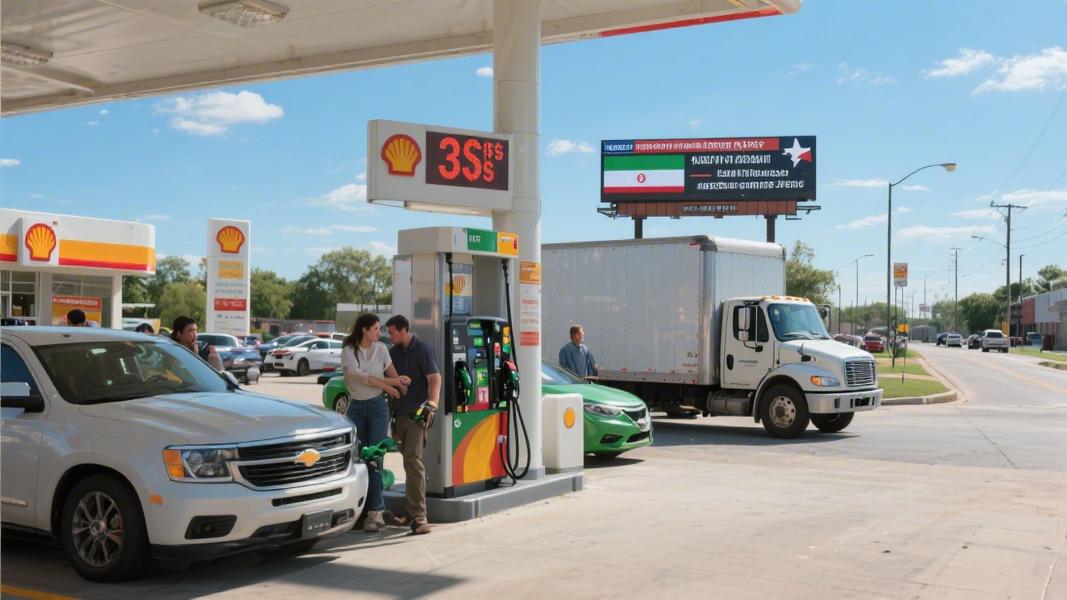
North Texas drivers pulled up to the pump this week and felt it immediately — gas prices surged to their highest level in more than a year, catching many commuters off guard mid-fill.
The regional average hit $2.98 per gallon on Friday, according to AAA data reported by Fox4, a jarring 11-cent jump in a single day and a 38-cent spike compared to the same day the prior week. For context, Texas drivers were paying just $2.42 per gallon as recently as February 3, according to data tracked by the Breckenridge Texan. That’s a gain of more than half a dollar in roughly a month — the kind of move that turns a routine errand into a budget conversation.
A Spike That’s Hard to Miss
Tommy Caram, a Lewisville resident, noticed the change firsthand on a single drive. “I passed the station. I believe it was a Quik Trip, and it was $2.42, and then I remember seeing that same one coming here just now. It was $3.19, so it was quite a jump,” he said. That’s not a gradual creep — that’s a wall.
For gig workers, the math gets personal fast. Robert Jackson, who drives for Uber part-time, put it plainly: “I do regret not putting gas in yesterday. Sometimes it’s not even worth it doing Uber because of the gas prices.” He’s not alone in that calculation. When fuel costs erode margins, the platform economy quietly contracts — fewer drivers, longer wait times, higher surge pricing. It ripples outward.
The statewide picture confirms the trend isn’t limited to one intersection or one city. The Texas retail gas price for the week of March 2 came in at $2.747 per gallon, a 4.13% jump from the prior week, according to figures compiled by YCharts. By March 6, AAA’s statewide average had climbed to $2.978, while the national average stood at $3.320, per AAA’s tracker.
What’s Driving the Surge
So what’s behind the sudden spike? The answer runs through a narrow waterway thousands of miles away. Jay Young, founder and CEO of King Operation Corporation, pointed to supply disruptions at the Strait of Hormuz as a key pressure point. “20 million barrels or so comes through this,” Young said. “And if you cut off that supply or if you delay it, what happens is prices will go up because people on the other end of that — China, India — that’s where they get a lot of their oil. And then the oil that was supposed to go to the United States is now going to China.”
That kind of supply redirection doesn’t stay contained to the crude market. Young was blunt about the downstream effects: “Oil is up probably 35, 40% in the past few days. Prices are going to continue to go up. And when prices go up, your gasoline goes up, your airline tickets are going to go up, everything’s going to go up. Your food costs will go up because of transportation.” It’s a familiar cascade — energy prices don’t just hit the pump, they work their way into nearly every consumer good that moves on a truck or a plane.
Still, the EIA’s monthly data offers some longer-term grounding. Texas all-grades conventional retail gasoline prices in the early months of 2026 had been averaging between $2.45 and $2.56 per gallon — making this week’s climb look less like a gradual trend and more like a sudden lurch.
Texas’s Complicated Relationship With High Oil Prices
But it’s not that simple — especially not here. Texas isn’t just a consumer of oil. It’s one of the world’s dominant producers, and that changes the calculus considerably. Young framed it this way: “Texas is one of the largest producing. You have countries — it would be number two. The United States is number one and Texas will be number two, but ahead of Saudi Arabia, Iran — and it’s all the Permian Basin and the Eagle Ford and fracking and delivering oil there.”
That production muscle means higher prices carry an upside for the state’s economy, even as they sting at the pump. “We’re going to see more taxes,” Young said. “The more money in the coffers of the government, we’re going to see a lot of jobs, a lot of job creation, but a lot of trickle-down economics will happen because we are producing and drilling for oil and gas.” Texas has long lived with this duality — what hurts drivers tends to help roughnecks, and vice versa.
As of March 2, Texas still ranked among the more affordable states, holding the 7th lowest gas price in the country at $2.62 per gallon, according to data cited by East Texas News. Cost-of-driving comparisons from Choose Energy also placed the state’s March average around $2.82 — still well below the national figure, though that gap appears to be narrowing quickly.
What Comes Next
Whether prices stabilize or keep climbing depends largely on geopolitical forces that no Texas driver — or analyst — can fully predict. Hormuz tensions, global demand shifts, and domestic drilling output will all play a role. For now, the advice from energy watchers is essentially: don’t wait.
Robert Jackson already learned that lesson the hard way. “I do regret not putting gas in yesterday,” he said. In a market moving this fast, yesterday’s price can start to feel like a bargain by morning.
