
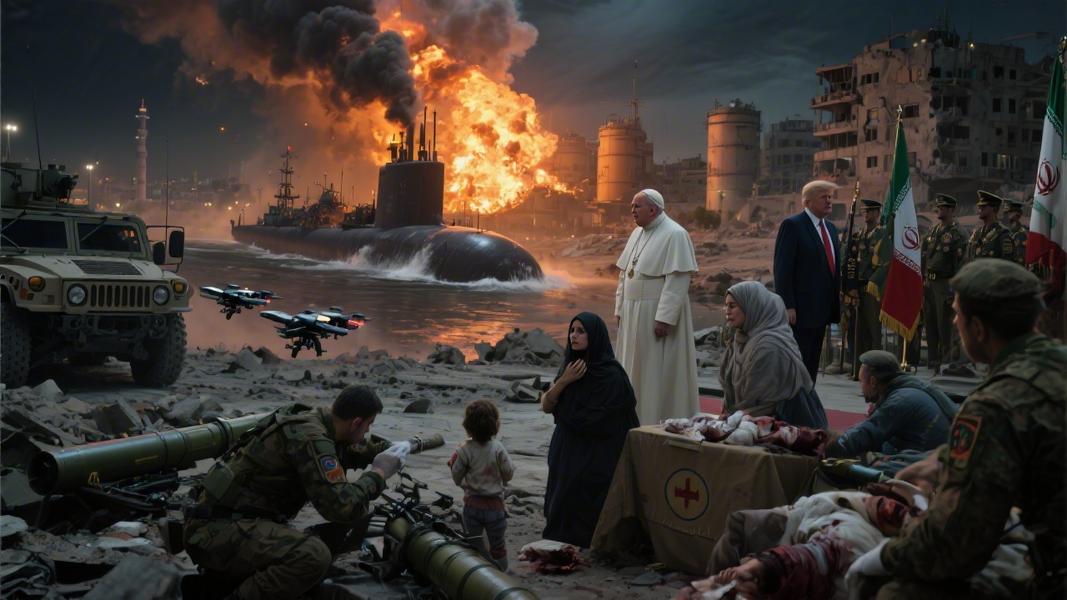
The Middle East woke up to a different world on the morning of February 28, 2026. Within hours, the most consequential military operation in a generation had already begun reshaping it.
In the early hours of that Saturday, the United States and Israel launched a sweeping, coordinated assault on Iran under two parallel operations — Roaring Lion and Epic Fury — targeting military command centers, missile stockpiles, air defense systems, and senior government officials. Among those killed, according to early reports: Supreme Leader Ali Khamenei, the man who had governed the Islamic Republic for nearly four decades. The strikes marked an almost unimaginable escalation in a region that had spent years teetering on the edge.
A Shock-and-Awe Campaign, Measured in Hundreds
The scale of it was staggering. In just the first twelve hours, U.S. and Israeli forces carried out nearly 900 strikes — hitting Iranian missile infrastructure, radar installations, Revolutionary Guard compounds, and military leadership nodes across the country. It wasn’t a surgical strike. It was a demolition, described by defense analysts as one of the most concentrated aerial campaigns since the opening salvos of the Iraq War in 2003.
President Donald Trump, never one to understate a moment, addressed the nation in characteristically sweeping terms. “Over the past 36 hours, the United States and its partners have launched Operation Epic Fury, one of the largest, most complex, most overwhelming military offensives the world has ever seen,” he declared. Hyperbole? Maybe. But the raw numbers made it hard to dismiss entirely.
The Justification — and the Questions Around It
How did the administration sell it? On legal and national security grounds, primarily. Secretary of State Marco Rubio told reporters that the strikes were preemptive — that Washington had credible, time-sensitive intelligence pointing to an imminent Iranian threat. “There absolutely was an imminent threat, and the imminent threat was that we knew that if Iran was attacked — and we believe…” he stated, his sentence trailing into the classified territory that so often swallows these explanations whole.
That’s the catch, isn’t it. The word “imminent” has done a lot of heavy lifting in American foreign policy over the years — from the Gulf of Tonkin to the WMD justifications for Iraq. Whether this instance holds up to scrutiny will be a question for congressional committees, international courts, and historians. Right now, the bombs have already fallen.
A Human Toll, Still Being Counted
Still, whatever the strategic calculus, the human cost is already coming into focus. At least 555 people have been killed inside Iran since the strikes began, according to figures released by the Iranian Red Crescent Society. The number is almost certainly an undercount — it always is in the early hours of a conflict this size. Hospitals in Tehran and other urban centers were reported to be overwhelmed, with power outages complicating emergency response across multiple provinces.
The dead include, by all accounts, both military personnel and civilians — a distinction that will matter enormously as international reaction begins to crystallize. Allies in Europe have been notably quiet so far. Others have not.
What Comes Next
Iran’s government, decapitated at the top and battered across its military infrastructure, has not yet issued a coherent formal response — which is itself a kind of signal. Proxy forces across the region, from Hezbollah in Lebanon to Houthi-aligned factions in Yemen, are watching. The world is watching. Markets opened Monday in a state of controlled panic.
It’s worth remembering that the last time a U.S. strike killed a senior Iranian official — Qasem Soleimani, in January 2020 — the region held its breath for weeks before the immediate crisis passed. This is an order of magnitude larger than that. The killing of a Supreme Leader doesn’t have a modern precedent in this part of the world. Nobody quite knows what the playbook looks like from here.
As the smoke continues to rise over Tehran, one line keeps circulating on social media — drawn, with some irony, from John F. Kennedy: Mankind must put an end to war before war puts an end to mankind. Whether that sentiment registers in any of the war rooms currently lit up across the Middle East and Washington remains, for now, an open question.
