
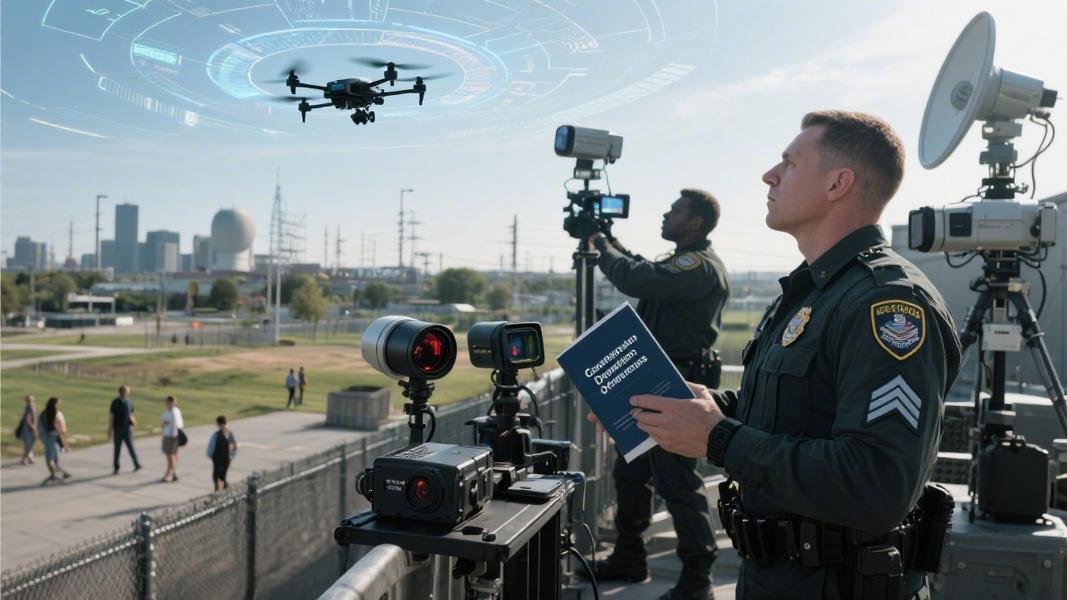
America’s military is done playing defense at the fence line. A sweeping overhaul of how the Pentagon detects, tracks, and neutralizes unauthorized drones is now reshaping homeland security from the ground up — and it’s moving fast.
At the center of it all is Joint Interagency Task Force 401, or JIATF-401, the Defense Department’s dedicated counter-unmanned aerial systems command. Over the past year, the task force has rolled out a cascade of new policies, procurement deals, training programs, and legal authorities that collectively represent the most aggressive domestic drone defense posture the U.S. has ever attempted. The stakes, officials say, are no longer hypothetical.
Beyond the Fence Line
“Countering drones does not start and stop at the fence line,” Brigadier General Matt Ross, director of JIATF-401, said in January, capturing in one sentence what amounts to a philosophical shift in how the military thinks about base security. For years, installation commanders were largely constrained to reacting to threats once they crossed a physical perimeter. That framework is gone.
Updated guidance issued on January 26, 2026, expands defensive perimeters outward, streamlines how commanders identify threats based on the totality of circumstances, and requires each installation to develop its own specific counter-UAS procedures within 60 days. Critically, it also enhances data-sharing pipelines between the Department of Defense, DHS, and DOJ — a recognition that drone threats don’t respect jurisdictional boundaries any more than they respect fence lines. The Pentagon announced the changes with unusual urgency for a bureaucratic policy update.
Earlier guidance, signed by Secretary of Defense Pete Hegseth and released on December 8, 2025, had already set the tone. That directive consolidated counter-UAS policy under Title 10 authorities and explicitly removed fence-line limitations, empowering commanders to act across broader protective areas. “With this new guidance installation commanders are empowered to address threats as they develop,” Ross noted, “and the guidance makes clear that unauthorized drone flights are a surveillance threat even before they breach an installation perimeter.”
The Science of Watching the Sky
So how exactly does the military track a drone it can’t yet see with the naked eye? The answer involves a layered stack of sensor technologies that JIATF-401 detailed in a March 9, 2026 guide titled Counter-UAS Operations: Safeguarding Freedoms and Preserving Privacy. The document outlines how Radar, Electro-Optical/Infrared, and Radio Frequency Detection systems work in concert to identify and track unmanned aircraft — while staying on the right side of federal surveillance law.
That last part matters more than it might seem. RF detection systems, for instance, analyze signal fingerprints rather than intercepting communications content — a deliberate design choice that keeps the technology compliant with federal wiretapping statutes. “Countering drones is not just a battlefield problem — it’s a homeland defense imperative,” Ross wrote in the guide’s introduction. The document reads less like a technical manual and more like a legal defense brief — which, given the civil liberties landscape, is probably intentional.
Procurement at Speed
Talk is cheap. Hardware isn’t. In its first six months of operation, JIATF-401 executed over $30 million in rapid procurement actions under its Domestic Shield initiative, established a centralized counter-UAS marketplace, and locked in an enterprise-wide licensing agreement for a common counter-UAS mission command system. The pace of acquisition was, by Pentagon standards, remarkable.
“From day one, our task was to close real gaps as quickly as we could,” Ross reflected in a six-month assessment. That’s not the kind of language you typically hear from a military bureaucracy — and it suggests the task force was operating with a level of urgency that didn’t leave much room for the usual procurement timelines. Whether that speed comes with tradeoffs in vetting and oversight is a question worth watching.
Hardening the Ground
Not every solution involves electronics. JIATF-401’s Guide for Physical Protection of Critical Infrastructure, released in late January 2026, takes a decidedly low-tech approach to part of the problem — recommending physical barriers like walls, hardened roofs, overhead netting, tensioned cables, and layered perimeters that extend beyond traditional fence lines. The guidance treats drone threats the way Cold War-era planners once treated aerial bombardment: as something to be physically denied, not just electronically countered.
It’s a reminder that even in an era of sophisticated RF jamming and AI-assisted radar, sometimes a steel net is still the right answer.
Training People, Not Just Systems
None of the hardware works without trained operators. The Joint Counter-small UAS University, known as JCU, has shifted to a train-the-trainer model designed to multiply expertise across the force more quickly than traditional centralized instruction could allow. Advanced courses, a counter-UAS planner’s curriculum, and hands-on field sessions — including recent training in Guam for Task Force Talon and the Guam National Guard — are part of the expanded program.
The task force also put its systems through their paces at a Counter-Small UAS Threat Simulation Exercise at Joint Base Myer-Henderson Hall, testing eleven sensor systems and three mitigation devices across dozens of simulated incidents, day and night. “This training is about more than just technology; it’s about people and partnerships,” said Col. Brian Reynolds, provost marshal of Joint Task Force – National Capital Region, in remarks that followed the exercise.
Authority Flows Downward
Perhaps the most structurally significant change is one of delegation. New Pentagon guidance grants service secretaries the power to designate facilities for special drone protections, pushing decision-making authority closer to the operational level. For commanders who’ve spent years waiting on Washington to approve responses to active threats, it’s a meaningful shift. “Drones are a defining threat for our time,” Ross told Breaking Defense. “Technology is evolving fast and our policies and c-UAS strategy here at home must adapt to meet this reality.”
JIATF-401 has also formalized much of this policy landscape in official fact sheets, giving installations a standardized reference point as they build out their own procedures. The bureaucratic infrastructure, in other words, is catching up to the threat — or at least trying to.
What Comes Next
Still, the pace of commercial drone development means the military is, in some sense, always running a lap behind. New airframes, longer battery life, autonomous flight capabilities, and increasingly affordable hardware are expanding what a determined adversary — state-sponsored or otherwise — can put in the sky over a sensitive installation. The question isn’t whether JIATF-401’s current toolkit is impressive. It is. The question is whether it’ll be enough a year from now.
For the moment, the task force seems to understand the assignment. Thirty million dollars in six months, new legal authorities, expanded training, smarter sensors, and a doctrine that no longer pretends the fence line means anything — it’s a serious posture for a serious problem. Whether it stays ahead of the threat is the story that hasn’t been written yet.
