
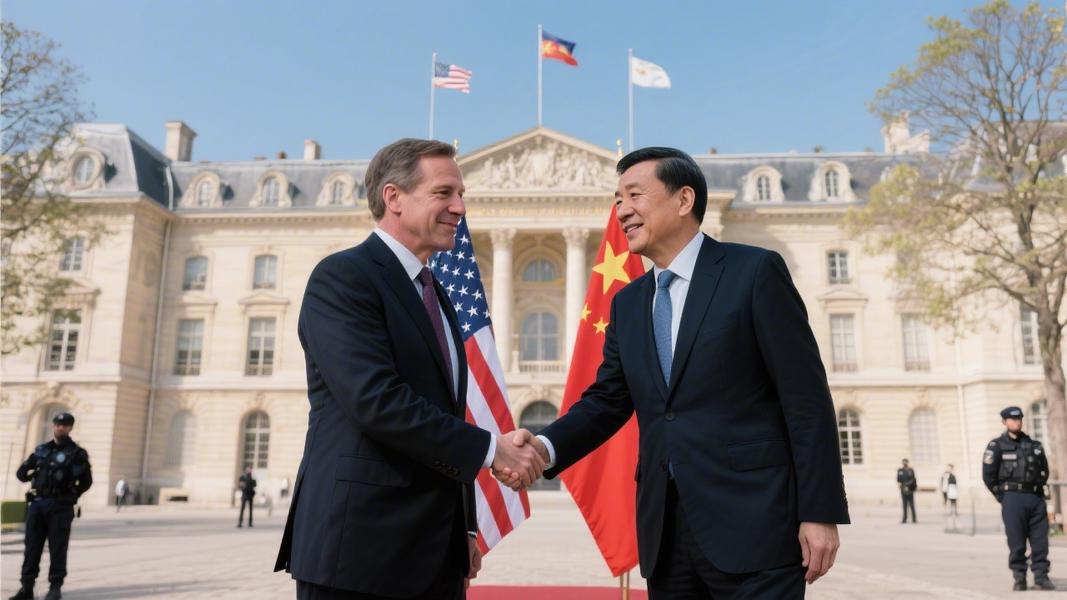
The world’s two largest economies are talking again — and this time, both sides appear to be showing up ready to deal.
Treasury Secretary Scott Bessent is set to sit down with Chinese Vice Premier He Lifeng in Paris on March 15–16, 2026, a high-stakes meeting that reflects just how much diplomatic ground the U.S. and China have quietly covered in recent months. With a Trump-Xi summit still on the calendar and trade benchmarks reportedly being met, the bilateral relationship is threading a surprisingly delicate needle — even as tensions over tariffs and rare earths simmer just beneath the surface.
A ‘Very Good Equilibrium’
Bessent hasn’t been shy about his read of the moment. Speaking earlier this year, he described the U.S.-China relationship as having reached a “very good equilibrium” — a phrase that raised eyebrows in Washington, given how turbulent that relationship has been for most of the past decade. But he backed it up with specifics. China, he said, had completed its full soybean purchase allocation under the Trump-Xi deal. “They actually completed their soybean purchases last week, their full allocation,” Bessent noted. He was quick to add the administration isn’t letting its guard down: “We are going to hold their feet to the fire.”
That combination — cautious optimism tempered by hard-nosed accountability — seems to be the posture the Treasury is carrying into Paris. In a statement released ahead of the meeting, Bessent framed the talks in terms of the personal rapport between the two heads of state. “Thanks to the bonds of mutual respect between President Trump and President Xi, the trade and economic dialogue between the United States and China is moving forward,” he said. “Under the guidance of President Trump, our team will continue to deliver results that put America’s farmers, workers, and businesses first.”
A Diplomatic Calendar Built to Prevent Blowups
Here’s what makes this moment genuinely interesting. Bessent has described a packed schedule of Trump-Xi engagements stretching through the rest of 2026 — a Trump visit to Beijing in April, a possible Xi trip to Washington or Mar-a-Lago over the summer, and the G20 in Miami. The logic, as Bessent explained it, is almost elegant in its simplicity: “If we have this series of meetings to move toward, then no one really wants to upset anything.”
That’s not naïveté. That’s architecture. By stacking the diplomatic calendar with high-profile summits, both sides effectively create a mutual disincentive to blow things up. It’s leverage dressed as scheduling.
Still, the architecture has been tested. Tariff tensions and China’s rare earth export controls have introduced friction that even the most optimistic observer can’t dismiss. Yet Bessent signaled that even those pressures haven’t derailed the most consequential meeting on the books. “President Trump said that the tariffs would not go into effect until November 1. He will be meeting with Party Chair Xi in Korea. I believe that meeting will still be on,” Bessent confirmed, referring to the APEC summit in South Korea.
Rare Earths, Boeing, and the Substance Behind the Summitry
What are they actually negotiating? The practical agenda is coming into sharper focus. Following U.S.-China trade talks in Stockholm, Bessent confirmed that China had begun accelerating the flow of rare earth magnets to American companies — a concession agreed upon in earlier London discussions. “Well, I would say they blocked all of their rare earth magnets and now we’re getting them,” Bessent stated at a press briefing.
That’s not a small thing. Rare earth magnets are critical inputs for defense systems, electric vehicles, and consumer electronics. Getting that pipeline moving again — after China had effectively shut it off — is a concrete win that goes well beyond the symbolic.
The Paris talks are also expected to touch on Chinese purchases of Boeing aircraft and continued U.S. soybean sales, according to people familiar with the agenda. These aren’t glamorous topics, but they’re the kind of durable, transactional wins that tend to outlast any single administration’s rhetoric. The South China Morning Post reported that the meeting is proceeding despite U.S. military strikes against Iran — a sign that both governments are treating the economic track as something worth insulating from geopolitical turbulence.
What’s at Stake
U.S. Trade Representative Jamieson Greer is also part of the Paris delegation, which underscores how seriously the administration is taking this round of talks. This isn’t a courtesy call. It’s a working session between two governments that have spent the better part of a decade treating each other with varying degrees of suspicion, and who are now, apparently, trying something different.
That said, it’s not that simple. The structural tensions — over technology, Taiwan, trade imbalances, and military posture — haven’t gone anywhere. They’re the permanent backdrop against which all of this careful diplomacy is unfolding. A completed soybean order and a pipeline of rare earth magnets are real progress, but they’re also, in the grand scheme of U.S.-China relations, table stakes.
The real question isn’t whether Bessent and He Lifeng will shake hands in Paris. They will. The question is whether the momentum they’re carefully building can survive the first serious test — and in this relationship, those tests have a way of arriving without much warning.
