
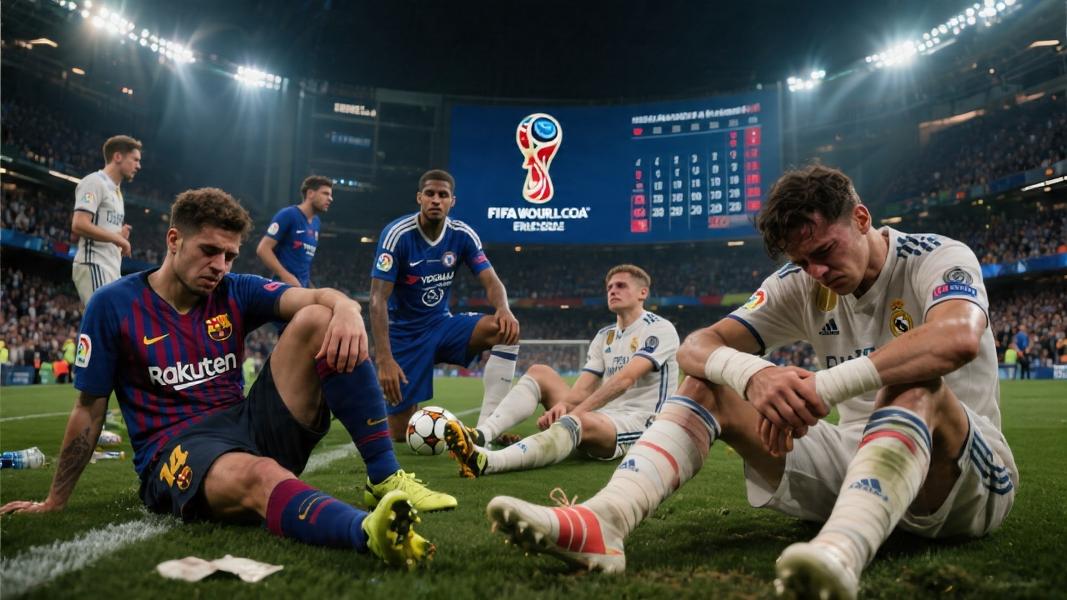
The injury list for World Cup 2026 keeps growing — and at this point, it’s starting to read less like a casualty report and more like a eulogy for what the tournament could have been.
With the 2026 FIFA World Cup set to kick off across the United States, Canada, and Mexico this summer, a string of serious injuries has already stripped several national teams of key players — some young stars, some seasoned veterans, and at least one whose story carries a particularly painful twist. From torn ACLs to fractured spines, the damage has been wide, swift, and, for many of these players, heartbreaking.
A Son’s Season Ends in the Worst Way Possible
Perhaps the most striking story belongs to Jonathan Klinsmann, the 27-year-old Cesena goalkeeper and son of German legend Jürgen Klinsmann. Playing in a Serie B match, Klinsmann suffered a fracture to his first cervical vertebra — a broken neck — along with a cut to the head. He confirmed the severity himself, writing on Instagram: “Unfortunately my season came to an end on Saturday. During the match I suffered a fracture to my spine which will sideline me for a while.” That calm, measured phrasing barely conceals what is an extraordinarily serious injury. He’s been ruled out of contention for the United States national team’s World Cup squad entirely.
Brazil’s Nightmare Keeps Compounding
If there’s one nation that’s taken the hardest collective hit, it’s Brazil. The Seleção has watched two of its most exciting attacking options disappear within weeks of each other. Rodrygo, the 25-year-old Real Madrid forward with 37 caps, tore his ACL during a La Liga match against Getafe in March. Gone. Then came the blow that stunned even the most stoic Brazilian supporters.
Estêvão — the 18-year-old Chelsea sensation who had already earned 11 senior caps despite barely being old enough to rent a car — suffered a grade four hamstring tear in April against Manchester United. A full tear. Six months of recovery, minimum. That’s not a setback; that’s a lost chapter. Both players had been considered near-certainties for Brazil’s squad, and now neither will be in North America this summer, as confirmed by multiple outlets tracking the squad situation.
Argentina Feels It Too — Repeatedly
How bad is it for Argentina? Bad enough that the defending world champions are losing players at an almost comical rate. Juan Foyth, the Villarreal defender who lifted the trophy in Qatar in 2022, ruptured his Achilles in January and won’t be back until next season. His World Cup is over before it began. Sports Illustrated has noted his absence among the tournament’s most significant losses.
Then there’s Cristian Romero. The Tottenham Hotspur center-back picked up a knee injury on April 13th, and while he hasn’t been officially ruled out yet, the timeline is tight and the prognosis is uncertain. A lengthy recovery looms. Argentina’s coaching staff will be watching that one nervously right up until squad announcement day.
Still, the cruelest story from the Argentine camp might be Joaquín Panichelli‘s. The Strasbourg forward, who had only just made his senior debut for the Albiceleste in November, tore his ACL — for the second time in two years. Two years. Two ACLs. At 22. It’s the kind of luck that makes you wonder what a player did to deserve it. He’s out, as documented across coverage of the tournament’s growing absentee list.
And then there’s Valentín Carboni, the 21-year-old midfielder currently on loan at Racing Club, who also tore his ACL in February. Despite having earned senior caps for Argentina already, he won’t get the chance to add to them this summer. Vanguard has listed him among the ten most significant World Cup absentees due to injury.
Young Talent, Older Losses
Spain will also be without one of its most exciting young forwards. Samu Aghehowa, the 21-year-old Porto striker, had been on a remarkable run — 13 goals in just 20 league appearances — before his ACL gave way in February during a match against Sporting CP. It was the kind of form that makes national team coaches giddy. Now it’s the kind of absence that forces a rethink of the entire attacking setup heading into the tournament.
And from West Africa, Mohammed Salisu — the 26-year-old Ghana defender with 22 caps and a stint at Southampton on his résumé — suffered an ACL tear back in January. Nine months of rehabilitation. He won’t be in the tournament either, a blow to a Ghanaian side that will need defensive solidity if it hopes to make a deep run.
The Bigger Picture
That’s the catch with a summer tournament hosted across a continent-sized stage: the build-up is long, the season is brutal, and the margin between glory and a surgeon’s table is thinner than anyone wants to admit. These aren’t freak occurrences in isolation — they’re the compounding toll of a football calendar that simply doesn’t stop. ACLs, Achilles ruptures, fractured vertebrae. The list of injuries reads like a trauma ward intake log, not a sporting update.
Coaches will adjust. Squads will be reshuffled. Other players will get chances they might never have otherwise received. That’s football. But for Estêvão, for Rodrygo, for Panichelli tearing the same ligament twice before his career has properly begun — no tactical reshuffle makes that sting any less. The 2026 World Cup will still be spectacular. It just won’t be the tournament it was supposed to be.
