
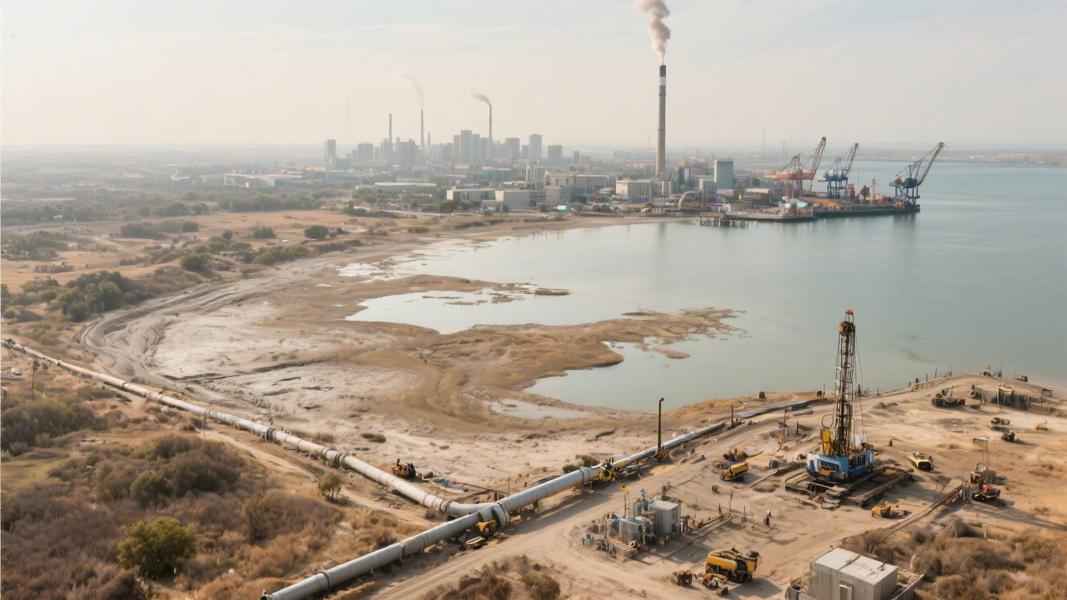
A South Texas city is careening toward a water emergency decades in the making — and now the state’s governor is threatening to take over.
Corpus Christi is staring down a crisis that’s hard to overstate. Lake Corpus Christi, the city’s primary reservoir, has dropped to just 10% capacity — the lowest level recorded since the lake was constructed in 1958. That’s not a drought statistic. That’s a structural failure playing out in slow motion, in public, with millions of people watching.
The Clock Is Running
City officials have acknowledged that a Level 1 Water Emergency could be triggered within months — specifically, 180 days before projected depletion. Functional failure, the point at which the system can no longer reliably deliver water, is expected to arrive before the reservoir actually runs dry, potentially as soon as next year. The distinction matters, but not as much as some officials might hope. Running low and running out are both catastrophic. The difference is mostly a matter of timing.
Into that vacuum stepped Governor Greg Abbott, and he didn’t come quietly. In remarks that have since spread widely, Abbott laid the blame squarely on local leadership, pointing to a staggering sum of state money he says went nowhere. “We were actually working with Corpus Christi in advance,” Abbott said. “We provided them with $750 million… three quarters of a billion dollars in funding for them to address their water problem. You know what they did? They squandered it. We can only give them a little time more before the state of Texas has to take over and micromanage that city and run that city.”
That’s a remarkable thing for a governor to say about one of the state’s largest cities. A threat of state takeover isn’t political theater — or at least, it’s not only political theater. It carries real administrative and legal implications, and it signals just how badly relations between Austin and Corpus Christi have deteriorated.
The City Pushes Back
Still, city leaders aren’t accepting that characterization without a fight. Corpus Christi officials have pushed back on what they call a misleading picture of inaction, pointing to an active and ambitious slate of projects already underway. “We understand the Governor’s frustration and sense of urgency to bring seawater desalination online,” the city responded, “and we continue to work on desalination options. In the meantime, the City is not merely planning; we are executing a $1 billion portfolio of water initiatives designed to provide generational stability. Several of these projects are already producing water, with additional capacity expected to come online gradually over the next 24 months.”
The city’s statement also pushed back on apocalyptic framing, insisting that Corpus Christi will not simply run out of water next year. Desalination projects at Inner Harbor, Harbor Island, and the Barney Davis Power Plant are all in various stages of development, officials say, and the city’s infrastructure strategy is built specifically to be drought-proof — not dependent on a reservoir that’s now sitting at historic lows.
So Who’s Right?
Honestly? Both sides have a point, and that’s what makes this so frustrating to watch. The governor isn’t wrong that a decade passed, money flowed in, and the reservoir still hit a record low. The city isn’t wrong that desalination is expensive, complicated, and slow — and that several projects are, in fact, now producing water. But none of that changes what the lake looks like today. It doesn’t change the timeline bearing down on the city’s roughly 330,000 residents, or the broader regional ripple effects for neighboring communities that rely on Corpus Christi’s water infrastructure.
There’s a version of this story where the city’s $1 billion portfolio comes online in time, the desalination plants ramp up, and Corpus Christi threads the needle. There’s another version where the projects take longer than projected — as infrastructure projects almost always do — and the city hits functional failure before the cavalry arrives. Right now, both versions are still possible. The next 24 months will determine which one gets written.
What’s already written, though, is the record. Ten percent capacity. The lowest in 67 years. That number doesn’t care about press releases from either side.
