
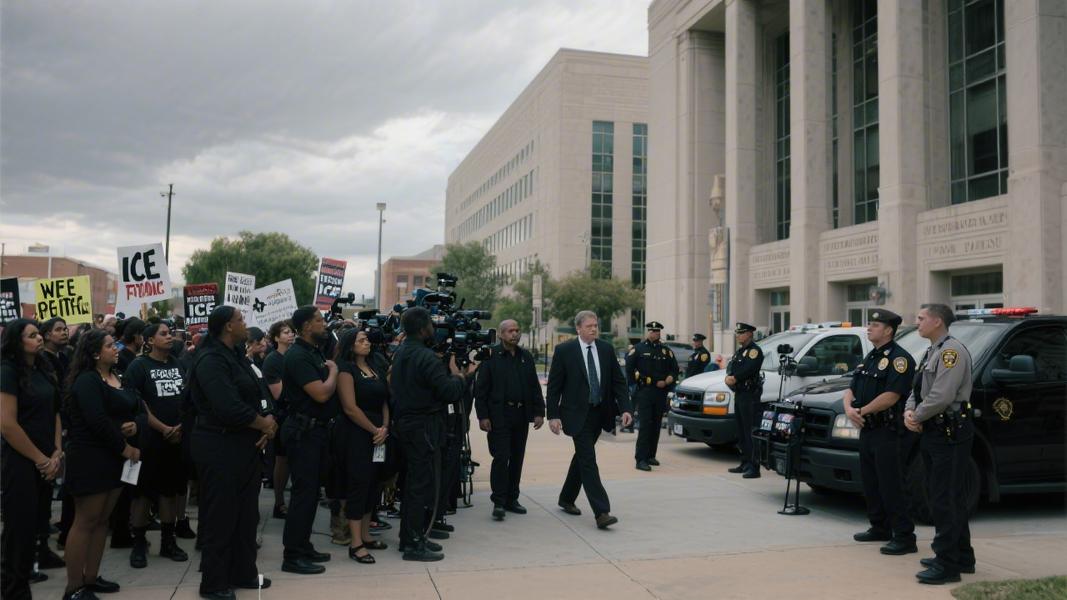
A Fourth of July that was anything but celebratory. On the night the country lit up its skies, a far darker scene unfolded outside a federal immigration detention facility in a small Texas town — and now nine people are sitting in a federal courtroom answering for it.
The trial stemming from the July 4, 2025 attack on the Prairieland ICE Detention Center in Alvarado, Texas has become one of the most politically charged federal prosecutions in recent memory. Prosecutors say it was a coordinated ambush. Defense attorneys say it was a protest that the government is twisting into something it wasn’t. What’s not in dispute: a police officer got shot in the neck, and the people who showed up that night came prepared for something a lot more serious than holding signs.
What Happened That Night
Around a dozen individuals — described by officials as wearing black military-style clothing — descended on the Prairieland facility on the evening of July 4th. They set off fireworks, vandalized vehicles, and then someone opened fire. Alvarado Police Department Lt. Thomas Gross was responding to a 911 vandalism call when he was shot in the neck. He survived. He’s back on duty. But the bullet came close enough to make everyone pay attention, and officials have since described the incident as “an egregious and coordinated attack against law enforcement.”
The gear recovered afterward told its own story. Investigators found AR-style rifles, twelve sets of body armor, two-way radios, spray paint, and — perhaps most telling — a Faraday bag, a device specifically designed to block cellphone signals. Searches of vehicles tied to the defendants and the surrounding area yielded the full inventory. It’s a strange shopping list for a peaceful demonstration.
A Historic Prosecution
Nine defendants are now on trial. The case has already made legal history: it’s considered the first federal indictment to involve Antifa-related domestic terrorism charges. That alone has made it a flashpoint — not just in the courtroom, but in the broader national argument over where protest ends and criminality begins. Charges include attempted murder of federal officers and multiple firearms offenses.
That’s the catch, isn’t it? The government’s case rests on proving intent — that this wasn’t a demonstration that got out of hand, but a planned attack from the start. And they believe the evidence makes that argument for them.
The Prosecution’s Case
In closing arguments, Assistant U.S. Attorney Shawn Smith didn’t mince words. He pointed to the all-black clothing, the weapons, the radios, the first aid kits — and asked the jury to think hard about what kind of protest requires that kind of preparation. “Why hide yourself? Why are you bringing weapons? There was no evidence of counter-protesters. Rifles, pistols, radios, first aid kits — why do you bring that stuff to a peaceful protest?” Smith argued in court. He also alleged that defendant Benjamin Song orchestrated the plan specifically to engineer a confrontation with law enforcement.
It’s a compelling frame. The prosecution is essentially telling jurors: look at what they brought, and ask yourself what they were planning to do with it.
The Defense Pushes Back
Still, defense attorneys aren’t conceding the narrative. Their argument cuts in a different direction entirely — that the government is criminalizing political opposition under the banner of counterterrorism. “The government is trying to put protestors in prison for being terrorists, something that hasn’t happened before,” one defense attorney contended during proceedings. They’ve framed the case as an unprecedented overreach, a warning shot aimed at anyone who might show up to protest federal immigration policy.
But it’s not that simple. Peaceful protesters generally don’t carry AR-style rifles or take steps to jam their phones. The defense has a steep hill to climb when the physical evidence is this specific.
A Courtroom Wrinkle
As if the case needed more drama, the first day of jury deliberations brought an unexpected complication. Unredacted body camera footage from the night of the incident was accidentally handed over to jurors — footage that included portions never officially entered into evidence. The judge moved quickly to address it. All twelve jurors confirmed they hadn’t watched the disputed segment, and deliberations continued. A near-miss, procedurally speaking. Whether it ultimately affects the outcome remains to be seen.
Lt. Gross, for his part, has returned to the job. He recovered from a gunshot wound to the neck and walked back into the Alvarado Police Department. That’s not a small thing. And as the jury weighs what happened on that holiday night in a quiet Texas town, his survival may be the most consequential fact in the room — a reminder that whatever this was, it carried real, near-fatal consequences.
The question the jury will ultimately answer isn’t just whether these nine people are guilty. It’s whether America has a coherent legal framework for what happens when protest and violence share the same parking lot.
