
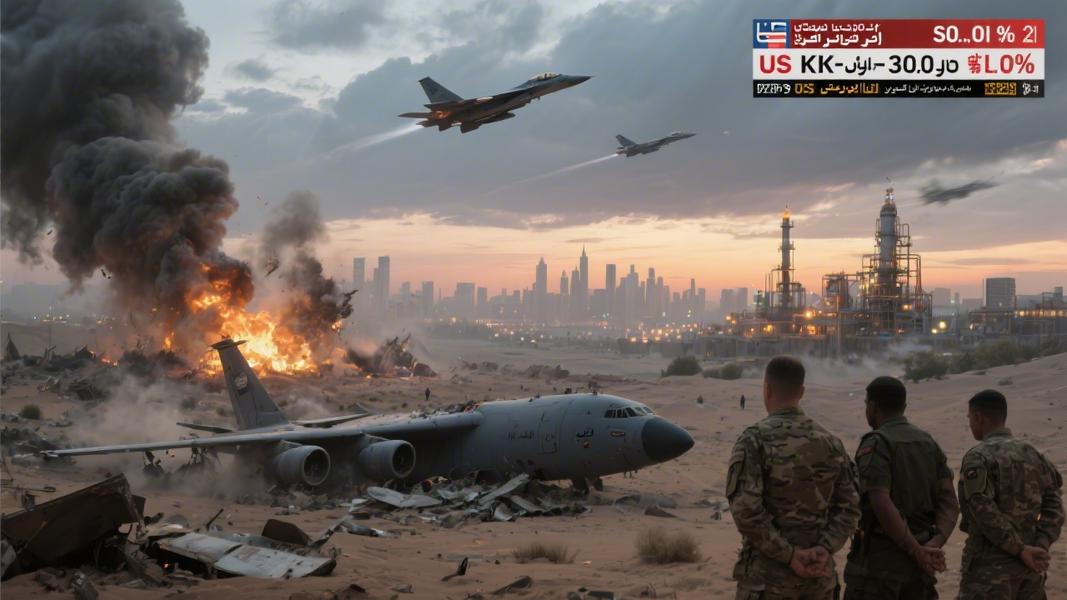
American warplanes hammered Tehran and its surrounding suburbs overnight, and oil markets are already in freefall — upward. Crude topped $100 a barrel for the first time in years as the United States escalated its campaign against Iran in what is rapidly becoming one of the most consequential military operations of the 21st century.
The strikes are part of a broader conflict that began on February 28, 2026, when U.S. and Israeli forces launched coordinated attacks under the codenames Operation Epic Fury and Operation Roaring Lion, targeting Iranian military infrastructure across the country. Since then, the war has chewed through Iran’s missile systems, naval assets, and the sprawling proxy networks Tehran spent decades building — at a cost of thousands of casualties on multiple sides. And it’s not slowing down.
Trump’s Words From the Oval
President Donald Trump left little ambiguity about his posture. In a post on Truth Social that ricocheted across global media, he wrote, “They’ve been killing innocent people all over the world for 47 years, and now I, as the 47th President of the United States of America, am killing them. What a great honor it is to do so!” It was the kind of statement that would have generated weeks of congressional hearings in a different political era. Right now, it’s Tuesday.
Trump also raised eyebrows when asked about Russian President Vladimir Putin potentially feeding Iran intelligence on U.S. assets. He didn’t exactly deny it. “I think he might be helping them a little bit, yeah, I guess,” Trump acknowledged, before pivoting to a kind of shrug-and-move-on logic: “And he probably thinks we’re helping Ukraine, right?” He confirmed the U.S. is still doing that too, adding, “It’s like, hey, they do it and we do it in all fairness.” Geopolitics, apparently, is a two-way street.
Four Airmen Dead in Iraq Crash
Not every casualty in this war comes from enemy fire. U.S. Central Command confirmed Thursday that four American service members were killed when a KC-135 refueling aircraft went down in western Iraq at approximately 2 p.m. ET on March 12. Gen. Dan Caine confirmed the crash occurred over friendly territory and was not the result of hostile or enemy action — an accident in the middle of a war, which somehow makes it more jarring, not less.
Defense Secretary Pete Hegseth, visibly somber but unbowed at the Pentagon briefing, said “war is chaos” and that the sacrifice of those killed “will only recommit us to the resolve of this mission.” He and Caine both made clear the mission isn’t winding down. Iran’s defense production infrastructure, Hegseth confirmed, “will soon be destroyed.”
The Strait of Hormuz: A Chokepoint on Fire
Iran closed the Strait of Hormuz — through which roughly a fifth of the world’s oil supply passes — and the economic consequences are already being felt at every gas station from Houston to Hamburg. Hegseth said the U.S. is working to ensure energy flows resume, adding tersely, “we’re dealing with it.” Trump went further, hinting at American naval escorts for commercial vessels attempting to transit the strait. That’s an enormous escalation in itself, if it happens.
Gen. Caine said the military’s immediate priority is dismantling Iran’s minelaying enterprise in the strait — the mechanism by which Tehran has turned one of the world’s most vital shipping lanes into a kill zone. It’s a military objective with a direct line to the global economy, and Washington knows it.
Iran’s Leadership, Wounded and Underground
How bad is it inside Iran? Bad enough that the country’s new Supreme Leader, Mojtaba Khamenei, is reportedly wounded and, according to Hegseth, likely disfigured following recent strikes. The Pentagon noted that Iranian leadership has gone underground in the wake of coordinated U.S. and Israeli strikes that have systematically disrupted the country’s command structure. The Islamic Republic’s government, once a deeply entrenched theocratic apparatus, is now running its war from bunkers.
Still, that doesn’t mean it’s over. Trump warned of even harder strikes coming in the week ahead, a signal that whatever the U.S. has done so far — and it’s been substantial — is apparently just the opening act. Combined U.S.-Israeli operations have already degraded Iran’s military capacity in ways that would have seemed unimaginable even a year ago, but Iran’s capacity to cause chaos, in the strait, through proxies, or through asymmetric means, hasn’t been extinguished.
A War With No Clean Edges
That’s the catch. Military campaigns with clear objectives and messy geopolitical realities rarely end the way the architects imagine. Russia is reportedly in the mix, at least tangentially. China is watching. Oil is above $100. Four American airmen are dead — not in combat, but in the machinery of war all the same. And the President of the United States is posting victory laps on social media while the bombs are still falling.
Whatever comes next — U.S. naval escorts, harder strikes, a fractured command structure in Tehran — the world in March 2026 looks nothing like it did in January. The question now isn’t whether this war has changed the Middle East. It’s whether anyone has a plan for what comes after.
