
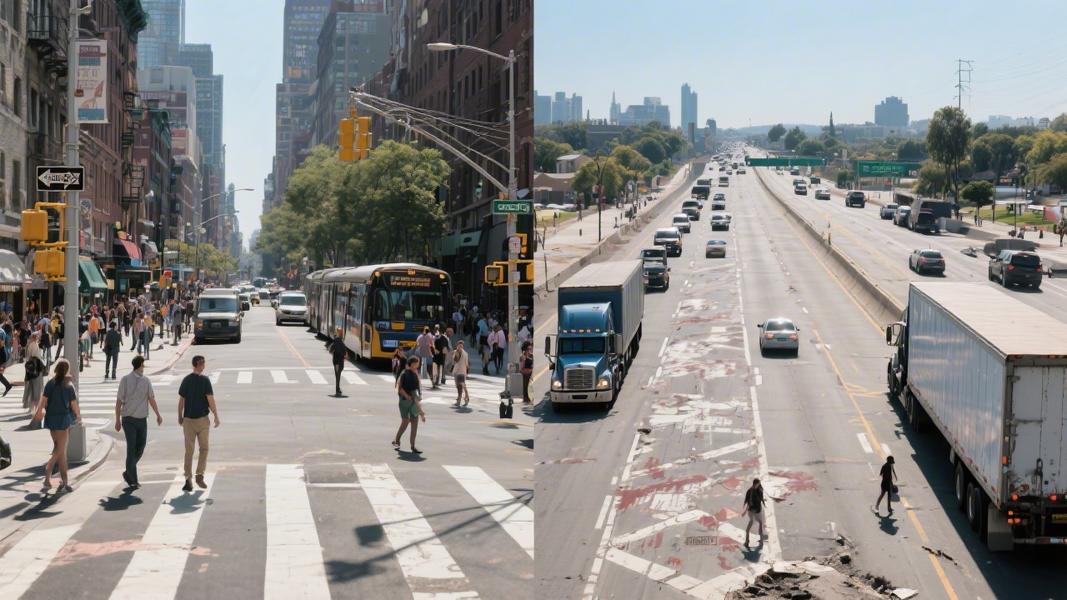
America’s streets are killing people — and the numbers make that hard to ignore. In 2023 alone, crashes resulting in injury or fatality reached a staggering 2.4 million nationwide, a figure that has renewed urgency around how cities design, manage, and think about their roads.
Now, a new benchmark is trying to cut through the noise. StreetLight Data has unveiled the U.S. Safe Streets Index, a comprehensive ranking of the 100 most populated metropolitan areas in the country across five weighted road safety factors: Vehicle Miles Traveled (VMT), Speed Differential, Speed-based Pedestrian Risk, Truck Activity, and Residential Speeding. It’s the kind of data portrait that transportation planners have long wanted — and that some cities probably weren’t hoping to see.
Who’s Leading — and Who’s Falling Behind
The results are striking, if not entirely surprising to anyone who’s spent time navigating a Sun Belt highway at rush hour. The New York, Boston, and Portland, Oregon metros claimed the top spots for overall street safety, according to the index. Larger, denser metros — the kind with robust transit networks and more compact street grids — tend to perform better across the board. That tracks with what urban planners have argued for decades: density, when done right, actually protects people.
Boston’s performance was particularly notable. As the index found, “Boston uniquely ranks in the top 30 for all five safety metrics” — a rare sweep that speaks to both its infrastructure design and the way drivers actually behave on its streets. It’s not just one good number. It’s consistent performance across every dimension the index measures.
Then there’s the other end of the spectrum. Sunbelt cities — sprawling, car-dependent, built around the assumption that everyone drives everywhere, fast — ranked lowest in the nation. That’s not a coincidence. Wider arterials, higher speed limits, and fewer pedestrian protections are baked into the DNA of many of those metros.
Why This Index Matters
So why build this index at all? StreetLight CEO Kevin Hathaway put it plainly: “Road safety is a top issue for planners, engineers, and consultants, but the way communities build and operate their transportation infrastructure varies dramatically,” he explained. The index is designed to give those professionals a consistent, comparable framework — something that doesn’t exist when every city is measuring safety differently, or not measuring it at all.
The five factors weren’t chosen arbitrarily. Each one captures a distinct dimension of risk. VMT reflects sheer exposure — the more miles driven, the more chances for something to go wrong. Speed Differential measures the variance between fast and slow vehicles, which is often more dangerous than outright speed alone. Pedestrian Risk flags how fast vehicles are moving on roads where people on foot are present. Truck Activity accounts for the outsized danger posed by heavy commercial vehicles. And Residential Speeding — arguably the most visceral of the five — captures what’s happening on the streets where people actually live.
Together, they paint a picture that’s more nuanced than a simple crash-count ranking. A city might have relatively few reported collisions but still score poorly on residential speeding — meaning the danger is latent, not yet fully realized. That’s a critical distinction for anyone trying to get ahead of the problem rather than react to it.
Data as a Tool for Change
StreetLight isn’t just publishing rankings and walking away. The company offers transportation analytics designed to help agencies pinpoint high-risk locations and prioritize improvements — using volume, speed, and multimodal data to move from diagnosis to action. For cities, that means being able to verify speeding concerns, analyze traffic patterns, and make the case for infrastructure changes with hard numbers rather than gut instinct, as their city-facing solutions demonstrate.
Still, data alone doesn’t fix a dangerous intersection. It doesn’t slow down a driver doing 55 in a 30. What it does — potentially — is make it harder for decision-makers to look away. When a city’s residential speeding problem is quantified, ranked, and published for anyone to read, the political calculus around road safety starts to shift. At least, that’s the theory.
The full index, covering all 100 metros across all five factors, is available in StreetLight’s published research reports. For anyone working in transportation planning — or for residents who’ve ever watched a truck blow through a stop sign on their block — it’s worth a look.
Because at the end of the day, 2.4 million crashes in a single year isn’t a statistic you can engineer your way around with better apps and dashboards alone. But knowing exactly where the danger lives? That’s at least a place to start.
