
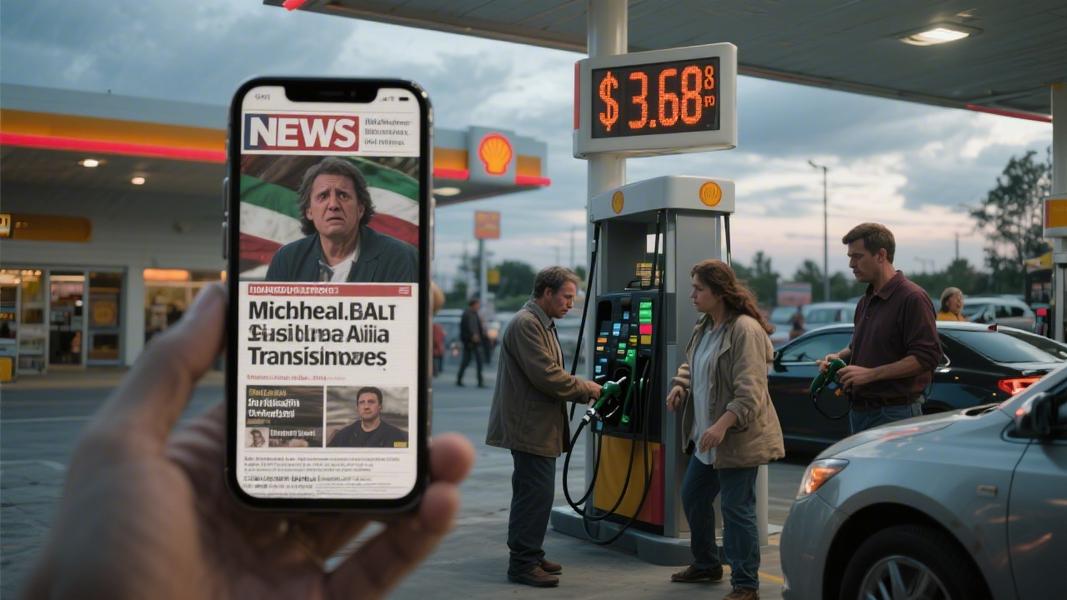
Gas prices are surging across the United States, and the culprit is thousands of miles away. Military strikes involving U.S. and Israeli forces against Iran have rattled global energy markets, sending prices at the pump to levels most Americans haven’t seen in months.
The national average price for a gallon of regular gasoline has jumped to $3.48 per gallon — nearly 50 cents higher than just one week ago. The spike follows U.S. and Israeli military action against Iran, which has sent shockwaves through oil markets and raised serious questions about the stability of one of the world’s most critical energy chokepoints.
Oil Breaks $100 — Then Keeps Going
It’s a number that tends to make economists nervous. Oil prices briefly surged past $100 per barrel — the highest mark in roughly two years — as traders priced in fears over potential disruptions to the Strait of Hormuz, the narrow waterway through which an estimated 20% of the world’s oil supply travels on any given day. That’s not a number you can easily reroute around.
Brent crude climbed as much as 13% to above $82 a barrel in the immediate aftermath of strikes on February 28, according to data cited by the World Economic Forum. That was just the beginning. In the days that followed, prices kept moving — and so did the numbers on signs outside every gas station in the country.
What Drivers Are Actually Paying
How bad is it, exactly? AAA, which tracks pump prices nationally, put the average at $3.25 per gallon as of this week — up 6 cents since yesterday and 27 cents since last week. “The national average is actually $3.25 per gallon — that’s up 6 cents since yesterday and 27 cents since last week,” an AAA spokesperson explained, noting that just days earlier the figure had already hit its highest point in more than three months at $3.19.
Still, those national figures can mask what’s happening in specific states. In Minnesota, the average price for regular gas hit $3.25 per gallon — up 7 cents from Friday alone and more than 40 cents higher than the week prior, with oil prices at one point nearing $120 per barrel, tracked by Minnesota Public Radio News.
The Hormuz Factor
But it’s not that simple — it never is with oil markets. The real anxiety isn’t just about what’s already happened. It’s about what could happen next. The Strait of Hormuz is the kind of geographic vulnerability that energy analysts lose sleep over. If that passage were disrupted — even briefly, even partially — the ripple effects on global supply chains would be severe and nearly immediate.
Right now, the strait remains open. But the threat alone has been enough to move markets in dramatic fashion. Traders don’t wait for disruptions to happen; they price in the possibility well in advance. That’s partly why Americans are already feeling the squeeze at the pump even as the conflict continues to unfold overseas.
No Quick Relief in Sight
For now, there’s little indication that prices will ease anytime soon. Geopolitical tensions rarely resolve themselves over a long weekend, and as long as uncertainty hangs over the Middle East, oil markets are likely to stay on edge. That means the summer driving season — already a perennial pressure point for gas prices — could arrive with a much heavier baseline than most forecasters anticipated just a few weeks ago.
The last time Americans dealt with sustained prices at this level, it reshaped spending habits, boosted demand for fuel-efficient vehicles, and became a defining political issue. Whether this spike is a sharp but temporary jolt or the beginning of a longer climb depends almost entirely on how the situation in the region develops — a variable that, at the moment, nobody can reliably predict.
In the meantime, the math is pretty straightforward for the average driver: fill up, hold on, and watch the news.
