
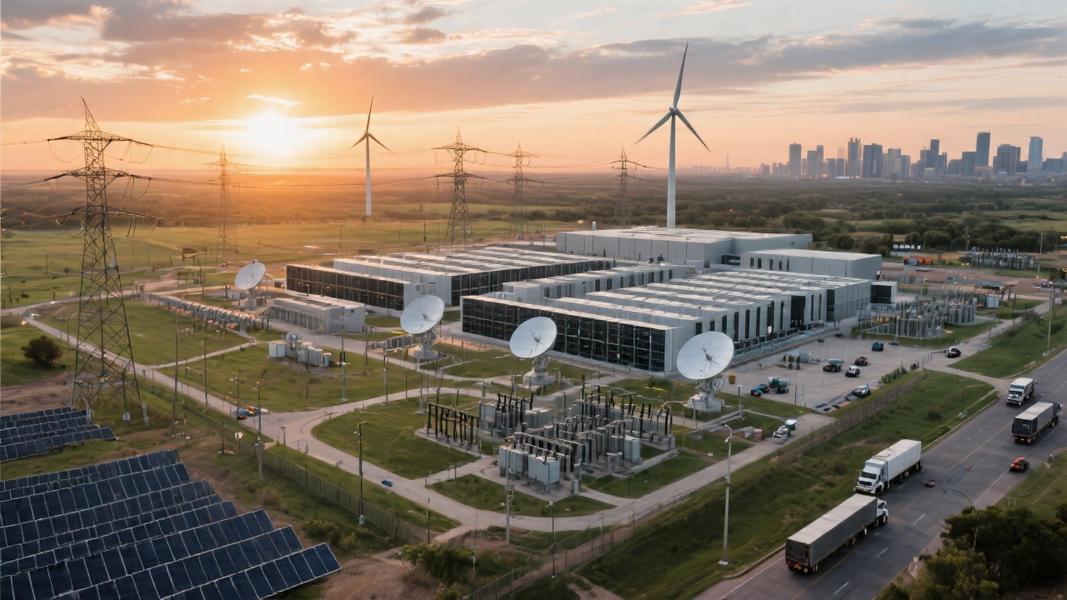
Texas is running out of runway — and the artificial intelligence industry is only picking up speed.
In less than twelve months, large load interconnection requests on the Texas power grid have exploded from 56 gigawatts to a staggering 205 gigawatts — nearly quadrupling in size. The culprit, if you want to call it that, is the insatiable appetite of AI-driven data centers, which are descending on the Lone Star State faster than its grid operators can process the paperwork. The stakes couldn’t be higher: Texas sits at the center of a collision between a booming technology sector and an infrastructure system that was never designed to handle this kind of demand.
A Number That Stops You Cold
Start with the raw figures. Interconnection requests — essentially, applications from developers who want to plug new facilities into the electric grid — are the clearest early signal of where industrial growth is heading. As one industry analysis noted, “That number almost quadrupled to 205 gigawatts within a year.” That’s not incremental growth. That’s a structural shift in what Texas is being asked to power.
To put that in human terms: the entire installed generating capacity of ERCOT, the grid that serves most of Texas, sits somewhere around 150 gigawatts. The pending requests alone dwarf it. Not all of those projects will be built, of course — many will stall, be withdrawn, or die quietly in the permitting process. But even a fraction of that demand materializing would place enormous pressure on a grid that’s already earned a reputation for operating close to the edge.
What AI Actually Costs in Electricity
How hungry are these facilities, really? Consider Google. The company’s global data center fleet, in 2024, likely consumed roughly twice as much electricity as the entire city of Austin — a metro of a million people and one of the most energy-intensive tech hubs in the country. And yet, as one detailed examination found, the company required only about one-fifth as much water. That’s a meaningful distinction in a drought-prone state where water rights battles have simmered for decades. Electricity, it turns out, is the bigger chokepoint — not water, despite what many local debates might suggest.
Still, it’s not just about consumption. It’s about concentration. When a single corporation’s server infrastructure outpaces a major American city’s energy draw, the implications for regional grid planning are profound. Texas isn’t hosting one Google. It’s hosting a wave of hyperscalers, co-location firms, and AI-focused startups all chasing the same low-regulation, land-rich environment that made the state attractive in the first place.
The Capital Behind the Current
Then there’s the money. Building a cutting-edge AI data center doesn’t come cheap — not even close. Industry figures suggest a cost of $25 million per megawatt of capacity, which means a single gigawatt-scale facility demands $25 billion in capital investment before a single GPU processes a single token. That’s a number that dwarfs the entire installed asset base of many rural utility systems, as analysts have observed. The private capital is clearly there — tech companies and their investors are deploying it at a pace that would have seemed fantastical five years ago.
But private investment in computing infrastructure doesn’t automatically translate into public investment in the transmission lines, substations, and generation capacity needed to actually power these buildings. That gap — between what the industry wants to build and what the grid can currently support — is where the real tension lives. Developers can break ground on a data center in months. Upgrading grid infrastructure takes years, sometimes decades, and involves a bureaucratic process that was designed for a very different era of energy demand.
What Comes Next
Texas has long prided itself on its deregulated, market-driven energy model. That model has delivered real benefits: competitive prices, rapid buildout of wind and solar, and a kind of entrepreneurial energy culture that matches the state’s broader identity. But a market built around residential and commercial load patterns wasn’t engineered for a future in which a single campus might draw as much power as a mid-sized city.
Renewable energy advocates argue that the answer lies in aggressive solar and battery storage deployment — that the same Texas sun that bakes the Hill Country in summer can, with enough investment, keep the servers cool and the lights on. Skeptics point out that intermittency remains a real problem, and that AI workloads demand the kind of around-the-clock reliability that weather-dependent generation can’t always guarantee on its own.
The honest answer is probably that there’s no single solution — just a long, expensive, politically complicated series of decisions about who gets to plug in, when, and at what cost to everyone else on the grid.
In the race to build the infrastructure of artificial intelligence, Texas may be the most important test case in the country. Whether it becomes a model or a cautionary tale depends on decisions being made right now — mostly in rooms that don’t get much press coverage, by engineers and regulators who are, quietly, running out of time.
