
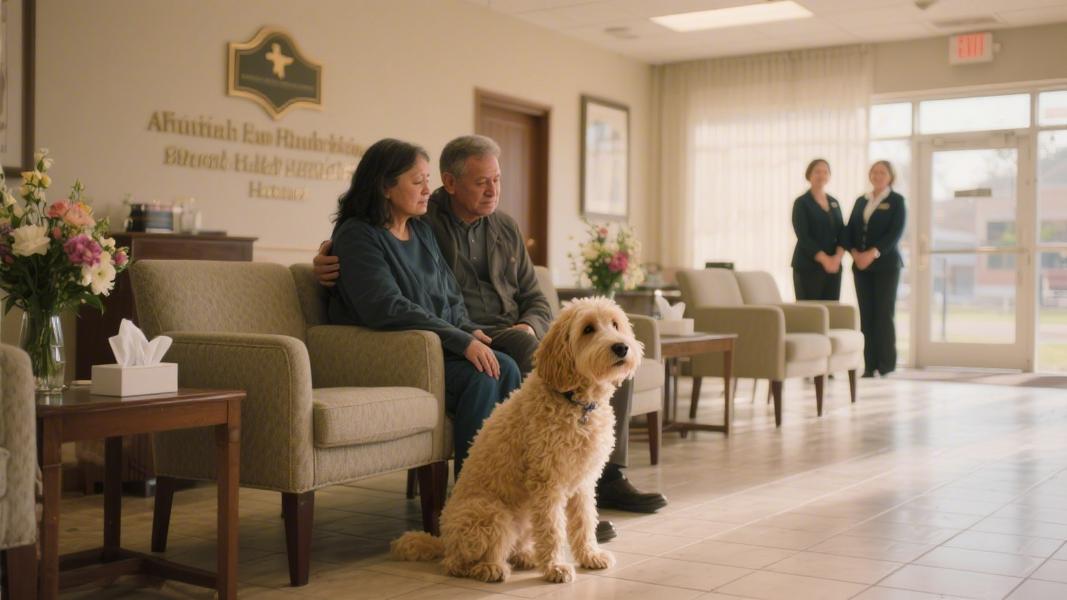
She doesn’t wear a badge, and she definitely can’t sign a death certificate. But at one North Texas funeral home, a fluffy golden puppy might be doing some of the most important work in the building.
Honey, an 11-month-old Goldendoodle, has taken up residence at Moore Funeral Home in Arlington, Texas, where her job description is both remarkably simple and quietly profound: show up, sit close, and stay as long as someone needs her. In an industry built around some of the hardest moments a family will ever face, the funeral home has made a deliberate choice to bring warmth — literal, fur-covered warmth — into the room.
A Different Kind of Staff Member
Grief, as anyone who’s lived through it knows, doesn’t follow a schedule. It arrives in waves, often at the worst possible moments, and it doesn’t respond particularly well to paperwork or protocol. That’s precisely where Honey steps in. As a noted by Moore Funeral Home, which operates under the Dignity Memorial network, Honey’s role is to greet families as they arrive, sit beside them during services, and offer the kind of quiet companionship that no human staff member — however compassionate — can quite replicate.
There’s something disarming about a dog. They don’t offer platitudes. They don’t fidget with discomfort the way people sometimes do around the grieving. They just stay. And in a funeral home, that stillness turns out to matter enormously.
Comfort dogs in professional settings aren’t entirely new — hospitals, courthouses, and college campuses have used therapy animals for years. But a permanent canine presence inside a funeral home is still a rare thing. It signals a shift in how some in the death-care industry are thinking about the experience of loss, and what support actually looks like in the moments that follow it.
The Logic Behind the Leash
Why a Goldendoodle? It’s not an accident. The breed is known for being hypoallergenic — or close enough — gentle, intuitive, and almost constitutionally incapable of being unfriendly. For a setting where families arrive already emotionally raw, those aren’t just nice qualities. They’re requirements.
At 11 months old, Honey is still technically a puppy, which means she brings an energy that’s soft rather than overwhelming, curious rather than demanding. She reads the room, in the way dogs inexplicably do, and adjusts accordingly. Beside a grieving widow, she’s calm. Around children who don’t fully understand why everyone is crying, she’s a gentle distraction — something warm and alive to focus on when everything else feels heavy.
Still, it’s worth acknowledging that not everyone is a dog person. Grief is personal, and so is comfort. What soothes one family might unsettle another. The funeral home’s approach, by all indications, is to let Honey be available rather than mandatory — present, but not intrusive. That balance, subtle as it sounds, is actually the whole trick.
Redefining What Funeral Homes Can Be
Moore Funeral Home’s decision to bring Honey on board reflects something broader happening across the funeral industry. Families today are looking for experiences that feel more human, more personalized — less clinical, less transactional. The days of the austere, hushed funeral parlor as the only model are giving way to something more varied, more responsive to what bereaved families actually say they need.
A comfort dog on staff is, in that sense, a statement of philosophy as much as it is a staffing decision. It says: we understand that grief isn’t just logistical. It says: we’re not just here to manage paperwork and coordinate services. We’re here to hold space for people while they’re falling apart.
That’s a harder thing to do than it sounds. And Honey, apparently, has a gift for it.
Small Paws, Lasting Impact
What makes Honey’s story resonate — beyond the obvious appeal of a fluffy dog doing meaningful work — is what it says about the nature of comfort itself. Human beings, especially grieving ones, often need something they can’t quite articulate. Not advice. Not solutions. Just presence. Just the wordless assurance that they are not entirely alone in the room.
Dogs have always understood that assignment better than most of us.
In Arlington, at a funeral home on an otherwise ordinary stretch of Texas suburbia, an 11-month-old Goldendoodle named Honey is showing up every day and doing exactly that — one quiet goodbye at a time. It’s a small thing, maybe. But then again, so is a hand on a shoulder. And sometimes, that’s everything.
