
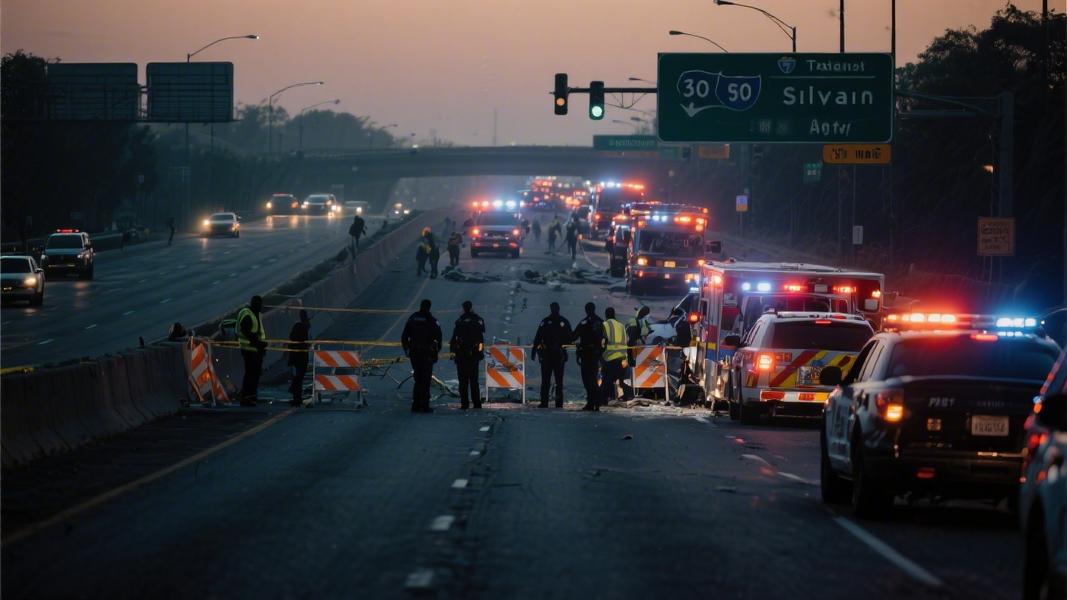
Three people are dead. The same stretch of highway. And the question nobody wants to answer out loud is whether anyone’s paying attention.
Interstate 30 — the artery that stitches Dallas and Fort Worth together across the heart of the Metroplex — has become the site of a troubling cluster of fatal pedestrian incidents in recent weeks. From predawn collisions in Dallas to a nighttime tragedy at a Fort Worth interchange, the corridor has claimed at least three lives since early February 2026, raising urgent questions about safety on one of North Texas’s most heavily traveled freeways.
Before Dawn in Dallas
The first incident unfolded in near-darkness. A pedestrian was struck and killed on I-30 near Sylvan Avenue in Dallas at approximately 4:45 a.m., with westbound lanes shut down entirely as crews worked to clear the scene. It’s the kind of crash that doesn’t make national headlines — but it should.
The Dallas County Sheriff’s Office confirmed the fatality and said the incident remains under investigation. No further details about the victim or the vehicle involved have been released. That silence, familiar in cases like these, leaves families and commuters alike without answers.
Fort Worth: A Driver Who Stayed
Then came February 1st. A 46-year-old man was on foot in the westbound lanes of I-30 at the I-30 and South Freeway interchange in Fort Worth when a Ford Explorer struck him at around 9:43 p.m. He didn’t survive. The driver, to their credit, remained at the scene. No charges or citations have been reported, and officials have not released additional details about the circumstances that put a man on foot in the middle of a freeway at night.
That last part matters. It always does. Was he disoriented? Did a vehicle break down? Was there nowhere else to go? These are the questions that rarely get answered in the brief official statements that follow tragedies like this one — and they’re the questions that could actually prevent the next one.
Dallas, Again — Two Weeks Later
Still, the deaths kept coming. On February 17, 2026, another pedestrian was killed on Interstate 30 — this time near North Hampton Road in Dallas, on the stretch locals know as the Tom Landry Freeway. The collision occurred around 8:30 p.m., according to reports. Details remain sparse, a pattern that’s become almost routine in these cases.
A separate account confirmed the same crash — same time, same location, same outcome. Three incidents. Three lives. Roughly three weeks.
A Corridor With a Body Count
How bad does it have to get? That’s not a rhetorical question. Traffic safety advocates have long flagged high-speed urban interstates as particularly deadly for pedestrians, especially at night and in areas where lighting, barriers, and emergency pull-offs are inadequate. I-30 through the Dallas-Fort Worth corridor checks several of those boxes.
None of these incidents, taken individually, is unusual in the grim statistics of American road fatalities. But three deaths on the same freeway in less than three weeks? That’s a pattern. And patterns, if nothing else, demand a response — from transportation officials, from law enforcement, from the public officials whose job it is to make these roads survivable.
Investigations are ongoing. Lanes have reopened. And somewhere on I-30, the traffic keeps moving — fast, relentless, and, for at least three people this winter, fatal.
