
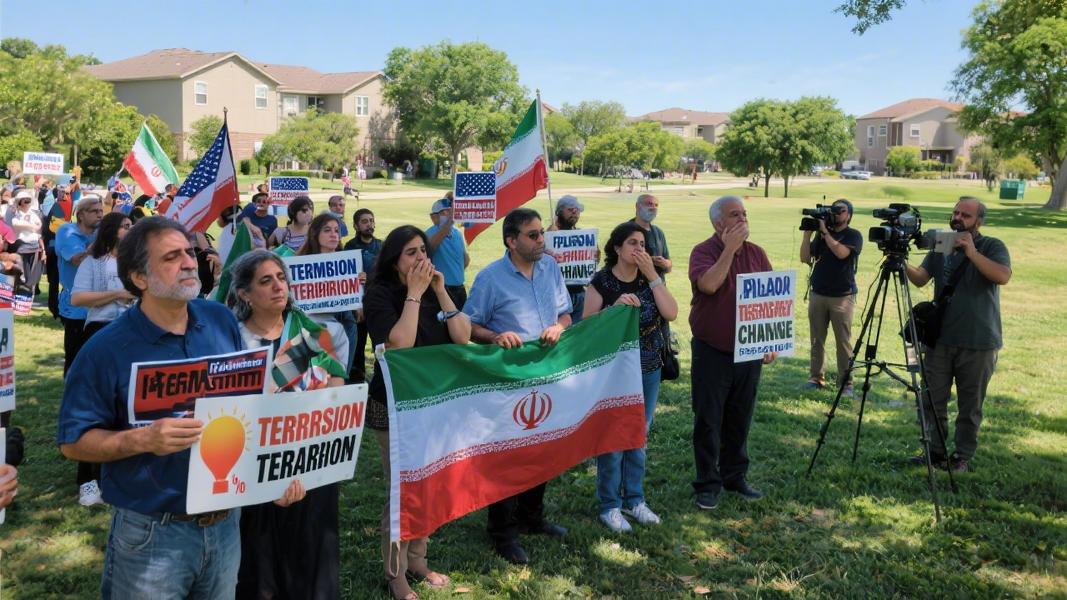
Every weekend, they show up. Flags, chants, photos of the dead — and a message that’s anything but simple.
Since hostilities between the United States, Israel, and Iran escalated into open conflict, Iranian Americans in the Dallas-Fort Worth area have been gathering in force, turning suburban Plano and downtown Dallas into unlikely stages for one of the most emotionally charged geopolitical debates playing out on American soil. The rallies, which intensified sharply around March 1, 2026, reflect a community that is deeply divided — and deeply invested — in what happens next to a country many of them or their parents once called home.
A War Some Are Welcoming
That might sound strange. War is war. But for a significant portion of the Iranian American diaspora in North Texas, the U.S. and Israeli strikes on Iran aren’t a tragedy — they’re a long-awaited crack in the wall. Demonstrators in Plano and Dallas have been waving flags and calling openly for regime change, celebrating the military campaign as a potential turning point after more than four decades of theocratic rule in Tehran. As one attendee, Michael Pima, put it plainly: reported by CBS News Texas, “Iran is going through a very difficult time at this time. There’s war, but it’s unusual to say that it is welcomed by the Iranians.”
That tension — mourning a country while hoping its government collapses — defines much of what’s happening at these gatherings. It’s not simple grief. It’s not simple celebration either.
Voices From the Pavement
Back in January 2026, before the strikes began in earnest, the Iranian American Community of Northern Texas had already taken to the streets of Dallas. Demonstrators carried photographs of activists and protesters killed by the Iranian regime, chanting slogans that rejected not just the current theocracy — but also any return to monarchy. The message, according to organizers, was unambiguous: they want a democratic republic, full stop. “Our community rallied in support of Iran’s uprisings, holding photos of those killed by the regime and echoing their voices for freedom and democracy,” the group stated in a release following the event.
Still, not everyone arriving at these rallies is there to cheer. Thousands poured into North Texas streets after the U.S. strikes began, and the crowd wasn’t monolithic. Some praised President Trump. Others carried signs warning of a wider, more catastrophic war. The same sidewalk, two very different fears.
Oil, Escalation, and the Bigger Picture
What’s the real-world cost of all this? Rising oil prices are already being felt at the pump, a reminder that conflicts in the Persian Gulf have a way of reaching into American wallets no matter how far away they seem. The prospect of the U.S. scaling back its military involvement has added another layer of anxiety — or relief, depending on who you ask — to these weekly gatherings in Plano.
North Texas, home to one of the largest Iranian American communities in the country, has become something of a barometer for diaspora sentiment. The rallies, documented by local radio and television outlets, have drawn participants from across the region — some driving hours to stand in a parking lot and hold a sign, because standing somewhere, saying something, feels like the only thing they can do from here.
Scenes from the protests have circulated widely on social media, amplifying voices that might otherwise stay local. And the crowds, captured on video by CBS News Texas, show a community that isn’t waiting for permission to be heard.
What Comes Next
But it’s not that simple — it never is. The Iranian American community doesn’t speak with one voice, and these rallies make that abundantly clear. There are those who believe military pressure is the only language the regime in Tehran understands. There are others who lie awake worrying about cousins, aunts, siblings still living inside Iran — people who have no say in where the bombs fall.
The flags will likely keep waving in Plano next weekend. And the weekend after that. Because for this community, the war didn’t start when the first U.S. missile launched — it started a long time ago, and they’ve been living with it, in one way or another, ever since.
