
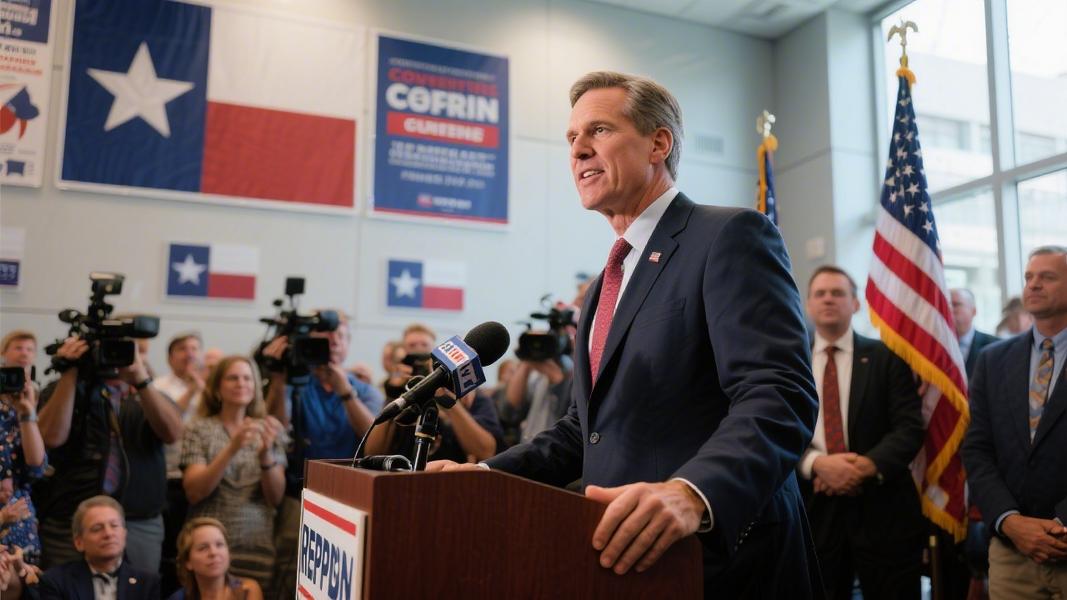
Jace Yarbrough didn’t just win the Republican primary for Texas’ 32nd Congressional District — he won it without even having to show up for the runoff. His would-be opponent bowed out, handed him the keys, and wished him luck in November.
That’s the short version. The longer one says something significant about where this race — and this redrawn district — is headed.
Yarbrough, a seventh-generation Texan, Air Force veteran, and constitutional lawyer, is now the GOP nominee for a North Texas seat that Republicans have been eyeing hungrily since redistricting scrambled the political map. His path to the nomination cleared dramatically on March 17 when Ryan Binkley — the independently wealthy CEO who’d loaned his own campaign more than $2.6 million — withdrew from the scheduled May 26 runoff rather than fight it out, as reported by Click2Houston.
A District Transformed
Here’s what makes this race worth watching: the 32nd District is barely recognizable from what it used to be. Under its old boundaries, it voted for Kamala Harris by 24 points. After redistricting, the same territory now leans toward Donald Trump by 18 points. That’s a swing of more than 40 points on paper — and it’s exactly why national Republicans have flagged it as one of five Democratic-held seats they’re targeting for a flip in 2026. The math, at least on the surface, is hard to argue with.
Still, maps don’t vote. People do.
Binkley, for his part, didn’t leave quietly or bitterly. In stepping aside, he threw his weight behind Yarbrough with genuine-sounding enthusiasm. “Jace and his team ran a disciplined campaign, and I am genuinely excited to see what he will accomplish for the people of District 32,” Binkley noted in his withdrawal statement. “Jace has my full support moving forward, and I look forward to seeing him win in November.”
The Man Behind the Nomination
So who is Jace Yarbrough, exactly? Depending on which part of his biography you lead with, the answer changes considerably. He’s a UT Austin and Stanford Law graduate who has spent years in courtrooms challenging vaccine mandates, DEI policies, and what he describes as religious discrimination. He co-founded a classical Christian academy. He’s a father of five. And he’s built his political identity squarely around the America First framework that’s defined Republican politics since 2016.
On his campaign website, Yarbrough frames his candidacy in explicitly Trumpian terms — not as an independent voice, but as reinforcement. “I’m stepping into the arena because President Trump needs reinforcements in DC to help deliver on his promises to the American people,” he wrote, “and keep the radical left from taking us backwards toward a distorted vision of America.”
His policy positions reflect that alignment closely: expanding domestic energy production, national reciprocity for concealed carry permits, opposition to vaccine mandates, legal immigration reform, a harder line on China, and a 100% pro-life stance. He’s also called for ensuring U.S. allies pay their fair share for defense — a recurring Trump-era demand that’s found new life in the current political moment.
The Primary Field That Was
It wasn’t always this clean. Before the March 3 primary, Yarbrough was one of several Republicans competing in what had become a genuinely crowded field. Binkley, Yarbrough, Paul Bondar, Darrell Day, and others squared off in forums and debates, each making the case that the newly drawn district needed their particular brand of leadership. At one candidate forum captured on video, Yarbrough told voters directly: “I’m running for Congress because our district needs leadership that really reflects their values right now. As you know, a lot of America is struggling — mainly financially.”
Binkley’s money didn’t save him. He finished second despite pouring millions of his own dollars into the race, then chose to step aside rather than grind through a runoff he apparently didn’t feel he could win. After Yarbrough emerged from the primary with the most votes, all seven of his former opponents — every single one — endorsed him. That kind of consolidation is rare, and it signals something about how unified the local GOP is heading into November.
What Comes Next
The Democratic side of this race still has its own primary process to work through, but whoever emerges will face a fundamentally different electorate than the one that made the 32nd a safe blue seat for years. The district’s transformation isn’t subtle — it’s seismic. And Republicans know it.
That said, flipping a seat on paper and flipping it on election night aren’t the same thing. Democrats will spend money here. They’ll make the case that the district’s character — suburban, educated, economically diverse — doesn’t match the hard-right profile Yarbrough is running on. Whether that argument lands is a question that won’t be answered until November.
For now, Yarbrough heads into the general election with something most candidates spend months trying to build: a unified party, a favorable map, and the kind of momentum that comes from winning without having to fight a second time. Not a bad place to start. Whether it’s enough is another matter entirely.
