
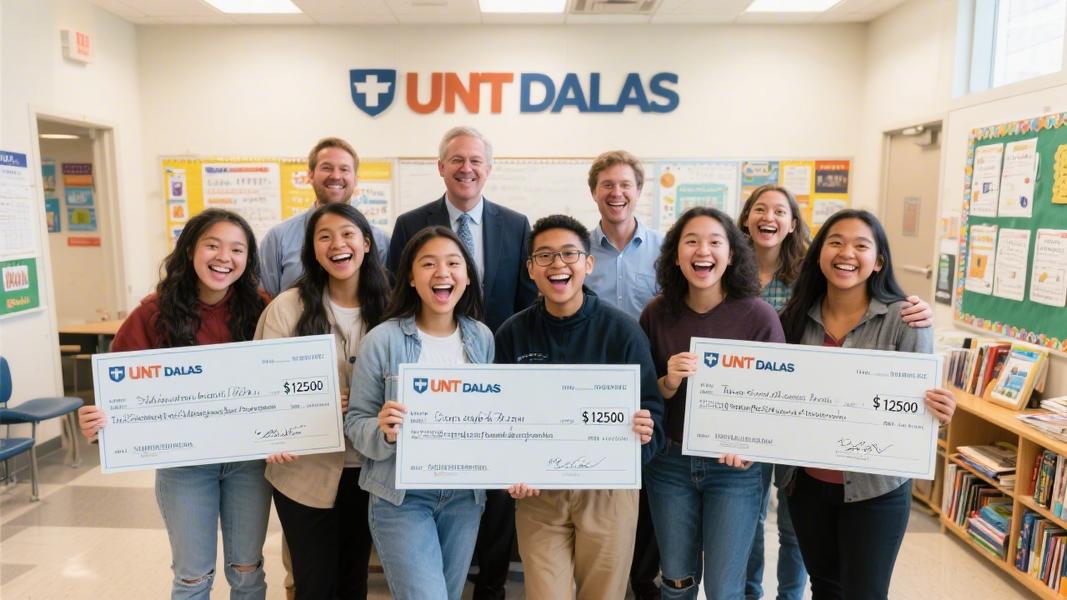
Nine student teachers at the University of North Texas Dallas didn’t expect much on an ordinary campus day. What they got instead were $12,500 checks — and, for some, the first real financial breathing room they’d had in months.
The surprise awards, funded directly by UNT Dallas, went to seniors enrolled in the university’s teacher residency program who are currently completing unpaid clinical teaching semesters in North Texas classrooms. The university says the one-time payments are designed to ease the financial strain of full-time, uncompensated student teaching — a burden that falls disproportionately on first-generation college students who can’t afford to simply stop working. Given the region’s persistent shortage of certified educators, the stakes extend well beyond the nine recipients.
“During your clinical teaching semester, you’re in the classroom five days a week, so working is very difficult,” said Laryssa Medina, one of the recipients, who is on track to graduate in May 2026. For students like her, juggling a job alongside a full-time classroom placement isn’t just exhausting — it’s often impossible. The check, she said, was something else entirely. “For me, this check means everything. I mean, it’s a wonderful blessing that I’ve been granted.”
A Financial Gap That’s Hard to Overstate
To understand why $12,500 matters so much here, it helps to know what these students are working with otherwise. UNT Dallas’s need-based institutional grant averages just $600 per academic year. The federal TEACH Grant, which requires a four-year commitment to teach in high-need fields at low-income schools, provides up to $4,000 annually — but comes with strings attached and still leaves a significant gap during the unpaid clinical semester. The $12,500 one-time award exceeds both, and it arrives precisely when students need it most: during a semester when earning a paycheck is structurally off the table.
Recipient Alanna Baker put it plainly. “I got to quit my job,” she said, “so now I just go to school and have more time to study for my certification exam.” That’s not a small thing. For students managing rent, groceries, and transportation while spending every weekday in a K-12 classroom, the ability to stop splitting focus is, in practical terms, transformative.
The federal grant landscape for aspiring teachers does include options beyond the TEACH Grant — Pell Grants, Federal Supplemental Educational Opportunity Grants (FSEOG), and the Iraq and Afghanistan Service Grant among them. Eligibility for most requires a completed FAFSA; the TEACH Grant additionally requires a 3.25 GPA or a passing score on a relevant content exam, plus admission to a Teacher Education Program. Students navigating the 2025-2026 aid cycle have also been reminded that summer 2026 funding requires an Expected Enrollment Form submitted by July 17, 2026, per university guidance. The verification paperwork alone — Dependent Household Size forms, Independent Household Size forms, Tax Filer Status Verification — can be a maze for first-generation students without a roadmap.
That layered complexity is exactly why a direct, no-strings check from the institution carries weight that grant applications simply don’t.
The Shortage Behind the Investment
North Texas isn’t just short on teachers. It’s short on the right kind. Emily Waneck, UNT Dallas’s Director of Clinical Practice, was direct about the distinction. “There’s definitely a teacher shortage, but I’ll say it’s more specifically a shortage of qualified teachers,” she said. “There’s a shortage of certified teachers. We’re pushing out fully certified teachers into the local school districts.”
That framing matters. Filling classrooms with warm bodies isn’t the goal — producing educators who are credentialed, prepared, and likely to stay is. Research consistently shows that residency-style clinical experience improves both teacher retention and student outcomes, which is why UNT Dallas has been working to expand and formalize its model. The program currently offers certifications in EC–6 ESL, EC–6 Bilingual, and EC–6 paired with an EC–12 Special Education Specialist endorsement — credentials that directly address documented gaps in the region’s teacher workforce.
Partner districts include Dallas ISD, Denton ISD, and Fort Worth ISD, with eligibility for the residency track requiring a minimum 2.75 GPA, completed TSI assessments, and admission to the Teacher Education Program, among other criteria.
Paid vs. Unpaid: A Growing Debate
Here’s where the picture gets more complicated. Not all teacher residents are working for free. In a 2024-25 pilot program, UNT Dallas partnered with Dallas ISD to pay five education majors $30,000 for the school year — with full benefits and Teacher Retirement System contributions included. That’s a meaningfully different proposition than an unpaid semester supplemented by a one-time check, however generous.
The UNT main campus in Denton runs its own residency program paying participants roughly $20,000 for a full year of classroom employment in partner districts. The Dallas-ISD pilot, at $30,000 with benefits, goes further still — and includes TRS credits that begin building a teacher’s retirement foundation before they’ve even earned their first full-year salary.
The $12,500 checks don’t replicate that. But they represent the university putting institutional money behind a cohort that, until now, was navigating the hardest semester of their training without compensation. Dr. Christine Remley, Dean of the UNT Dallas School of Education, has been candid about the program’s ambitions. “We are thrilled to bring this opportunity to the students at UNT Dallas,” she said when the Dallas ISD pilot launched. “The research indicates that candidates who complete a residency-type clinical experience drive increased teacher retention and student learning. The district, the student teachers, and most importantly, the students will benefit from this arrangement.”
Earlier participants in the paid pilot echoed the sentiment. “It’s so exciting to be able to go into a classroom,” said Valerie Castaneda, one of the 2024-25 cohort members. “Ultimately, I know that through this program, I will gain invaluable experience that will help me in my career.” Marlene Tello Fabian, another participant, said she hoped to “learn many new skills that will be beneficial to me as I become a teacher and gain great connections and collaborate with other teachers and administrators.”
The broader trajectory points toward a more formalized, potentially compensated model — one that could eventually seek Texas Education Agency approval as a recognized residency route. That process takes time, and in the interim, surprise checks may be the most direct tool available.
More Than a Paycheck
Still, ask the recipients what this semester is actually about and the conversation shifts quickly from finances to something harder to quantify. Medina, who’s spending her days in a classroom of kids who may not have many reliable adults in their lives, described what draws her to the work. “It’s giving the students a trusted adult because not every student has that,” she said, “and being that for students is so important.”
That’s the reason any of this matters — not the grant comparisons or the TRS credits or the dollar figures stacked against each other. The students getting these checks are weeks away from becoming the certified teachers North Texas schools are desperate for. Keeping them financially solvent long enough to get there isn’t charity. It’s infrastructure.
Whether $12,500 is enough to close the gap — or whether paid residencies eventually become the standard — is a question the university is still working out. For now, nine student teachers have a little more room to breathe, and the kids in their classrooms have a trusted adult who showed up.
