
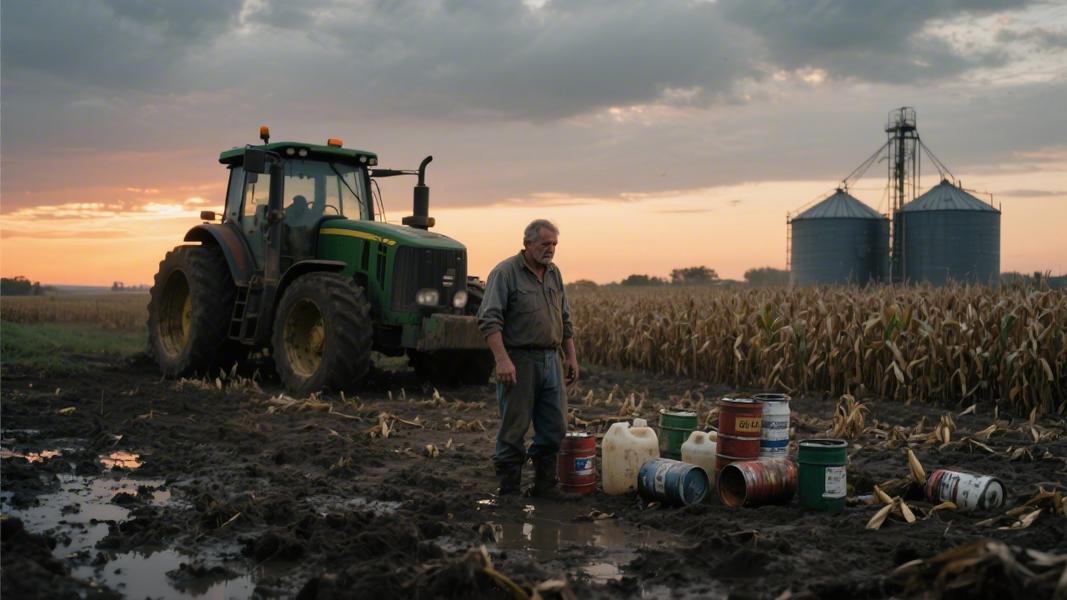
Lance Lillibridge has been farming in Vinton, Iowa, long enough to know that bad years come with the territory. This one, he says, is different.
Since the United States went to war with Iran on February 28, the cost of running his operation has surged roughly 25 percent compared to last year — driven by skyrocketing diesel and fertilizer prices that show no signs of coming down. “It couldn’t have come at a worst time,” Lillibridge said. He’s not alone in feeling that way.
Across the American heartland, farmers are being squeezed from multiple directions at once. The Iran conflict has sent energy and agricultural input costs into territory that many operations simply can’t absorb — layered on top of an already brutal stretch that included tariff disruptions, USDA budget cuts, and thinning profit margins. The result is a farm economy that’s cracking under pressure, with consequences that will eventually land on every grocery store shelf in the country.
The Numbers Are Stark
The math isn’t subtle. Ammonia fertilizer prices have climbed 20 percent since the war began, while urea — another critical nitrogen source — is up 50 percent, according to Oxford Economics. Diesel, the lifeblood of virtually every farm operation, has risen 43.5 percent, per AAA data. Anhydrous ammonia, a staple nitrogen fertilizer for corn growers, has crossed $900 per ton, a threshold that analysts at the University of Illinois flagged as a serious threat to 2026 corn and soybean returns.
And here’s the cruel twist: most farmers had already locked in their 2026 inputs before prices exploded. They’re not just paying more going forward — they’re managing the fallout from purchases made under entirely different economic assumptions.
Scott Marlow, an agricultural policy expert and former USDA deputy administrator, put it plainly. “This situation is not driven by either the person producing the food or the person buying it,” he noted. “It really impacts the cost of every step of the process, all the way from seed, all the way through to finished product, which affects the price when it gets to your grocery store.” That’s the chain that connects a war in the Middle East to a higher price tag on a box of cereal in suburban Ohio.
The Strait of Hormuz Problem
Why is a conflict thousands of miles away hitting Iowa farmers this hard? A significant part of the answer runs through a narrow stretch of water in the Persian Gulf. The closure of the Strait of Hormuz — through which roughly one-third of the world’s fertilizer trade passes — has choked off supply chains that American agriculture depends on more than most people realize. A single Qatari facility that routes product through the strait supplies approximately 20 percent of the fertilizer used by U.S. farmers, according to reporting on the broader agricultural crisis. Nitrogen fertilizer prices alone are up 29 percent — about 20 cents per unit — since hostilities began.
The disruption to global energy markets compounds everything. Diesel prices don’t just affect what farmers pay at the pump — they ripple through transportation, processing, and distribution costs across the entire food system. “When farmers face supply shortages or major price increases, those impacts ripple through the entire food chain,” said Zippy Duvall, president of the American Farm Bureau Federation, who warned that consumers shouldn’t expect to be insulated from what’s happening in farm country.
Bankruptcies Are Rising Fast
How bad is it? U.S. farm bankruptcies increased 46 percent in 2025 compared to 2024, according to the American Farm Bureau Federation. That figure predates the full impact of the Iran war — meaning 2026 could look considerably worse.
Vanessa Garcia Polanco, who has been tracking the agricultural stress closely, described a cascading effect that’s pushing farmers past the breaking point. “All the stress that we have seen compounding from last year has really driven more farmers to bankruptcy, to take on more loans, or just actually stop farming altogether,” she explained. The war didn’t create this crisis, but it arrived at exactly the wrong moment — landing on an industry already battered by tariff fights, shrinking federal support, and years of tight margins.
Mike Lavender, another voice from within the agricultural community, acknowledged the industry’s built-in tolerance for hardship. “Farming is an inherently risky business,” he said — but what’s unfolding now, he stressed, is “something different.” That’s not a phrase farmers use lightly.
What Comes Next
Still, the full weight of these cost increases may not be visible yet. Most of the 2026 planting season’s inputs were purchased months ago, which means the real reckoning — what happens when farmers try to plan for 2027 under these conditions — is still ahead. Analysts project significant pressure on corn and soybean returns this cycle, and if the Strait of Hormuz remains closed or contested, there’s little reason to expect relief anytime soon.
For Lillibridge and the thousands of farmers like him, the question isn’t whether this hurts — it clearly does. The question is how long it lasts, and how many operations will still be standing when it’s over. As Duvall put it, the food chain doesn’t absorb these shocks quietly. Sooner or later, they reach the checkout line.
Farming has always been a bet on the future. Right now, the odds feel longer than usual.
