
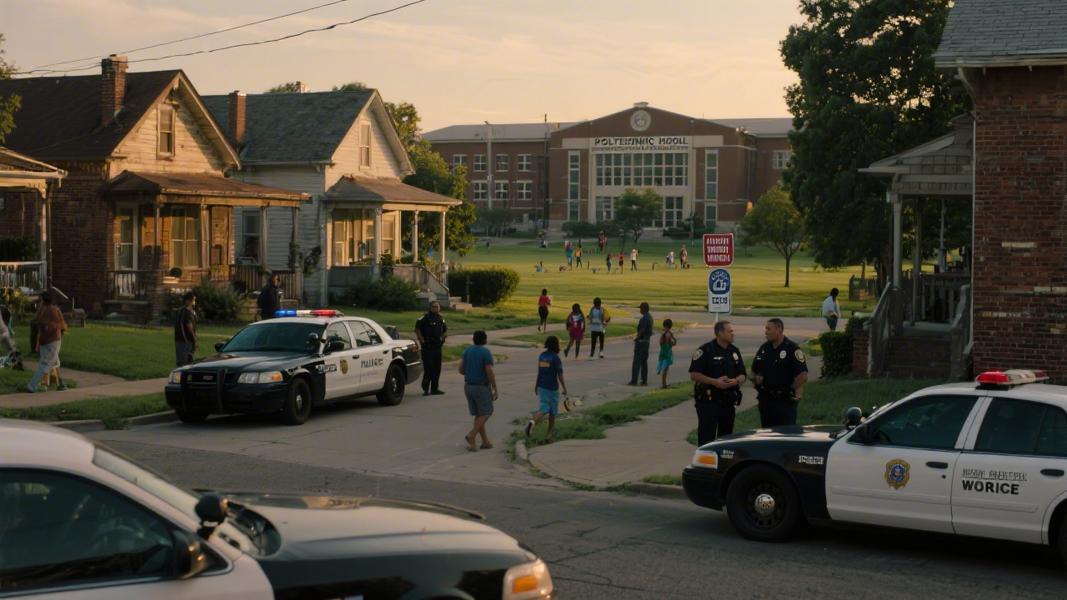
Federal agents and local law enforcement have drawn a hard line around some of Fort Worth’s most troubled neighborhoods — and they’re making clear they intend to hold it.
On Tuesday, the FBI, Drug Enforcement Administration, and a coalition of federal and local agencies announced a sweeping expansion of anti-crime efforts into southeast Fort Worth, targeting the Poly, Southside, Stop 6, and Rosedale Park neighborhoods. The move comes on the heels of a two-month enforcement blitz that already netted 76 arrests and enough seized firearms to stock a small arsenal — raising both hopes and hard questions about what comes next for communities that have lived with this violence for years.
A Zone Defined by Violence
U.S. Attorney Ryan Raybould formally added southeast Fort Worth to the Project Safe Neighborhoods initiative, a federal program already operating in two Dallas communities, citing crime data that painted a grim picture of the area. “Our mission is to remove violent criminals from the streets and restore safety to our homes and businesses,” Raybould said. “The newly expanded Fort Worth PSN zone is an area plagued with violence, gangs and firearm offenses … So the message to the violent criminal out there is, ‘Stop and we will hold you accountable for what you did to our community.'”
It’s a pointed message — and one backed up, at least on paper, by the numbers from Operation Showdown, the sixty-day enforcement campaign that wrapped its initial phase on June 18, 2025. That operation alone produced 76 defendants on federal and state charges. But the weapons haul is what’s likely to turn heads.
The Seizures: Guns, Drugs, and a Lot of Both
How bad is it out there? Consider what investigators pulled off the streets: 287 firearms, including 91 pistols, 17 rifles, 25 machineguns, and — perhaps most alarming — 147 machinegun conversion devices, the kind of illegal switches that transform semi-automatic handguns into fully automatic weapons. On the narcotics side, agents seized 14.8 kilograms of cocaine, 7.5 kilograms of methamphetamine, 480 grams of fentanyl, and smaller quantities of heroin and marijuana.
DEA Special Agent in Charge Eduardo A. Chavez didn’t mince words about what those numbers represent. “There is no debate that guns and drugs in the hands of criminals is everybody’s problem,” he stated. ATF Special Agent in Charge Bennie Mims echoed that sentiment, noting that the damage spreads far beyond individual victims. “Every day, someone living throughout the Dallas/Fort Worth Metroplex is affected by gun violence,” Mims added. “And the effects of it are spread throughout the victims’ families and the community.”
Federal Charges With Real Teeth
Of the 76 defendants, 56 face federal charges — a distinction that matters considerably. Federal prosecutions for offenses like illegal firearms trafficking, unlawful possession of machineguns, and conspiracy to distribute cocaine, methamphetamine, and fentanyl carry potential sentences ranging from 10 years to life in prison. There’s no parole in the federal system. Prosecutors, clearly, are not interested in revolving doors.
Tarrant County Sheriff Bill Waybourn announced the Operation Showdown results at a press conference, and his message was about as direct as law enforcement messaging gets. “What we’re doing is sending a message to our citizens that we’re going after the bad guys, and we’re getting them,” Waybourn declared. “And number two is, if you’re one of the bad guys, and we haven’t got you, we’re coming for you.”
Enforcement Is Only Part of the Picture
Still, anyone who’s covered urban crime long enough knows that arrests alone rarely solve what drives violence in the first place. That’s where programs like VIP Fort Worth come in. Overseen by United Way of Tarrant County, the initiative is specifically designed to interrupt the cycle of retaliatory gun and gang violence in Fort Worth’s Districts 3, 5, and 8 — many of the same communities now under federal enforcement focus. It’s a recognition, even if an implicit one, that handcuffs and indictments can only go so far.
The Project Safe Neighborhoods expansion to a second Fort Worth location, confirmed by federal and local officials, is itself a signal that the enforcement strategy isn’t built to be a one-time sweep. PSN is a sustained, data-driven framework — one that’s supposed to stick around after the press conferences end.
What Comes Next
The residents of Stop 6, Poly, Southside, and Rosedale Park have heard promises before. Enforcement surges come and go. The question — always the question — is whether this one holds, and whether the communities themselves end up feeling safer rather than simply more surveilled. Federal prosecutors are betting that a combination of aggressive charging, sustained street-level pressure, and intervention programs can shift the calculus for people considering violence.
That’s a lot of moving parts. But 287 seized firearms, including nearly 150 devices designed to make handguns fire like military weapons, suggest the stakes of getting it wrong are not abstract. As U.S. Attorney Raybould put it — the message is out. Now comes the harder part: making it stick.
