
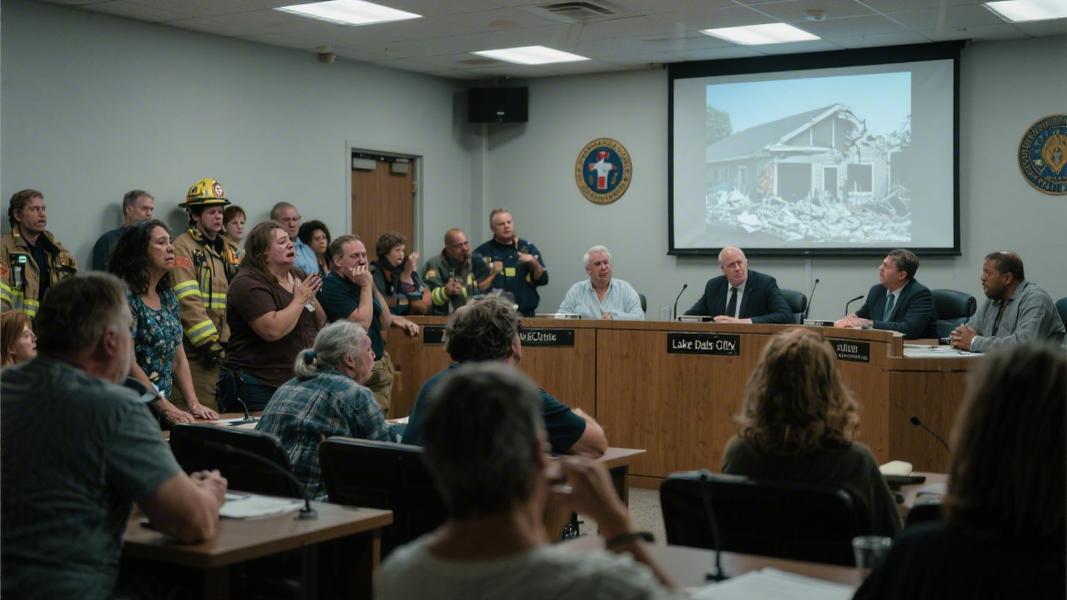
A quiet Thursday evening in Lake Dallas ended with a house reduced to rubble — and a young woman fighting for her life. The explosion at 620 Moseley Street on March 19, 2026, has since ignited something else entirely: a community demanding answers from both a utility giant and its own city government.
At approximately 7:05 p.m., a home in the 600 block of Moseley Street collapsed in a blast that sent shockwaves through the north Texas suburb. Jessica Bailey Lopez was critically injured and had to be airlifted to a hospital. A neighbor pulled her from the wreckage. Emergency responders evacuated between 40 and 50 people in the chaotic aftermath. The cause, investigators would soon determine, traces back to a gas leak beneath a nearby street — infrastructure that, in some cases, has been in the ground since the 1970s.
A Leak Hiding in Plain Sight
Atmos Energy confirmed it discovered a leak on its gas main running under Wilson Drive, near the Moseley address. The pipe section in question is a short stretch of aging infrastructure — originally installed in the 1970s under a predecessor company that Atmos acquired in 2004. In the wake of the explosion, the utility announced it is removing two miles of similar piping throughout Lake Dallas. That’s not a minor patch job. That’s a signal that the problem may run deeper than one street corner. Atmos VP Chris Slaughter addressed the public cautiously, stating, “While the investigation into the event at 620 Moseley is ongoing, we want to share with you what we have learned to date. We discovered a leak on our gas main under Wilson Drive near 620 Moseley.”
What makes the timeline even harder to swallow: just two days before the explosion, on March 17, 2026, there were two separate natural gas pipeline strikes in Lake Dallas — one near City Hall, another at Hunley Drive and Shady Shores Road — both prompting evacuations. Three incidents in 48 hours. In the same small city. That’s not coincidence — that’s a pattern.
Residents Are Furious. And They Have Questions.
How do you tell 40 people to leave their homes with no alert system in place? That’s the question neighbors and advocates have been asking since the night of the blast. Sarah Parker, speaking on behalf of Lopez and the broader community, didn’t mince words. “A young woman’s life is forever altered,” Parker said. “Traumatized for something that was completely preventable.” She pushed further, demanding accountability in real terms: “What is your plan to prevent this from ever happening again? What is your plan to notify this community? What is your emergency action plan — because there is zero.”
That last part stings a little more given what city officials acknowledged afterward. Lake Dallas City Manager Luke Olson confirmed the city does have an emergency plan — but no resident alert system. He said the city would consider implementing one in upcoming budget discussions. Upcoming budget discussions. For a city that just watched a home collapse and dozens of people flee into the night, that timeline feels a bit leisurely. Resident Hughes put it plainly: “The city employees, I think maybe they just didn’t have a plan, they didn’t know how to handle such a catastrophe.”
The Bigger Picture
Still, it would be too easy to pin this entirely on Lake Dallas’s city hall. The deeper issue is aging natural gas infrastructure — pipes laid during the Nixon administration, quietly pressurized beneath American neighborhoods for decades, sometimes acquired through corporate mergers with little public fanfare. Atmos’s removal of two miles of similar piping suggests the utility knows it’s sitting on a liability. The question is how many other cities across the country are sitting on the same kind of ticking infrastructure, waiting for a neighbor to pull someone out of the wreckage before anyone acts.
Jessica Bailey Lopez survived. But as Parker noted, her life is changed. And in Lake Dallas, so is the conversation — whether the people responsible for it are ready or not.
