
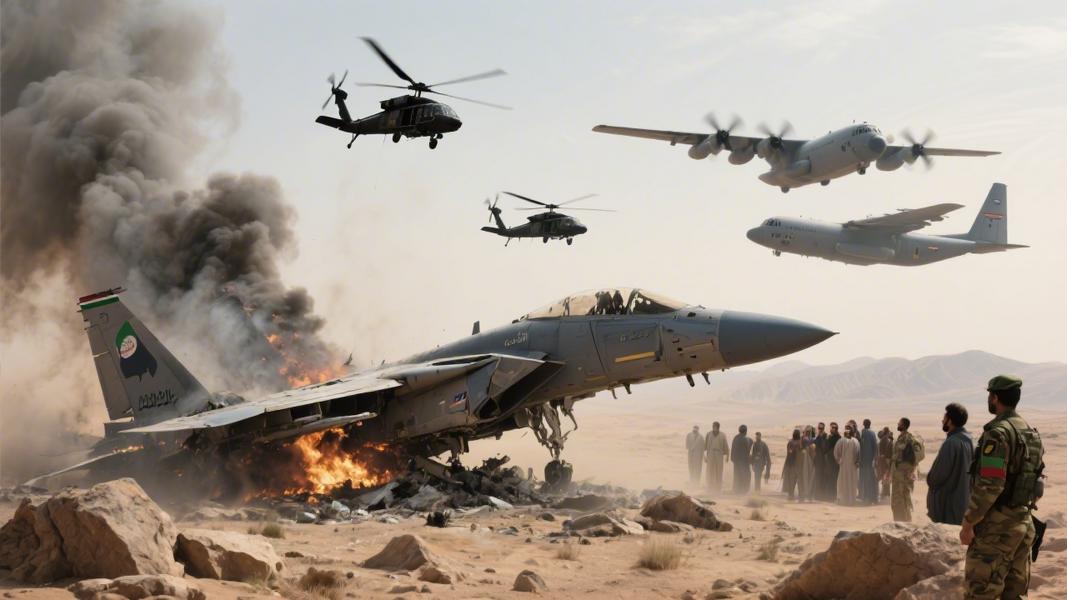
A U.S. warplane is down over Iran. That’s a sentence American military planners hoped they’d never have to write — and now they have.
A U.S. Air Force F-15E Strike Eagle was shot down over Iranian territory, becoming the first confirmed combat loss of a manned American aircraft during the conflict. The incident marks a significant and sobering escalation, raising immediate questions about crew survival, search and rescue operations, and what comes next for U.S. military posture in the region. Air and Space Forces Magazine confirmed the loss and reported that search and rescue efforts were underway.
A Threshold Nobody Wanted to Cross
The F-15E Strike Eagle is one of the most capable and battle-tested aircraft in the American arsenal. It’s fast, it’s lethal, and it’s been flying combat missions for decades without a loss like this. The fact that one is now down — on Iranian soil, no less — is the kind of development that reshapes a conflict overnight.
How bad is it? In purely symbolic terms, it’s hard to overstate. The U.S. military has gone to extraordinary lengths over the years to avoid exactly this scenario: an American crew potentially in enemy hands, a downed jet available for Iranian state media to parade in front of cameras, and a domestic political firestorm waiting to ignite back home.
Still, the immediate priority isn’t optics — it’s the crew. Search and rescue operations were launched following the downing, though the conditions under which those missions are being conducted remain deeply complicated. Operating inside or near Iranian territory to recover personnel isn’t just dangerous. It’s the kind of mission that can spiral into something much larger, very quickly.
What the Loss Signals
The F-15E isn’t just any aircraft. It’s a dual-role fighter-bomber designed for both air superiority and precision ground attack — the kind of platform you send when the mission matters. Its presence over Iran suggests the U.S. was conducting active strike operations, not surveillance. That context matters enormously when assessing what Iran’s air defenses managed to pull off here.
For years, American officials and defense analysts maintained that U.S. air power held a commanding advantage over Iranian surface-to-air missile systems. That calculus may now need revisiting. It doesn’t mean U.S. air dominance has collapsed — but it does mean Iran demonstrated a real capability at a critical moment, and that’s not something the Pentagon can quietly footnote away.
That’s the catch. A single aircraft loss doesn’t rewrite the military balance of power. But it does hand Iran a propaganda victory of considerable weight, emboldens those within the Iranian government who’ve argued that American forces are not untouchable, and puts enormous pressure on U.S. commanders to respond — carefully, or otherwise.
The Human Element
Behind the hardware and the strategy, there’s the crew. The F-15E is a two-seat aircraft, typically carrying a pilot and a weapons systems officer. Whether one or both were aboard, whether they ejected, whether they’ve been located — those answers were not immediately available, and every hour without them is its own kind of tension.
Search and rescue in a hostile environment is among the most dangerous and complex operations the military undertakes. It requires coordination, speed, and no small amount of luck. The crews who fly those missions know the risks. They go anyway. That’s worth remembering in a news cycle that will quickly move toward geopolitical analysis and Pentagon briefings.
Where Things Stand
The broader conflict between the United States and Iran has been building through a series of strikes, retaliations, and escalating rhetoric. The downing of an F-15E doesn’t just add another data point to that arc — it changes the arc. A manned aircraft lost. Crew status unknown. Rescue operations active in one of the most volatile corners of the world.
Whatever comes next, one thing is already certain: the war just got harder to contain.
