
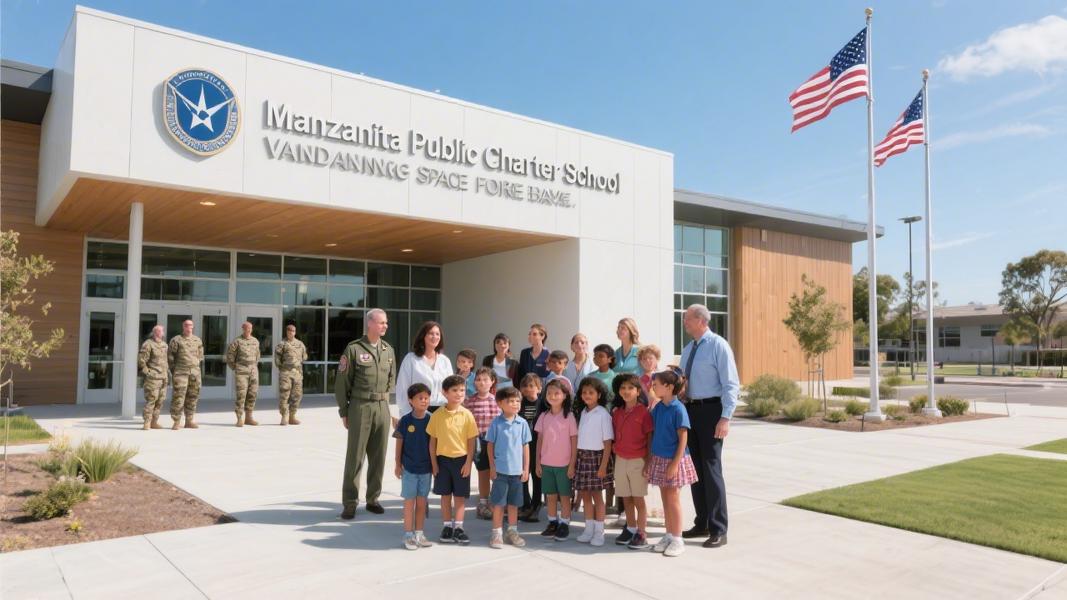
A crumbling mid-1960s campus on a Space Force base is finally getting the overhaul it’s needed for decades — and a $45.4 million federal grant is making it happen.
The Department of War’s Office of Local Defense Community Cooperation has awarded Lompoc Unified School District a $45.4 million grant as the federal share of a $60.5 million project to renovate and construct a new Manzanita Public Charter School at Vandenberg Space Force Base in Santa Barbara County. The project, years in the making, will serve 522 students from transitional kindergarten through sixth grade — children of military families who’ve spent years learning in facilities that haven’t seen meaningful upgrades since Lyndon Johnson was in the White House.
A School That’s Been Waiting a Long Time
How bad is it? Bad enough that Manzanita was ranked #40 on the 2019 Deputy Secretary of Defense “Public Schools on Military Installations Priority List” — a federal catalog of schools flagged for serious facility capacity and condition deficiencies. That ranking, grim as it sounds, ultimately helped unlock the funding pipeline that led to this grant. The original campus dates to the mid-1960s and has received no significant improvements since. That’s not a typo.
Planning for the new school began back in 2021, when KBZ Architects was brought on to lead design efforts. Construction isn’t expected to break ground until 2026, meaning students and staff will wait a bit longer still. But the funding structure is now firmly in place — the Public Schools on Military Installations (PSMI) grant operates on an 80/20 funding mechanism, with the federal government covering the lion’s share and the district contributing the remainder of the $60.5 million total project cost.
Todd Jespersen, connected to the project’s development, put it plainly: “Lompoc Unified and Manzanita Public Charter always put the children first, and I am tremendously excited to see the beneficial impacts on those scholars.” It’s the kind of quote that sounds like boilerplate until you consider that the kids currently attending that school have never known anything but aging, overcrowded buildings on a military installation.
More Than Just Bricks and Mortar
The Manzanita renovation isn’t the only major investment flowing into Lompoc Unified right now. Earlier this year, the district was awarded a $4,987,500 Community Schools Implementation Grant from the California Department of Education — part of a sweeping $1.3 billion statewide initiative to transform traditional schools into full-service community hubs. The idea is to wrap wraparound services — mental health support, family resources, extended learning — directly into the school environment.
LUSD Assistant Superintendent Brian Jaramillo didn’t hide his enthusiasm. “We are thrilled to receive this grant and continue our work toward creating Community Schools that serve the whole child and the whole family,” he said, adding that “this funding will allow us to deepen our partnerships and expand our services to better support our students and families.” The district’s school communities have shown, according to Jaramillo, “tremendous enthusiasm” for the community schools model — which, in a district that serves a significant military-connected population, makes a certain kind of intuitive sense.
A District Quietly Punching Above Its Weight
That said, it’s worth stepping back for a moment. Lompoc Unified is not a large district. Manzanita itself currently serves roughly 453 students in kindergarten through sixth grade, according to data from DonorsChoose. It’s a small school, embedded in a military installation, serving a transient population that often doesn’t have the luxury of long-term community roots. And yet, between the PSMI federal construction grant and the state’s community schools investment, the district has secured well over $50 million in new funding in a remarkably short window.
Still, money on paper is not a school. The construction timeline stretches to 2026 at the earliest, and the students who’ll ultimately benefit from the new Manzanita campus are, right now, sitting in classrooms built before the Apollo program put a man on the moon. The grants are real, the architects are engaged, the federal priority list did its job — but for the families at Vandenberg, the wait continues.
Sometimes the most important sentence in a grant announcement is the one nobody writes: this should have happened sooner.
