
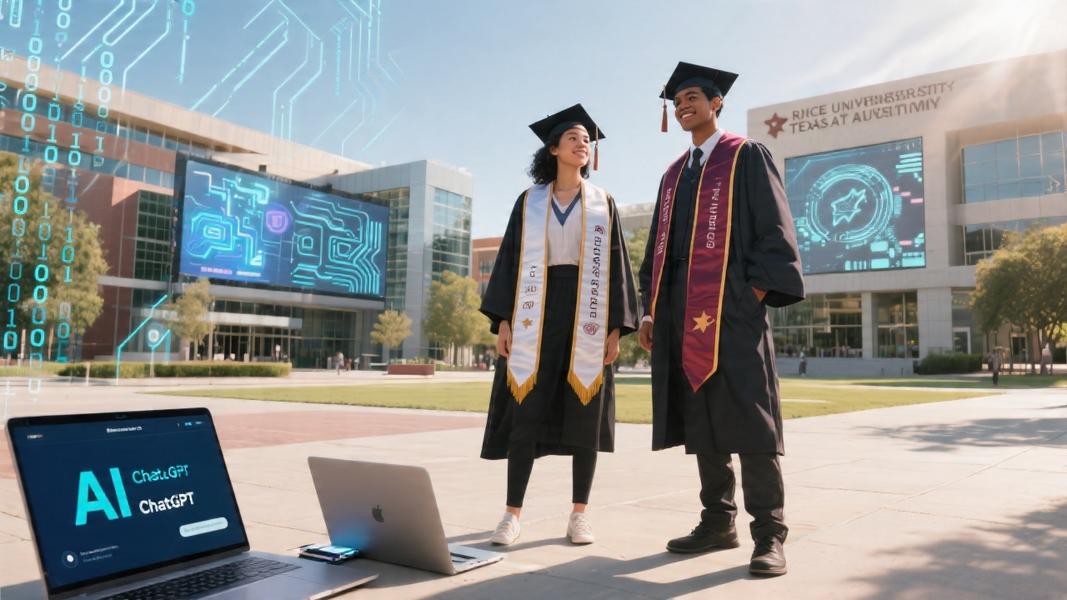
Texas just got a pair of gold stars from the business world — and artificial intelligence is a big reason why.
Rice University and the University of Texas at Austin have both earned spots on Forbes’ 2026 “New Ivies” list, an annual ranking of 20 colleges — ten public, ten private — whose graduates are considered among the most sought-after by today’s employers. The list, published April 22, 2026, arrives at a moment when artificial intelligence is fundamentally rewriting what companies expect from the people they hire straight out of college.
A Different Kind of Prestige Race
Forbes’ methodology isn’t just about test scores or selectivity, though those matter. The ranking starts by pulling from all U.S. four-year, degree-granting public and private nonprofit colleges — and right away, it throws out the old guard. Traditional Ivy League schools are excluded, and so are what Forbes calls “Ivy Plus” institutions: Stanford, MIT, Duke, the University of Chicago, Johns Hopkins. The idea, clearly, is to find the schools doing elite-level work without elite-level name recognition propping them up.
From there, evaluators weigh enrollment size, admissions selectivity, and whether standardized test scores play a meaningful role — at least half of admitted students must have submitted SAT or ACT scores to qualify. But the piece that carries real weight? A survey of more than 100 C-suite executives and hiring managers, asked directly about which schools produce graduates who are actually ready for the modern workforce. And in 2026, that increasingly means graduates who understand AI.
Rice Has Been Here Before
For Rice, this isn’t a surprise. The Houston-based university is appearing on the New Ivies list for the third consecutive year — which says something about consistency, not just a single strong cycle. The school has made a deliberate push to weave AI into coursework across disciplines, not just in computer science or engineering. Students in various fields are being asked to do something genuinely interesting: compare their own work against AI-generated outputs, then critically evaluate the differences in reasoning and, crucially, bias.
That’s a pedagogical choice that reflects where the job market is heading. As Rice provost Amy Dittmar put it bluntly in the Forbes report, “Those people that know how to use AI will replace those that don’t.” It’s a line that might sound harsh out of context, but in the context of what hiring leaders are actually saying right now, it reads more like a statement of fact than a warning.
UT Austin Is Playing the Long Game
UT Austin’s path to the list looks a little different — and arguably more ambitious in scope. The flagship state university is in the process of building an entirely new School of Computing, backed by a plan to hire 50 new faculty members. The explicit goal isn’t just to deepen technical training for computer science majors. It’s to spread computing and AI literacy across majors — to make sure the business student, the public policy major, the aspiring journalist all graduate with a working fluency in the tools that are reshaping their industries.
That’s a big bet. Hiring 50 faculty is expensive and logistically complicated, and building institutional culture around a new school takes years. But the signal it sends to employers — and to prospective students — is hard to miss.
What the Executives Are Actually Saying
So what do the people doing the hiring think? According to Forbes’ survey of over 100 executives and hiring leaders, AI isn’t just changing what new graduates need to know — it’s raising the bar for what entry-level work even looks like. Tasks that once justified a full-time hire can now be handled, at least partially, by a well-prompted model. That doesn’t mean fewer jobs, necessarily. But it does mean that the graduates who thrive will be the ones who understand how to work alongside these tools, interrogate their outputs, and bring something distinctly human to the table.
Both Rice and UT Austin, it seems, are betting their curricula on exactly that premise.
In a hiring landscape being redrawn almost in real time, the question for every university right now isn’t whether AI matters — it’s whether they’re moving fast enough to keep up. If Dittmar’s framing is right, the schools that figure it out won’t just be producing better graduates. They’ll be producing the only kind that employers still want.
