
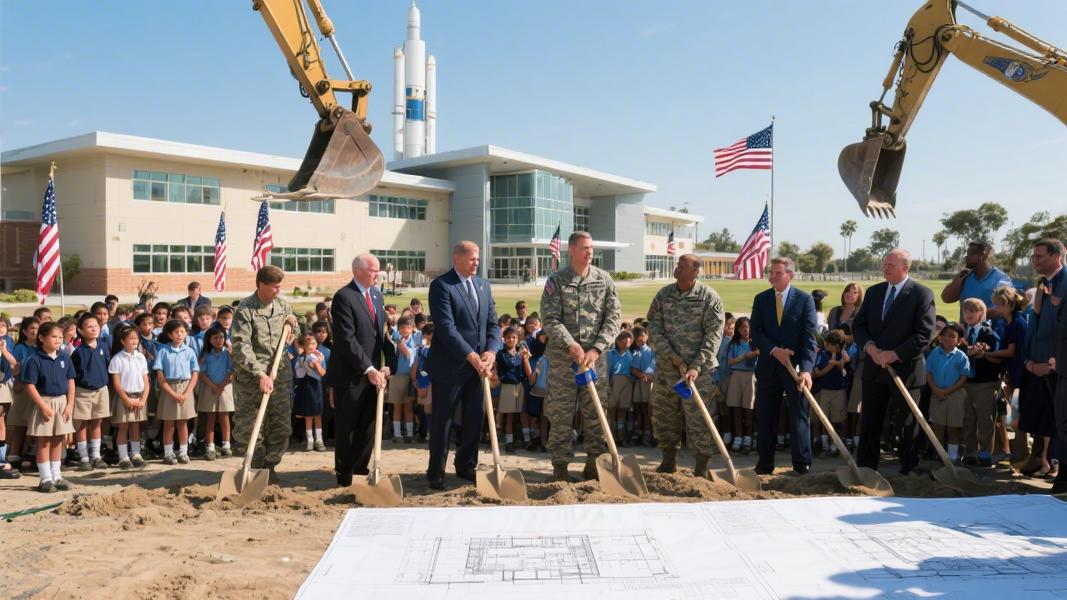
A crumbling school on a military base is getting a long-overdue overhaul — and the federal government is footing most of the bill.
The Department of War’s Office of Local Defense Community Cooperation has awarded the Lompoc Unified School District a $45.4 million grant to renovate and reconstruct Manzanita Public Charter School, located on Vandenberg Space Force Base in California. The grant represents the federal share of a broader $60.5 million project — one that’s been a long time coming for a school that’s struggled with serious facility deficiencies for years, as the department announced.
A School That Couldn’t Wait
How bad is it? Bad enough that Manzanita ranked #40 on the 2019 Deputy Secretary of Defense Public Schools on Military Installations Priority List — a federal ranking that exists precisely to flag schools in the worst shape. That list isn’t honorary. It’s a triage system, and Manzanita’s placement on it reflects documented deficiencies in both facility capacity and physical condition that have gone unaddressed for far too long.
When construction wraps, the school will serve 522 students in grades transitional kindergarten through sixth — children of the service members and defense personnel stationed at one of the country’s most strategically significant military installations. That’s not a small thing. These are kids whose families move frequently, sacrifice stability, and depend on the base community to deliver the kind of education available anywhere else in America. Right now, the building they’re learning in doesn’t reflect that obligation, as documented in federal planning records.
How the Money Works
The funding flows through the Department’s Public Schools on Military Installations Program, which directs resources to schools with the most serious facility failures first. It’s a competitive process, and not every school in rough shape makes the cut. A Federal Evaluation Team — drawn from the Assistant Secretaries of the Air Force, Army, and Navy, alongside the Office of Local Defense Community Cooperation — reviewed the Manzanita project before it moved forward, according to records from the department’s contracts division.
Still, the mechanics of the funding are almost secondary to what it’s actually meant to accomplish. The department made that clear in its own language. “In correcting the identified facility condition and capacity issues at the Manzanita Public Charter School, this grant keeps faith with service members, improves the quality of education for defense-connected students, aids in the recruitment and retention of vital skills at Vandenberg Space Force Base, and enhances partnerships between the community and the installation,” the department stated.
More Than Bricks and Mortar
That phrase — keeps faith with service members — carries weight. Military families make extraordinary demands on themselves in service to the country. In exchange, they’re promised a baseline: decent housing, access to healthcare, and yes, schools that don’t undermine their children’s futures. When that baseline slips, it doesn’t just affect morale. It affects whether talented people choose to stay in uniform at all.
Vandenberg Space Force Base isn’t just any installation. It’s a hub for some of the military’s most advanced space launch operations, and the competition for skilled personnel there is real. A deteriorating school in the middle of that community sends exactly the wrong message to the people the Pentagon needs most.
The renovation, then, is as much a recruitment and retention tool as it is a construction project. That’s the quiet logic behind the whole program — and why a cracked ceiling or an overcrowded classroom on a military base is never really just a local problem.
For the 522 kids who’ll eventually walk through Manzanita’s new doors, though, the policy rationale won’t matter much. What will matter is whether the building is safe, the classrooms are functional, and the school actually works. After years on a federal priority list, they deserve at least that much.
