
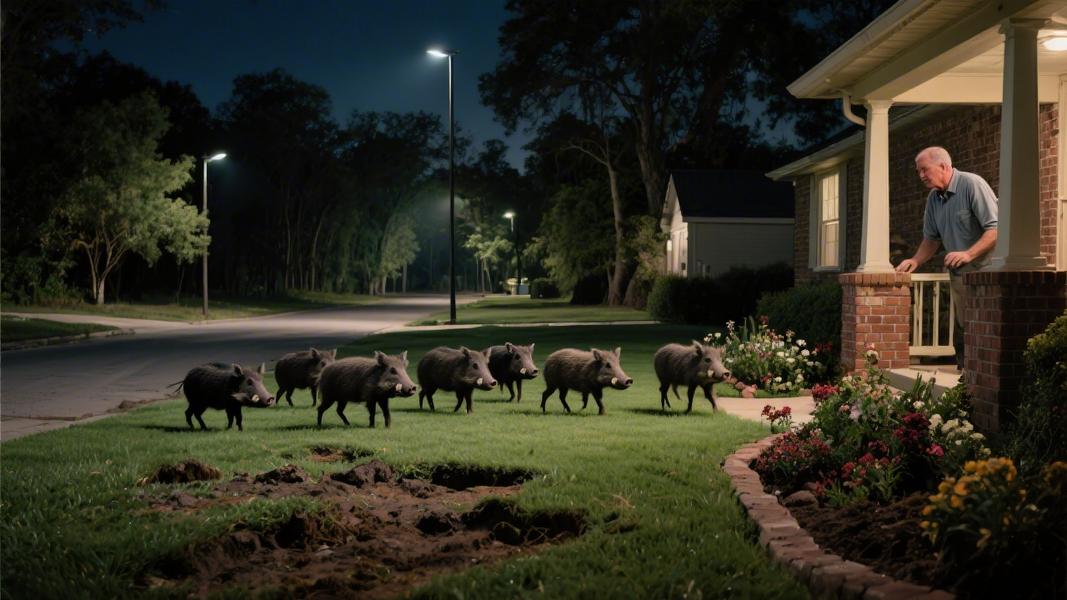
They come at night, in packs, and they’re tearing up one Mesquite neighborhood one yard at a time. For residents of the Falcons Lair community, feral hogs have stopped being a curiosity and started being a crisis.
Over the past six weeks, wild hogs have caused thousands of dollars in damage to properties along the north Dallas suburb’s eastern edges — ripping up lawns, upending landscaping, and rattling nerves. It’s a problem that’s been quietly spreading across North Texas for years, and for some longtime residents, the patience has finally run out.
A 17-Year Battle Comes to a Head
Ted Faulkner has lived in Falcons Lair for 17 years. He’ll tell you the hogs were there when he moved in. “The first two months I was here, it caused me to change my flowerbed into a rock garden. After that, it was dormant for maybe a year or two,” he said. What followed was a long, uneasy truce — until recently, when the animals returned with a vengeance.
“All of this damage that you’re looking at was done by feral hogs within the last six weeks,” Faulkner said, gesturing across a yard that looks less like a suburban lawn and more like a construction site mid-dig. He’s captured video of the culprits: packs of roughly six to ten hogs moving through the neighborhood under cover of darkness, rooting through soil with the kind of efficiency that would, as Faulkner dryly noted, qualify them for work at an excavation company. “We’re talking about several thousand dollars of damage,” he said.
More Than a Nuisance — A Safety Risk
How bad does it have to get before someone gets hurt? That’s the question Faulkner is already asking his neighbors. He’s been warning people to stay inside after dark. “Do not walk out here after dark because you might encounter the hogs, they become frightened, and they might attack,” he said. “That’s the biggest concern — public safety.”
It’s not an unfounded fear. Feral hogs, when startled or cornered, can be aggressive. They’re fast, they’re heavy, and they don’t give much warning. For a neighborhood where evening walks and kids playing outside are part of daily life, the threat changes the calculus entirely.
The City’s Hands Are Largely Tied
Faulkner hasn’t been sitting idle. He’s filed three separate reports with animal control and the city manager’s office. The response, while not dismissive, hasn’t exactly been swift action. “The assistant city manager is saying they have contacted Texas Parks and Wildlife to see if they can get some assistance, because Mesquite doesn’t have the capability to trap these hogs,” he explained.
That’s the catch. The City of Mesquite encourages residents to report feral hog sightings — but animal services can’t trap or remove them. It’s a gap in local infrastructure that’s becoming harder to ignore as sightings increase. In the meantime, city officials recommend treating lawns for grub worms, which attract the animals in the first place, and installing motion-activated security lights and sprinklers as deterrents. Practical advice, sure. But it’s a far cry from a solution.
A Broader Problem Without Easy Answers
Still, Mesquite isn’t alone in this. Feral hogs have been spreading steadily across North Texas for years — pushing further into suburban and even urban areas as their populations grow and natural habitat shrinks. There are no easy answers here, and wildlife managers across the state have been wrestling with the issue for decades.
Faulkner has his own proposal: fence off the wooded area directly across from his house, which he believes is where the hogs are sheltering between their nightly raids. It’s a targeted, straightforward fix — the kind that makes you wonder why it hasn’t happened already.
For now, the hogs keep coming. And until state wildlife officials or the city find a lasting remedy, Falcons Lair residents are left with motion lights, lawn treatments, and a standing warning not to go outside after dark — in their own neighborhood. “That’s the biggest concern,” Faulkner said. It probably shouldn’t take a mauling to prove him right.
