
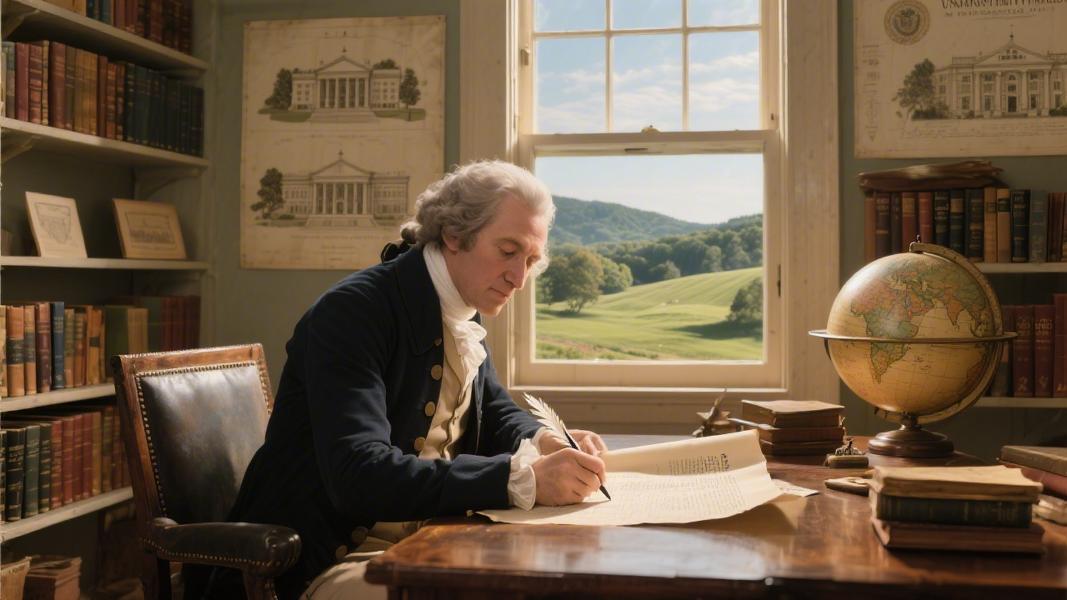
Two hundred and fifty years later, America is still trying to figure out what Thomas Jefferson meant — and whether it lived up to any of it.
As the nation gears up for its semiquincentennial in 2026, the birthday of one of its most complicated founders is getting renewed attention. On April 13, 2026, Jefferson turns 283 years old, and the milestone is arriving at a moment when the country is deep in the business of deciding what, exactly, it’s celebrating. The America 250 commemoration — marking the 250th anniversary of the Declaration of Independence — has put Jefferson’s legacy front and center, for better or worse.
A Founding Voice, Revisited
The White House didn’t miss the moment. A presidential message marking Jefferson’s 283rd birthday highlighted his role as the principal author of the Declaration of Independence, adopted on July 4, 1776 — a document that, whatever its contradictions, set the ideological foundation for a republic still arguing about what freedom actually means. The message was issued alongside broader commemorations of the Second Continental Congress’s first convening.
It’s a lot of anniversaries stacking up at once. But that’s sort of the point.
The America 250 Foundation has been building toward this moment for years, and Jefferson’s birthday has become one of its signature touchstones. This year, a dedicated podcast episode exploring Jefferson’s enduring — and contested — legacy dropped in honor of the occasion, part of a broader series examining what liberty looked like in 1776 and what it looks like now. The episode was released as part of a programming slate that doesn’t shy away from the harder questions.
What Are We Actually Commemorating?
That’s the question hovering over all of this, isn’t it? The Eisenhower Presidential Library, one of the institutional voices lending historical weight to the America 250 effort, put it plainly in its own commemorative framing. “We in our time must make certain that the genius of the Constitution and of our government shall not perish, that it shall belong to the young and to those who come after us,” the library noted — a quote that sounds almost urgently contemporary, even if it wasn’t written yesterday.
Still, framing a national birthday party around Jefferson requires a certain amount of reckoning. He wrote that all men are created equal. He also enslaved more than 600 people over his lifetime. These are not new facts, but they’re facts that the 250th anniversary can’t paper over the way previous milestones sometimes did.
Former President Bill Clinton understood that tension when he spoke at Jefferson’s 250th birthday ceremony back in 1993 — lauding Jefferson’s values of freedom and justice while implicitly acknowledging the distance between the ideal and the reality. That ceremony was broadcast live and remains a useful marker of how the country has talked — and sometimes talked around — its founders across the decades.
The Road to July 4, 2026
The America 250 Commission has been coordinating a sweeping range of events leading up to the main celebration on July 4, 2026. Monticello — Jefferson’s Virginia estate and one of the most symbolically loaded pieces of real estate in the country — has been a key partner in shaping how the anniversary handles its central figure. Andrew Davenport of Monticello weighed in on exactly that challenge in a recent discussion that was covered as part of the commission’s public programming.
The logistics alone are staggering. Hundreds of events across all 50 states, international delegations, historical exhibitions, civic engagement campaigns — it’s the kind of undertaking that hasn’t been attempted since the Bicentennial in 1976, and organizers are acutely aware that the political and cultural climate in 2026 is considerably more fractured than it was then. Whether that makes the exercise more necessary or more fraught probably depends on who you ask.
More Than a Birthday Party
What’s striking, if you step back, is how much work Jefferson’s birthday is being asked to do in 2026. It’s not just a historical footnote or a calendar curiosity. It’s a kind of stress test — a moment for the country to ask whether the principles articulated in that Philadelphia summer of 1776 still hold, still inspire, still obligate.
Jefferson himself was famously ambivalent about legacy. He rewrote his own epitaph, leaving out his presidency entirely and choosing instead to be remembered as the author of the Declaration, the founder of the University of Virginia, and the author of Virginia’s statute for religious freedom. He knew, on some level, what he wanted to stand for.
Whether America in 2026 can hold both the vision and the failure of a man like Jefferson — and still find something worth celebrating — might be the most honest test of the anniversary yet.
